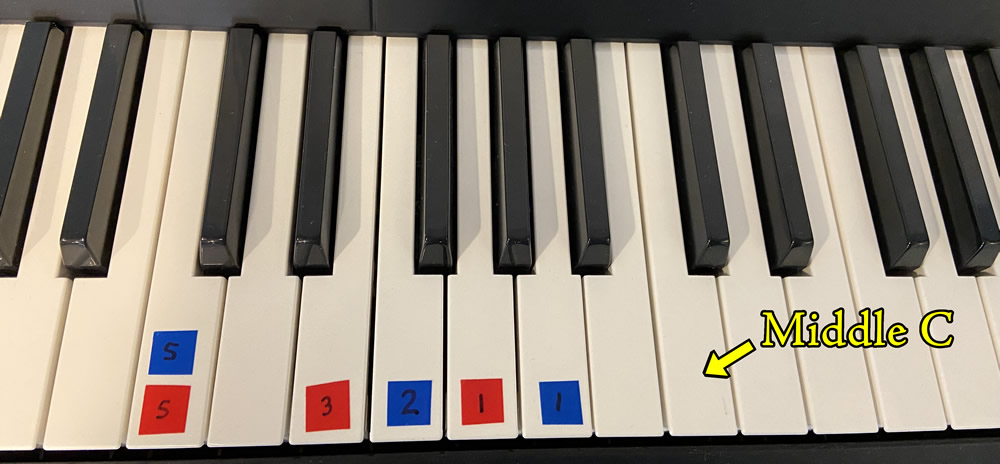

 Lesson #2  This week we learned the fingering for the BLUE chord in the left hand! Now you can put your blue stickers on your piano for the left hand. They go on notes C-F-A. Stress correct fingering of 5-2-1. Feel free to write the finger numbers in permanent marker on the stickers. See “Making Musicians” below! Here’s a picture of what your stickers should now look like on your keyboard:
Notice that there are no stickers for the right hand. We don’t need those musical training wheels anymore, so if you still have them, please remove them! Celebrate Connection A few ideas to bring playfulness to practice time!

Music Alphabet 
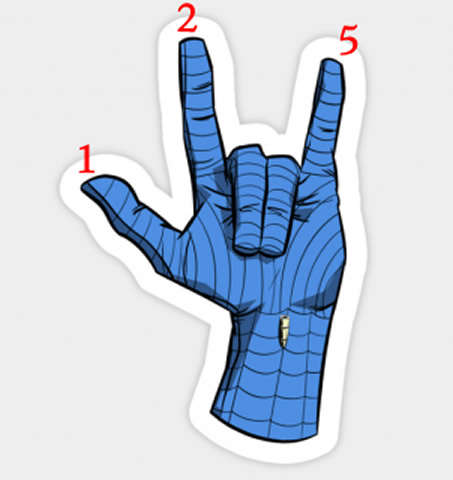
Who Am I? I’m the SPIDEY BLUE CHORD!
Spin a chord of fun playing the Left Hand Blue Chord with fingers 5-2-1. It also looks like ASL for “I LOVE YOU”! Just remember how much you love playing the blue chord with your left hand! Just don’t forget to play the chord with bubble hands…this is ONLY to help you remember which fingers to use, not the shape you make while playing the blue chord! Have a musical day! -Ms. Bethany 🙂  |

-
Document 
Lesson # 2 
“Home Fun Activities” are designed to help you continue the learning and fun at home! They are always optional, but if you choose to do them, please keep the materials in your tote bag and bring them to class each week. While we will not use them every week, your child will be excited to participate with their own creations when we do!
 Next week’s songs:
 - The Shape Song
- Name, Name
- Thread Follows Needle
- In My Class I Have Some Bells
- Miss Mary Mack
- If You Want to Speak in French
- This Little River
- The Button Factory
I added the small rubber bands that hold the triangle handle in place. If your rubber band ever needs to be replaced, here’s a video that another teacher made that shows how I did it!
Learning Names: Name recognition is a wonderful beginning literacy skill because
children’s names are the most important and meaningful word they
know. Learning NamesBeat Mat: The beat mat allows children to process rhythm in three ways: aurally, visually and physically! LPM Blog, Beat Develops Brain, Steady Beat

This semester we use the bell set to learn the pentatonic scale. This scale is comprised of only 5 notes, and contains no semi-tones (or half steps). This combination of notes produces a universally pleasant sound, and music based on this scale can be found in folk music from virtually all over the world. The pentatonic scale is a great place to start when working with young children who are just learning to use their voice because the absence of half steps makes it easier to sing in tune.
Optional Home Fun Activity:
Color the bells on page 9 of your workbook.
You can hold a piece of paper on both sides of each bell to help your child color within the lines!Here is a Facebook video another teacher’s husband made of the song “If You Want to Speak in French” that goes over the pronunciation. (I think you need to be logged in to Facebook to see it.) We’ll start this song next week, but you can get a head start if you like!

Alphabet: In the same way that children internalize and begin to make meaning of verbal language before they are able to speak it, hearing letter names and sounds establishes the foundation for connecting the alphabet to written language.
Sound Beginnings is education through musical play! It prepares children for success in Kindergarten and Let’s Play Music. Sound Beginnings provides research-based elements that stimulate growth in the areas particularly crucial to the development of the young child. These elements make up the foundation of the Sound Beginnings curriculum. Here is just one: 
Sound Beginnings channels the young voice into beautiful, in-tune singing by providing proper vocal modeling in the correct range. Solfege hand signs teach pitch relationships; the minor 3rd (SOL-MI) pattern is used to develop in-tune singing and pitch matching. Have a musical day!
-Ms. Bethany 🙂
-
Bridge Lesson 
Lesson #9B
Here is what we did in class this week:
Online Fun:
Purple Flashcards
(All Notes, Use Timer)Green Interval Flashcards
(Level 3)Build a Major Scale
(Major ONLY)- We played hopscotch using the pattern of WWHWWWH so we could remember how to create a major scale.
- We use 2 feet for the whole steps because a whole step is the same as two 1/2 steps.
- One foot for half steps because 1/2 step is the very next note
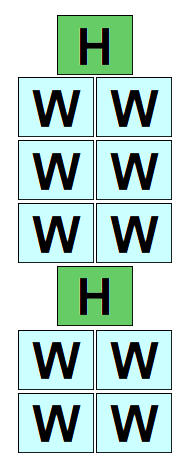
Start Here - All Major Scales have the same pattern, no matter what note you start on… even black notes!
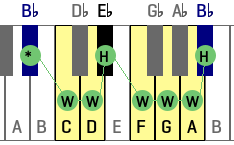
B-flat Major Scale - We practiced our Secret Circle Finger exercise again in class. We are getting much stronger knuckles, but we can still work on it!
- We reviewed our anchor Cs (low C, bass C, middle C, treble C, high C)
- "This is My C Song" will help us remember all these… Now we can play this song!
- We added to our G Major exercises:
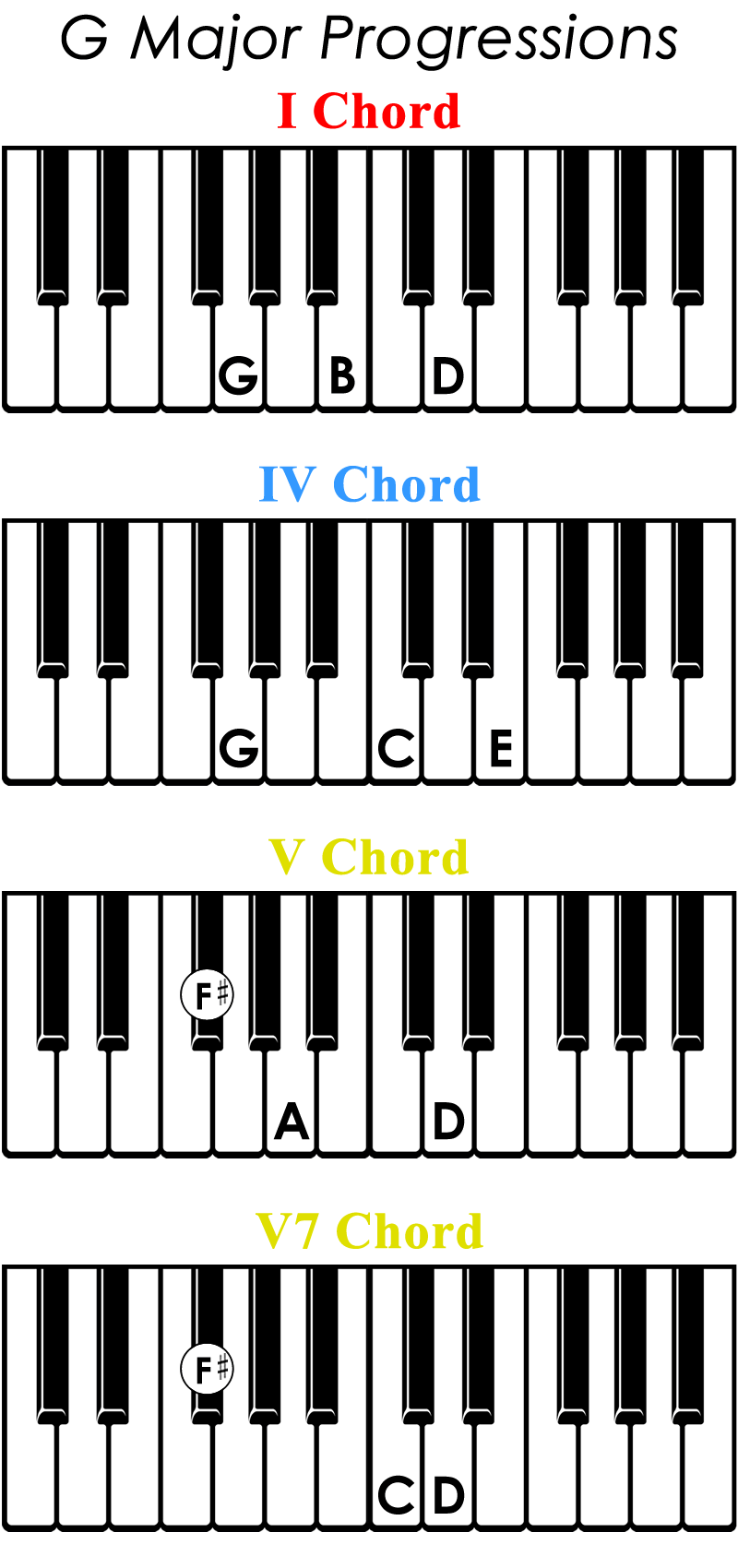
- Triads are all snowman shaped and move around the keyboard. (See last week’s email if you’re confused!)
- Progressions are simply the way we learned chords to begin with… I=snowman, IV=top heavy, V=bottom heavy.
- When we play the yellow chord, we have to remember to play F#!
- Arpeggios feel the same as they did in the key of C Major because we don’t need any black keys for our G Major triad.
- Try to play it smoothly so you can’t tell when one hand stops playing and the next hand starts.
- Inversions also feel the same as they did in the key of C Major because we don’t have any black keys in the G Major triad.
- Remember: root (snowman), bottom heavy, top heavy, root (snowman)
- Remember to help get your child’s C-Major and F-Major exercises and songs passed off by sending me a video of each (red book, pages 6 through 9 and 10-13)! (So far I’ve only had one person pass all of these off!) I would like them to play the scales, triads, and progressions HT with the backtracks (9-11 for C and 13-15 for F). Arpeggios and inversions can just be played as written in the book. I would also like them to play all 4 songs on pages 8 and 9 while singing. We will do this for every key we learn! It is best if they can pass off one key before getting too far into the next key. They don’t have to be perfect, but I do need to see that your child understands how to do them and they are trying their best. You can email, text, or Marco Polo those to me. There will be special prizes at the end of the year for passing off all the songs and scales!
- I’ve noticed that more in our class are doing the flashcards! Yay! They are a wonderful tool for helping to read music quickly. Please take advantage of this by having your child do the flashcards every time they practice! It can be with the purple flashcards or my online flashcard game.
Here’s this week’s homework assignment sheet and we’re doing the BLUE highlights! (You can click the image to open a PDF!)
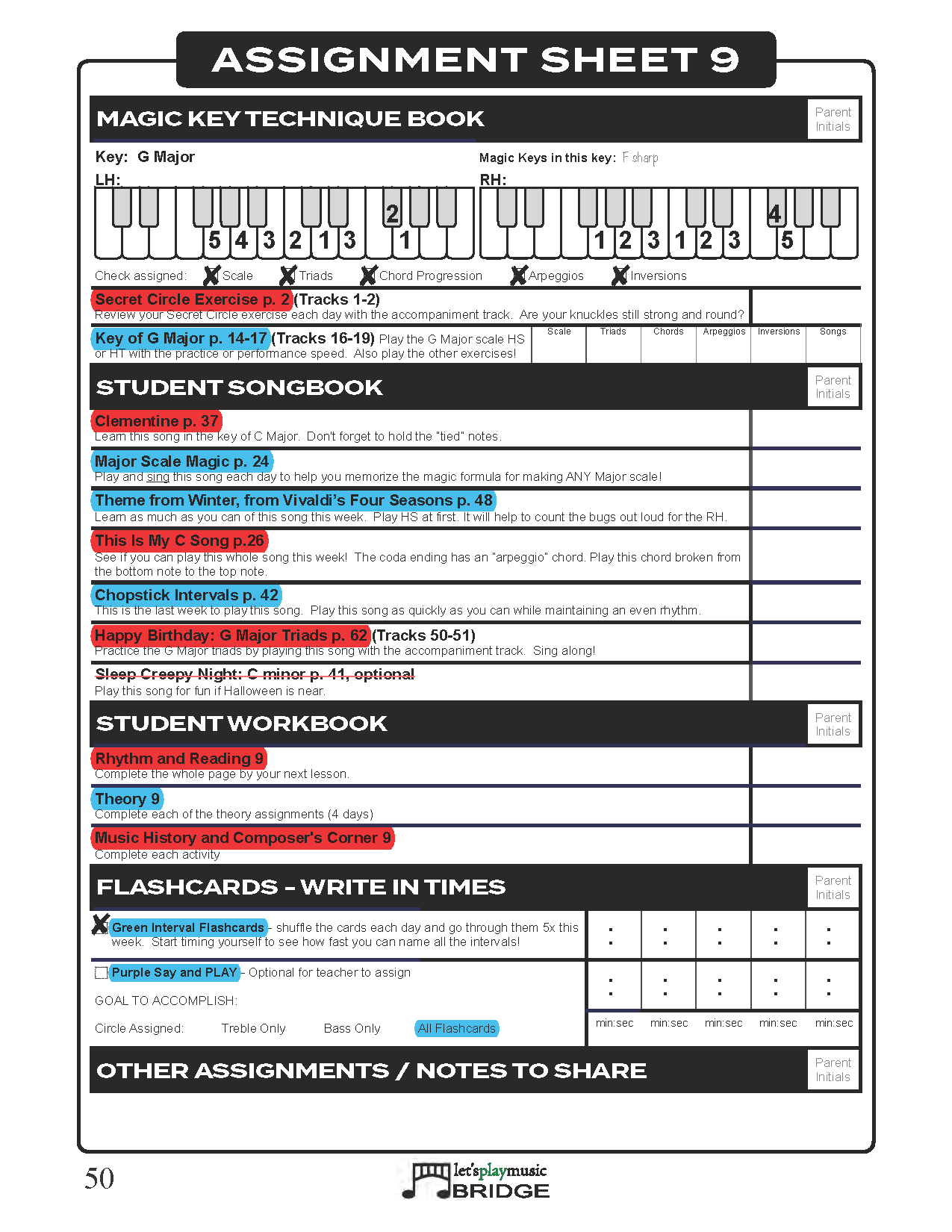
There was some confusion about which part of the assignment was supposed to be done last week. Last week was supposed to be only RED highlights and this week is the BLUE highlights (or finish the lesson).
Please let me know if you have any questions!
Have a musical day!
-Ms. Bethany 🙂
- We played hopscotch using the pattern of WWHWWWH so we could remember how to create a major scale.
-
<!-- InstanceBeginEditable name="doctitle" -->Orange Roots Newsletter<!-- InstanceEndEditable -->  Lesson #1
What a great first lesson! There is always so much info to pack in while I have you in class once a month! Thank you for coming! In class we signed up for the times when we will do our private lessons on weeks 6 and 11. If you weren’t there, I’ll text you with the remaining times available and you can let me know what works for you.
Please check the calendar in your student portal so you can be sure you are scheduling parent days in the right places! You can sync the calendar to your google calendar or whichever digital calendar you use. If I need to make any changes, I’ll text you to let you know.
Our last semester of Let’s Play Music is packed with amazing musical concepts that some kids will get in middle and high school music classes, if they are lucky! This is going to be an amazing ride as we make skipping snakes, play with the roots of chords, build triads, compose a song, add to our musical repertoire, and much, much more.
Because we are moving right along now, my hope is that you will continue to put highest priority on your practice time. Each week we will be building on concepts and skills practiced the previous week. Of course, we have been doing this all along in the other LPM semesters. However, if the students get behind this semester, they will most likely feel lost rather quickly. As a result, they won’t feel happy going to class because they won’t know the material and won’t have practiced the songs. This will quickly lead to frustration and unhappy students. We’d like to avoid this from the start, by putting highest priority on practice from the beginning. This will eliminate much of the distress that could develop because of neglected practice.
More than any other semester, the music has lyrics that will really help teach musical concepts. There are way fewer songs, but that is because they are very important! Be sure to listen to the class music with your child so you can know how to help!
 Tuition is due this week and is $280 for the Orange Roots semester. You can pay via Zelle using my phone number (preferred, so I don’t have to pay Venmo transaction fees). Zelle is a way to transfer money from your bank account to my bank account without needing to wait or pay extra fees. It’s easy to set up through your bank and even easier to use once it has been set up. You could pay via Venmo @musikandme if you really can’t set up Zelle. If you need to make monthly payments, rather than paying for the semester, it will be $75/month. (You will save $20 by paying for the semester up front!)
 Celebrate Connection
Think of ways you can focus on making practice time as fun as possible – give your child warm, friendly eye contact, smile with your voice, be a little silly, show you are relaxed and happy to sit with your child, and look for the good in your child’s effort. Notice the joy in your child’s eyes. Verbalize the good you see and hug your child often. This practice relationship will be essential to your child’s success in Let’s Play Music. The more you invest your energy into positive interaction, the more solid and successful this habit will become.
After doing your assignment for class, allow your child to fool around and experiment if he wants to, and play a song he knows — no matter how simple. This can be done anytime or multiple times throughout the week. Model joy as you play the piano. If you make a mistake, smile and show that you are relaxed and enjoy trying again to fix the mistake. Celebrate your effort to give him the idea his efforts are something to enjoy and celebrate.
Online Fun:
(content here)Primary Root Chords Song
Wow! We had to do some hard thinking during class with this song. Playing our old familiar song in a new way is helping us understand that root and how to play chords when they are in root position. We are jumping all over the keyboard to play this song, but don’t forget, to play these root position chords you simply put your thumb on the root and then play what “feels” like a red chord.Cockles and Mussels
Our first repertoire song this semester is an old Irish folk song from the 1800s. This week, we are focusing on learning the melody. The fun part of this song comes soon, when we look at the ROOT position chords in the left hand. This piece allows us to strengthen our fingers as hands play together, tests our sight reading skills, and gives us the opportunity to improvise with a broken chord variation. Ha ha! Is there anything it doesn’t do??? Our Let’s Play Music blog has a great post with fun facts and practice videos dedicated to our new “Cockles and Mussels” repertoire piece. Gather the family together and enjoy!Let’s Find the Root
Ever wonder why we learn so much about chords in Let’s Play Music? Chords are the building blocks of songs and harmonies. In our 6th and final Orange Roots semester, we will finally analyze and label the chord theory and structure that our fingers have been playing and singing since we were Red Balloons! The idea of “it’s not about the shape, it’s about the pieces” will take on new meaning as we label those pieces and discover the most important of those pieces–the ROOT! Don your sunglasses, and keep it cool while you sing “Let’s Find the Root” to understand what the root is, and how to find it in our chords! In case this feels a little foreign to you, I have added a couple pages here to help you out! Here is a parent help that dissects the lyrics to Let’s Find the Root with visual examples and simple explanations to better help you understand the theory concepts I am teaching in class. There is also a Parent Theory Note that has a little more info and explains things a little differently. Please ask me if you need ANY clarification on these. This video is good at explaining how our chords can be rearranged to be in root position, but still be red, blue and yellow chords.
Primary Root Chords Song  Homework theory answer key, all skills videos, and make-up videos for missed classes:
 (tap, click or scan)
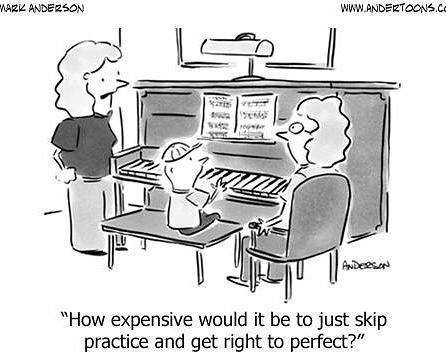
 As you start out this year, check out this practice tip from our Let’s Play Music Blog. And here’s a little ‘practice humor’ for you, just for fun!

Also, the Monsters puppet show puppets are in your book now, but if you’d like you can also download, print and let your child color the characters as you discuss their favorite part about the puppet show! Cut, laminate, and add sticks if you wish! (Can you hear the characters that you are coloring?)Have a musical day!
-Ms. Bethany 🙂
-
<!-- InstanceBeginEditable name="doctitle" -->Blue Bugs Newsletter<!-- InstanceEndEditable --> 
 Homework theory answer key, all skills videos, and make-up videos for missed classes: (tap, click or scan)
  Have fun with reading this blog post on Old Paint! (Lots of extra fun here, so definitely check it out if your child needs more to do!)
 Here is a qucik chord matching game that I created on my website to help remember which solfege goes to which colored triangle! Here’s also a solfege hand sign matching game!
Also, I’ve added the Triumphant March puppets here for you! Enjoy coloring together and making your own puppets! (Don’t forget to listen to the music while coloring!) If you’d like to laminate them, I can laminate them for you and it only costs just barely more than the cost of the laminating sheets.
Have a musical day!
-Ms. Bethany 🙂
-
Document Lesson # 1 Our first class was a fun start to Silver Buttons. It was great seeing both new and familiar faces. Singing and playing together is such a bright part of my week! I look forward to getting to know you and your children better. Each class we will sing these songs: - Everybody Say Hello
- The Letter of the Day
- ABC Song
- Everybody Say Goodbye
Next week we’ll sing these songs in class, (if you want to be sure you know them beforehand):- The Shape Song
- Name, Name, What’s Your Name?
- In My Class I Have Some Bells
- Mary, Mary Quite Contrary
- Thread Follows Needle
- Miss Mary Mack
- This Little River
- The Blue Danube
- Make New Friends
- A Bushel and a Peck
A few reminders:
- Please keep all materials (workbook, triangle, and puppets/props) in your tote bag to bring to class each week.
- Please leave food, drinks and toys at home, in your car, or upstairs. They are a distraction to your own child as well as others in the class.
- Please turn off your cell phone during class. Remember, parent bonding is one of the best features of this class!
- Please utilize the “break area” if your child becomes fussy or disruptive.
- Feel free to contact me with any questions you may have throughout the semester.
- Please be sure to download and listen to your class music on the LPM app!
- Tuition is due today. I prefer payment via Zelle (just use my phone number) because I don’t have to pay fees for that (so I can keep my tuition low), or you may pay with Venmo (@musikandme), which does charge me transaction fees, but either one is fine.
SOLFEGE: Using Solfege syllables and hand signs increases the brain’s ability to connect with pitch relationships. LPM Blog: parts one, two & three
SMART MOVES DANCES: Smart Moves dances are an age-appropriate way to encourage active listening and expose children to classical form, themes, and motives. Basic Active Listening, Themes & Motifs
Music and language processing take place in the same area of the brain, so learning music strengthens the area of the brain used for processing language. Sound Beginnings capitalizes on the fact that music and literacy skills are so perfectly paired. By focusing on name recognition and learning the alphabet and letter sounds, we are setting a great foundation for future literacy skills. Optional Home Fun Activity:
Do the Name Recognition activity on page 20 of your workbook.Here is a video that will help you to know what Sound Beginnings is all about and how it will benefit your child. This was created by another teacher and she was generous enough to share it! Here are some videos for specific ways you can participate with your BABY in class! Check out all of these if you have a baby that is under 2 years old!
Sound Beginnings is education through musical play! It prepares children for success in Kindergarten and Let’s Play Music. Sound beginnings provides research-based elements that stimulate growth in the areas particularly crucial to the development of the young child. These elements make up the foundation of the Sound Beginnings curriculum. Here is just one: 
A child learns when he or she feels loved. In class, purposeful touching, eye contact, partner activities, and generational nostalgia help develop the all-important parent/child relationship. Have a musical day!
-Ms. Bethany 🙂
-
<!-- InstanceBeginEditable name="doctitle" -->Yellow Arrows Newsletter<!-- InstanceEndEditable --> Lesson #1 What a great class this week! We learned so many new things and reviewed many others. Please be sure to look at the Google class calendar so you can be aware when scheduling for parent days. You can sync it to your own digital personal calendar too!
If your child wants to still work on the Christmas Break Challenge this week, I’ll still give out rewards next week, if they bring it back signed!
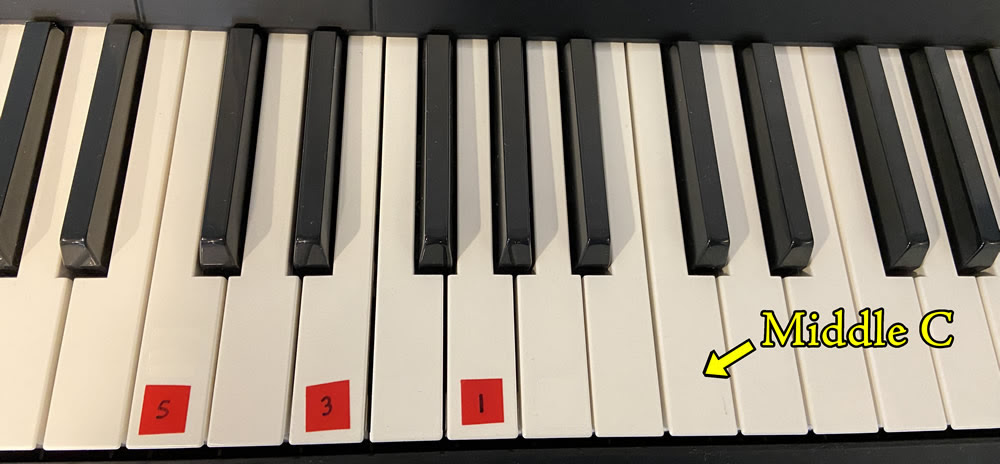 Don’t forget that the keyboard stickers are like training wheels. Once the children know where your fingers should go, they don’t need them anymore! Left Hand Red Sticker PlacementIf your child needs to use the right hand stickers a few more practices, that is fine, but please remove them before next class! (Although the electrical tape stickers I gave you should come off clean, Goo Gone can get any leftover residue if there is any.) Now that we’re learning to use our left hand, you may add your RED chord stickers for the LEFT HAND! We will hold off on the blue and yellow chords for now.
 Tuition is due this week and is $280 for the Yellow Arrows semester. You can pay via Zelle using my phone number (preferred, so I don’t have to pay Venmo transaction fees). Zelle is a way to transfer money from your bank account to my bank account without needing to wait or pay extra fees. It’s easy to set up through your bank and even easier to use once it has been set up. You could pay via Venmo @musikandme if you really can’t set up Zelle. If you need to make monthly payments, rather than paying for the semester, it will be $75/month. (You will save $20 by paying for the semester up front!)
Celebrate Connection
A new semester and a fresh start! Focus on making practice time as fun and loving as possible – give your child warm, friendly eye contact, smile with your voice, be a little silly, show you are relaxed and happy to sit with your child, and look for the good in your child’s effort. Notice the joy in your child’s eyes. Verbalize the good you see and hug your child often. This is the beginning of the practice relationship that will be essential to your child’s success in Let’s Play Music. The more you invest your energy into positive interaction, the more solid and successful this habit will become.
After doing your assignment for class, allow your child to fool around and experiment if he wants to, and play a song he knows — no matter how simple. This can be done anytime or multiple times throughout the week. Model joy as YOU play the piano. If you make a mistake, smile and show that you are relaxed and enjoy trying again to fix the mistake. Celebrate your effort to give him the idea his efforts are something to enjoy and celebrate.A few ideas to bring playfulness to practice time!
- Pull out the bells from last year and notice how fun it is to play some of the Yellow Arrows songs on the bells.
- Any chance you get, have visitors listen to your child play his/her favorite song at the piano and applaud generously! As a family, sing along with the songs.
- Can you collaborate with your child at the piano, a parent duet, someone on the Let’s Play Music bells from last year and someone else playing a shaker or simply singing along? THIS is joy for your child when it is done with emotional safety and celebration!
Online Fun:
(content here)Left Hand Finger Power through Bubble Hands & Turtle Shells
This semester we will focus on strengthening our LEFT HAND finger muscles! Playing Bubble Hands in numerical order on the keyboard is a great way to strengthen and reinforce finger numbers. “Pinky’s 5, Ring is 4, Middle’s 3, Pointer’s 2, and Thumb is 1.” LH pinky is on C, the bottom red dot. After your child is confident with the finger numbers in order, mix it up to cement this concept with the Left Hand! Also, you can log in to your student portal and download the “Finger Numbers Matching Game” that I created for my daughter when she didn’t want to do “Let’s Play Music” homework. (The best part about it was that she didn’t even realize she was learning…we were just playing a game!)Playing Turtle Shells with the CD will ALSO help strengthen those fingers. Look closely at the music on the page and it will help you know what finger numbers to play. Hold each interval down the entire time you are singing until the next interval. It will be tricky at first, but with a little practice, it will become easy!
Do You Want To Build a Red Snowman?
The Left Hand Red Chord looks the very same on the staff: stacked up nice and neat with a 3rd on the bottom and a 3rd on the top in a snowman shape. We PLAY the red chord with our left hand finger numbers 5-3-1 (finger #5 on bass C, the bottom red dot). Invite your little musician to play Old Paint with the left hand this week! They’ll be thrilled to play a song they already know, PLUS they will be strengthening their fingers! Double bonus!The Caterpillar Song
The proper hand position for this technique song is Middle C Position where both thumbs SHARE Middle C like a BUTTERFLY! This week work on coordinating both hands at once by singing finger numbers SLOWLY until they get the hang of this 5 finger pattern. Then add the lyrics. Homework theory answer key, all skills videos, and make-up videos for missed classes: (tap, click or scan) Since both red chords are shaped like a snowman, how do we know which hand to play it with? By looking at which CLEF is on the staff.
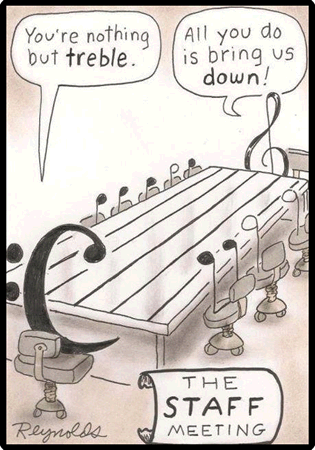
The TREBLE CLEF has a lot of curls, like “Girls Curly Hair,” (say it in a high pitched voice because those are the high notes that we play with our right hand). Don’t pull her hair or you’ll get in “TREBLE!”
The BASS CLEF looks like “Father’s Strong Arm and some father’s like to play bass-ball!” (say it in a deep voice because those are the low notes that we play with our left hand).

Also, I’ve added the Pirate Ship puppets for you to download, print and let your child color the characters as you discuss their favorite part about the puppet show! (Don’t forget to listen to the music while coloring!)
Have a musical day!
-Ms. Bethany 🙂
-
Bridge Lesson Lesson #9A
Here is what we did in class this week:
Online Fun:
Purple Flashcards
(All Notes, Use Timer)Green Interval Flashcards
(Level 3)- We found some strategies to help us know when we’re hearing a 5th interval.
- We can sing the major scale in our head: DO, RE, MI, FA, SOL.
- We can think of our Chords in Pieces song for the red chord: DO, MI, SOL.
- We can think about the beginning of “Twinkle, Twinkle, Little Star”… that’s a 5th interval! DO, DO, SOL, SOL, LA, LA, SOL
- We found some strategies to help us know when we’re hearing a 4th interval.
- We can sing the major scale in our head: DO, RE, MI, FA.
- We can think of our Chords in Pieces song for the red chord: DO, FA LA.
- We can think about the beginning of “Boom, Boom, Ain’t it Great to Be Crazy”… that’s a 4th interval! DO, FA, Ain’t it Great!
- Depending on what key you’re in, the solfege can be different. When we learned that song, we said “SOL, DO, Ain’t it Great,” but it’s still a 4th!
- We noticed in “Clementine” p. 37 that we have a lot of tied notes and we hold some of the notes for 5 counts and some for 6 counts!
- We learned about the different kinds of “dots” in music. In the song “I Spot a Dot” we learned that the dot after a note extends the value of the note by half the value of the note!
- A dotted quarter is 1 1/2 counts because a quarter note is 1 count. Half of 1 is 1/2, so we add those together to make 1 1/2 counts.
- A dotted half note is 3 counts because a half note is 2 counts. Half of 2 is 1, so we add those together to make 3 counts.
- We already knew that one from our “Bugs Are So Fun” song, but now we know WHY a slug plus a dot equals 3!
- We looked at the notes with a dot under them and remembered that those notes were played STACCATO, or choppy.
- One more dot we looked at had a curve over it that looked like a snail shell. That helps us remember to take our time because snails are slow. We play those notes longer than usual. There’s not a set amount of time to play a fermata.

- We started working on our G Major triads.
- The roots of the G Major chords are G, C, and D.
- When we play the D triad, we have to remember to play F#!

- The song “Happy Birthday” is in G Major so we can practice our G Major triads on p. 62!
- Remember to help get your child’s C-Major and F-Major exercises and songs passed off by sending me a video of each (red book, pages 6 through 9 and 10-13)! I would like them to play the scales, triads, and progressions HT with the backtracks (9-11 for C and 13-15 for F). Arpeggios and inversions can just be played as written in the book. I would also like them to play all 4 songs on pages 8 and 9 while singing. We will do this for every key we learn!
- Don’t forget to do flashcards! They are a wonderful tool for helping to read music quickly. Please take advantage of this by having your child do the flashcards every time they practice! Remember, you can do the flashcards on my website instead (or in addition), if that works better for your student.
Here’s this week’s homework assignment sheet and we’re doing the RED highlights! (You can click the image to open a PDF!)
optional text here
Please let me know if you have any questions!
Have a musical day!
-Ms. Bethany 🙂
- We found some strategies to help us know when we’re hearing a 5th interval.