
 Lesson #12  No class next week because of Spring Break! Parents come the following week and final payment is due! If you are unsure if you are caught up on your payments or not, please just ask. All entries for the Spirit Month drawing are due this Saturday by 8:00pm. NO EXCEPTIONS. You MUST fill out this form if you wish to enter the drawing. You can text me a picture of your BINGO card if you didn’t bring it to class. Next class we will choose what your child will be playing in the showcase. I’ll give you each a few options. I’d like all the kids to have a couple opportunities to shine. Remember, we are not a performing group, but we do like to showcase what we’ve learned, so please have them practice their part. They don’t need to have it memorized, but they will feel more confident if they do. Celebrate Connection A few ideas to bring playfulness to practice time!

Don’t Put Your Trash 
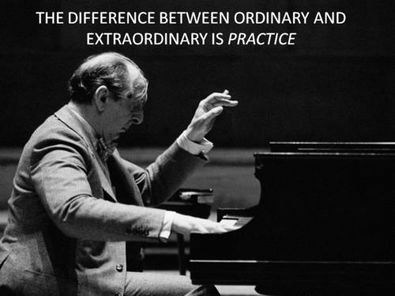
World renowned pianist Vladimir Horowitz shares an inspiring perspective of practicing!
Have a musical day! -Ms. Bethany 🙂  |
-
Yellow Arrows #11
<!-- InstanceBeginEditable name="doctitle" -->Yellow Arrows Newsletter<!-- InstanceEndEditable --> Lesson #11 Here is a really great technique idea you can try at home! It’s a video made by a Let’s Play Music teacher in Ogden. Please watch it and try it with your child, especially if they are having trouble keeping their “bubble hand” shape! This will help keep fingers from “flying away”. Give it a try! (Add "Mr. Rest" between each note on "Scale In and Out" while keeping bubble hands the whole time!)
Registration for next year is open for current students and we are at the final stages! You have until April 22nd to register and enroll your student for 3rd year. If you register by March 20th, you won’t have to pay the $20 registration fee! I realize some of you are waiting on other details before finalizing your class time. Just be sure you watch the deadline so you don’t get a late registration processing fee.
Celebrate Connection
A few ideas to make practice time more playful!
- Tap the rhythm of your RH while tapping the rhythm of your LH on the keyboard cover (Or just tap one hand if the song is hands alone).
- Pick a measure to play, then close your book and try it from memory.
- Face Time (or call) a family member and play for them.
Online Fun:
Need to review finger numbers?
Finger Number MatchingScale In and Out
This technique is teaching contrary motion where the same finger numbers are played together moving in opposite directions. RH pinky (5) begins on Treble C and LH pinky (5) begins on Bass C. Play and sing IN the major scale with fingers 5 4 3 2 1 POP 3 2 1. Both thumbs will land on Middle C. Then play back OUT using fingers 1 2 3 POP 1 2 3 4 5.
Oh, When the Saints
March 2, 3, 4! We can march with our feet AND our fingers. A marching chord is a type of stylized chord that will make this song sound much more like a march. To play a marching chord, play the bottom note of the chord alone and the top two notes (interval) together and the fingers are MARCHING! Feel free to march around the house as your child plays marching chords with this energetic song!
Tinga Layo
To practice Tinga Layo, play the block chord as written with the calypso rhythm. An example of how to play this rhythm is at the bottom of the page in the songbook. Follow the chords and CHANT in rhythm Shoo-oot the Bug Bug or Ting-a Lay-O while playing!
C Major Scale In and Out Homework theory answer key, all skills videos, and make-up videos for missed classes: (tap, click or scan)
 With Spring in the air, your blooming musician can hop on this life-size keyboard practicing the music alphabet in the sunshine!
Have a musical day!
-Ms. Bethany 🙂
-
Yellow Arrows #10
<!-- InstanceBeginEditable name="doctitle" -->Yellow Arrows Newsletter<!-- InstanceEndEditable --> Lesson #10 This week we played broken chords with the LH. It is imperative we play all chords with correct fingerings as this transfers over to every chord structure with all 12 major and 36 minor keys!!!
Continue to solidify the Right Hand, RH, and LH Red, Blue, and Yellow Chords! Watch that fingering, it makes a big difference when done correctly. (I can tell that some of the students aren’t practicing it correctly at home because they aren’t doing it correctly in class!)
Celebrate Connection
A few ideas to make practice more playful!
- One day this week, have Mom or Dad be the student. Show them where to place their hands, what chord/note to play, how to look up at the notes, and YOU point to each note as they play. Watch for nice bubble hands! Sometimes being a teacher is the best way to prove that you’ve learned something!
- Play your piece backwards. Start on the last measure and work your way to the front.
- Play through your piece replacing Mr. Rests with a “shh”
Registration is now open for current students! Classes are just about full for next fall! Thanks to those that have already registered for 3rd Year. Remember, in 3rd year the parents only come five times a semester!
I still have a few openings in my Sound Beginnings and 1st Year Let’s Play Music classes. I’ve also got an evening Sound Beginnings class for working parents! If you know of anyone who might be interested, I’m holding free preview classes for LPM and SB. PLEASE share this link to any friends you think might be interested in music classes: https://www.eventbrite.com/cc/free-preview-classes-at-musik-me-studio-1756869 Also, I LOVE having current students at my preview classes. Please sign up if you are able to come to either or both of the classes. I can’t do “make up” classes, but you can think of this as being a bonus class if you ever missed one… or even if you didn’t!
Did you see that I’m offering Ukulele classes and Recorder classes this spring and summer? Some of the kids in this class are old enough to enroll in those classes! Great for any siblings age 6-12 too!
Are you still working on your Spirit Month BINGO worksheets? I will have drawings for a MINI YOTO PLAYER, an mp3 player, egg shakers, cage bell set, tambourines, singable storybooks, CASH ($20, $10 & $5), and MORE! Here is the BINGO worksheet again, if you need another copy. They will be due on lesson #12, and you and your child can decide which prizes you want to put your tickets toward! I’ll do the drawing the following Friday.
Online Fun:
Do you remember the pieces of our chords?
Primary Chord TrianglesThe Wheels on the Bus sing Melodic Patterns
Melodic patterns are found in every song. How many Sol-Mi-Do’s and Sol-Sol-Do’s can you hear in this version of a favorite childhood song?I Gotta Shake
Get ready to play the rests in this silly song! Our fingers must rest from playing or holding down the note when we see a quarter rest sign. 1st say ‘sh’ or ‘rest’ while playing. Then play again hearing the rest inside while playing the silence in the song.How to Skip
Keep skipping with fingers 1-3-5 in the RH saying the middle anchor notes. Play the LH separate while singing 1st the chord color and 2nd the melody with this favorite song. We will put hands together soon!Tinga Layo
Duet time with shakers! Invite your child to play the chords on the piano while you or a sibling play “shoot-the-bug-bug” rhythm with a shaker. Switch! Make your own shaker with rice, beans, pennies, small beads, etc. in a plastic egg, empty spice container, or baby food jar. Shake away! Homework theory answer key, all skills videos, and make-up videos for missed classes: (tap, click or scan) Charles Gounod was born in 1818 in Paris, France. His mom was a piano teacher and his father was an artist, so he started receiving music instruction very early in his life. He attended excellent musical schools. By the time he was 21, he was receiving awards and prizes for his compositions. He also taught other musicians, most notably, Georges Bizet. Today people still recognize his songs, O Divine Redeemer, Ave Maria, and Funeral March for a Marionette (our current puppet show known as March of the Gnomes!) Can you hear the kings heavy down beat in this recording?
Have a musical day!
-Ms. Bethany 🙂
-
Yellow Arrows #9
<!-- InstanceBeginEditable name="doctitle" -->Yellow Arrows Newsletter<!-- InstanceEndEditable --> Lesson #9 Thank you, parents, for coming to class! We enjoy having you here and bonding with your child. What a gift you are giving them!
Tuition is due for those who didn’t pay for the entire semester up front.
Registration starts this FRIDAY at NOON for the next semester of Let’s Play Music and we’ll start Purple Magic! If you register by March 20th, you don’t have to pay the $20 registration fee! I’ll have two class times available for 3rd Year.
If you know anyone with a child the right age for LPM, I will be doing some preview classes the next couple weeks. Please sign up for any preview classes you would like. (Think of them as “make up” classes for any you may have missed!) Please let your friends know about the preview classes as well. Full preview classes are WAY more fun than small classes. I have to cancel any preview class that doesn’t have at least 3 families in it!
You should have received a separate email about Spirit Month, so have fun earning as many tickets as you can!
Celebrate Connection
A few ideas to make the alphabet pieces game more playful!
- Super Skippers:
Your child draws out an alphabet letter and places it on the keyboard as a ‘starter’. Next, she chooses another piece and checks to see if it can make a skip up or a skip down from the starter. If not, discard it and player 2 gets a turn to play (player 2 should start her skipping chain on a different octave from player 1). Keep taking turns until someone makes a chain, by adding skips at the top or bottom, that is 7 letters long and wins!
- Parking Lot Cars:
Draw a letter from the lot and park your car on the white key “parking space” that matches. Keep going until you run out of cars (or whatever counters you have).
- Cowboys and Indians:
Start one tiny plastic character (ANY tiny plastic figures you have will do: Pokemon, animals, cowboys, princesses, etc.) at one end of the keyboard on a white key, and another at the other end. Draw a tile out and move the low guy up to that key. Draw another tile and move the high guy down to that key. Keep going until they meet (and battle, or shake hands, or whatever you pretend!)
Online Fun:
Do you need a review of your finger numbers? Try to match them as fast as you can! Finger Number MatchingBug Scale
We can now play UP the C Major Scale with our RH! Place the RH in C position and play with fingers 1-2-3 (CDE) then POP UNDER with the thumb to make a new bubble and continue playing with fingers 1-2-3-4-5 (FGABC). Choose your favorite BUG to practice this new skill. One way to remind where to pop is to insert POP with the bug like this: Butterfly, Butterfly, Butterfly, POPPERfly, Butterfly, etc. As always, we try to make our technique drills so fun that the kids don’t even notice they are getting practice!
A Warm Welcome to Middle B and Middle D
The 5 anchor notes used in 2nd year include the members of the “C” family: Treble C, Middle C, and Bass C and the Middle Friends including Middle B who is B-elow Middle C and Middle D who is Down under the first line on the staff. ?"Middle C, Middle C, has 2 Bud-Dies: B and D!"?
How to Skip
We will master all of our middle anchor notes with this song: Middle B, Middle C, Middle D. Use the same 3 fingers for the entire song: 1-3-5. Simply move your thumb to the appropriate starting note. Sing “C-skip-skip-skip, D-skip-skip” etc. emphasizing each anchor note. This is where the practice of seeing and playing those middle anchor notes connect!
I am Robin Hood
If your child can play each hand of “I am Robin Hood” comfortably, they are ready to put both hands together! Isolate 1 or 2 measures at a time to have a successful experience, then continue to add 1-2 measures until they can play the entire song with confidence! While practicing with your child, you can guide their eyes by pointing note by note with V fingers. Hooray for Hands Together!March of the Gnomes
What did you think of our new puppet show? Look in the back of the piano book and you’ll find the “March of the Gnomes” coloring pages.C Major Scale Right Hand Ascending
Homework theory answer key, all skills videos, and make-up videos for missed classes: (tap, click or scan) How instinctive is your child getting with their keyboard geography and naming all of the white keys? Time your child for 1 minute and see how many alphabet pieces they can put on the piano. Your student will treasure these game ideas as they continue to solidify all of the notes on the keyboard.

Also, I’ve added the March of the Gnomes puppets for you to download, print and let your child color the characters as you discuss their favorite part about the puppet show! (Don’t forget to listen to the music while coloring!) Perform the puppet show together for the rest of your family!Have a musical day!
-Ms. Bethany 🙂
- Super Skippers:
-
Yellow Arrows #8
<!-- InstanceBeginEditable name="doctitle" -->Yellow Arrows Newsletter<!-- InstanceEndEditable --> Lesson #8 Parents come next week, tuition is due, and SPIRIT MONTH is right around the corner! (You’ll receive a separate email with details.)
Registration will be happening soon. The fall schedule should be ready next week!
Celebrate Connection
A few ideas to bring playfulness to practice time!
- Alpha-frogger:
Pretend each alphabet foam piece is a tiny frog. Have your child choose an alphabet frog, then hop it across the keyboard helping froggie find all keys of that letter. These frogs don’t croak- each time the “frog” lands on one of her special lily pads, sing the letter (on pitch!).
- Hiss:
Place one letter on the keyboard as a starter snake. Each player takes turns drawing a letter and checking to see if they can add it to the head or the tail with baby steps to make the snake longer. If not, start a new snake somewhere else on the keyboard. Anytime someone makes a snake with 8 or more segments, they get to remove it from the keyboard and keep the points (1 per segment)! Play until the pieces run out. It’s pretty cool if you are able to join 2 snakes by drawing the missing link between them, and win a really long snake! You might enjoy non-piano Hiss, too.
- Silly Songs:
Have your child draw out 5-10 alphabet notes and line them up along the music stand. With her right hand in C position, play each note with the finger touching that key. If the note is a B, slide the thumb down to yellow position to reach it; if the note is an A, slide the hand into blue position to reach it. This might be a wacky song, or it might be something cool. If you like the tune, play it again!
Online Fun:
Test your memory skills with this fun Melodic Pattern Memory Matching game (level 3)!!Oh, When the Saints & Lullaby and Goodnight
D-O-W-N and that’s the DOWN-BEAT! The downbeat is the strong beat that tells us when to begin playing a song. Sometimes the downbeat is on the first word of a song, sometimes it is not. Ask your child what word the DOWNBEAT is on in both of these songs!Tinga Layo
Our toe-tapping donkey, dances a shaky, stylized rhythm called CALYPSO. See if you can hear this fun rhythm while singing along!I am Robin Hood
It’s duet time! While your child plays the melody, you or a sibling can clap or pat drumbeats on lap in a repeated slug pattern. Then switch! Once your child is confidant playing the melody by themselves, invite them to pat their own leg while playing. Impressive harmony! Homework theory answer key, all skills videos, and make-up videos for missed classes: (tap, click or scan) When listening to Don’t Put Your Trash encourage your child to do the actions to the part he hears during the harmony. It is also creative to change up the lyrics especially when encouraging chores: Don’t put your SOCKS (insert any noun) in my BEDROOM (insert any place) my bedroom’s full!
Have a musical day!
-Ms. Bethany 🙂
- Alpha-frogger:
-
Yellow Arrows #7
<!-- InstanceBeginEditable name="doctitle" -->Yellow Arrows Newsletter<!-- InstanceEndEditable --> Lesson #7 I am so happy with the progress of class! One thing I would love them to focus on this week is doing the Alphabet Pieces Game consistently. I know it doesn’t seem like a very important activity BUT, the 3rd year students who do not do it consistently, struggle to know their keys. Here is a link to some fun ideas to make it more enjoyable! We will be doing races in class to help them get faster at naming the notes and I want everyone to feel successful. (More fun ideas at the end of this email…keep reading!)
Is your child starting to fight you on practice time? Here is a post about motivation and a focus on your child’s learning style to make practice time more cooperative and enjoyable. Don’t forget, we’re trying to get ONE tally mark for each activity EACH DAY for FIVE DAYS. This will help your child to really understand and master the concepts taught that week.
Registration for next semester is right around the corner! I’ll be holding free preview classes in just a couple weeks for new families to see what Let’s Play Music is all about. Please help me spread the word… I do give referral bonuses! Please feel free to sign up for a free preview class if you ever had to miss a class. (It’s the closest thing to having a make-up class that I’m allowed to do!) Classes are always more fun with experienced families, even if the kids are a little older!
Do you have another child that is going to be 4 years old by September 1st? Sign up for a Let’s Play Music free preview class for them!
Do you have another child that is 0-4 years old that would benefit from Sound Beginnings? You’re welcome to sign up for a free preview class for that as well!
Celebrate Connection
A few ideas to bring playfulness to practice time!
- Alphabet Race:
Have your child take one alphabet piece from the bag and quickly set it on the correct white key. Continue until the bag is empty! Time yourself and see if you can beat yesterday’s time. For students who struggle, have the student look at the picture (key-group diagram) in the back of the Yellow Songbook and form his own visual conclusion.
- Take a Second:
Have your child choose two alphabet pieces and place them on the keyboard. Identify what interval they make, and play the interval. If it’s anything other than a 2nd, play again! The game ends when you take a second to make a 2nd.
- Go Fish:
Each player starts with 3 alphabet tiles hidden in his hand. Try to make matches by asking the other player: “Do you have a…” then PLAY the note on the piano to make your request. If you end up with an empty hand, draw 3 more tiles. Keep playing until the tiles are all gone, and see who got more matches.
Online Fun:
What’s that piano key name? Play Keyboard Letter NamesMelodic Patterns
When learning to play melodic patterns:- Play all 5 in Middle C Position.
- Play at separate times. The clef tells which hand will play. Treble Clef is RH and these patterns go DOWN. Bass Clef is LH and these patterns go UP.
- What are the notes telling you to play? Steps, skips, or leaps? They ALL end on Middle C.
I am Robin Hood
This theme song is significant because it is the first song we play hands together with each hand playing independently. In class we learned to play the melody with the right hand. Place your RH thumb (1) on Middle C, 2nd finger on Middle D, and the 3rd finger on the black note above Middle D. And then play in the rhythm of BUG-BUG-BEETLE-BUG, BEETLE-BEETLE-SLUG. Practice hands separately this week. We will put it all together soon!
Lullaby and Goodnight
Did you know that we can make a song sound different by changing a block chord to a broken chord? It’s time to break all of the chords in Lullaby and Goodnight. Stylizing the block chords to broken will change the mood of this song into a calm, peaceful lullaby. Played piano (find the p under the music) with broken chords this lullaby will be sure to put you to sleep! Homework theory answer key, all skills videos, and make-up videos for missed classes: (tap, click or scan) Are you ready for spring to come? Let It (Winter) Go is a cool piece to play now that our students are warmed up with all of the chords in right and left hand.
 If your child is really into learning things digitally, I found a very simple app (FREE with NO ADS!) that quizzes them on the piano keys. I believe it’s only available for Apple devices though. (I haven’t tried finding it on Android yet.) It’s called Bees Keys. Time your child to see how fast they can get all 7 letters, then see if they can beat that time! Have them look at the letter diagram in the back of their book if they don’t know it. Remember, we’re NOT teaching them to count up from C, but teaching them to know the letters by just looking at the keyboard. It will be way faster in the long run!Have a musical day!
-Ms. Bethany 🙂
- Alphabet Race:
-
Yellow Arrows #6
<!-- InstanceBeginEditable name="doctitle" -->Yellow Arrows Newsletter<!-- InstanceEndEditable --> Lesson #6 Please watch this week how your students’ mastery of Melodic Patterns and Chord Fingerings are going. I am seeing some fingering confusion and habits that will be hard to break the longer they practice them incorrectly. Focus and encourage lots of Red, Blue, and Yellow chord transitions this week, with both right and left hands separately.
Celebrate Connection
A few ideas to bring playfulness to practice time!
- When the notes go up the keyboard, lean to the right; when the notes go down, lean to the left.
- Sing along in pig-latin
- Play (and sing) a song as *Forte* as you can!
Registration for next semester is right around the corner! I’ll be holding free preview classes in just a couple weeks for new families to see what Let’s Play Music is all about. Please help me spread the word… I do give referral bonuses! Please feel free to sign up for a free preview class if you ever had to miss a class. (It’s the closest thing to having a make-up class that I’m allowed to do!) Classes are always more fun with experienced families, even if the kids are a little older!
Do you have another child that is going to be 4 years old by September 1st? Sign up for a Let’s Play Music free preview class for them!
Do you have another child that is 0-4 years old that would benefit from Sound Beginnings? You’re welcome to sign up for a free preview class for that as well!
Online Fun:
For practice with melodic patterns, try this fun memory game. Memory: Melodic Pattern Matching (You can play at level 3 now!)Melodic Patterns
We get to PLAY all of the melodic patterns this week! The value of this daily practice technique is to SEE, SING and PLAY each pattern all at once. Though their well-trained ears might tempt them to play each pattern by ear, insist they look at the book with their goggles, binoculars, laser beam eyes, telescopic vision, x-ray vision, heat vision, freeze vision, or night vision eyes while they play and sing!
Here are the verbal cues we sing in class with our hand signs. Invite them to sing these cues, finger numbers, or be creative and make up different words on the pitches of each melodic pattern.- MRD – Baby Steps Down
- SFMRD – Baby Steps Go-Ing Down
- SMD – Skip-Ping Down
- SSD – Same Same Leap-up
- SLTD – Baby Steps Going Up
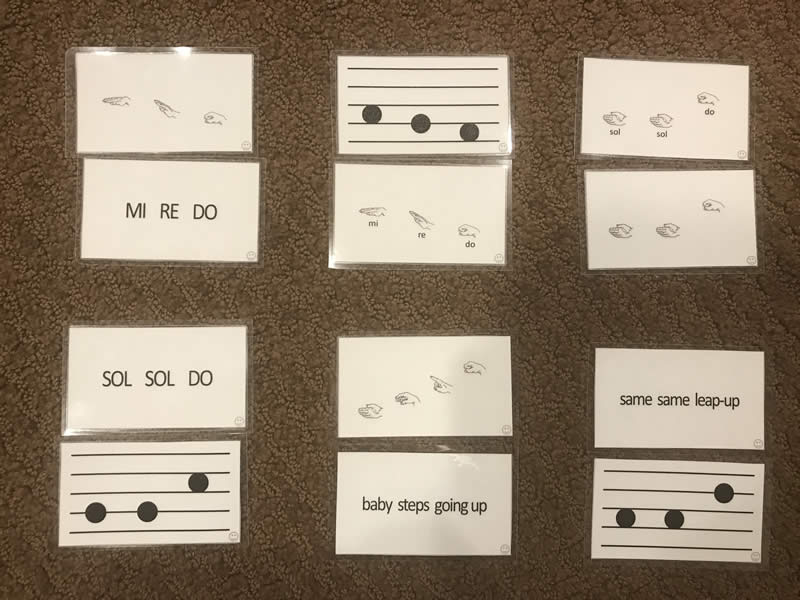
In case you missed it, I have created this printable Melodic Patterns Matching Game. This has all 5 melodic patterns in it. You may use whichever cards you wish (as long as there is a match). Any card that has the same pattern is a match (see picture example). The simplest way to make this game is to print on thick paper (or even regular paper) and cut them out. You can laminate them if you wish. Better yet, they fit perfectly on business card paper so you can just print, fold, and tear apart! Be sure you and your child sing ♫ each pattern as you turn the cards over!
Can’t Bug Me
Drumroll please…..Introducing BEAT BUG! “The BEAT is the BUG and the others play a long!” The Beat Bug sets the tempo on the metronome! He might go fast or slow but the beat is a ‘bug’ (quarter note) and the other rhythms (beetles, caterpillars, grasshoppers, butterflies, slugs) follow and fit within that given tempo.Hickory Dickory Dock
This song introduces parallel motion by following a steady beat through a metronome (a tick-tock is what we’ll call this motion in class).
Lullaby and Goodnight & Go to Sleep
After we solidify the chord transitions in our lullabies, we will make them sound more serene and calming by stylizing them with broken chords. Feel free to invite your child to color the chords in their piano book to make this an easier transition.
Primary Chord Song/Primary Cadence
Time to put on a show for the family! Your child can play ALL chords with BOTH HANDS! Invite them to perform the chords while singing the chords out loud! Play them hands separate, then try hands together with the correct fingerings! Homework theory answer key, all skills videos, and make-up videos for missed classes: (tap, click or scan) Why the importance of chords in piano playing? Kristi Ison, a Let’s Play Music teacher in Mesa, Arizona, shares the Top 10 Reasons for Learning Primary Chords!
Have a musical day!
-Ms. Bethany 🙂
-
Yellow Arrows #5
<!-- InstanceBeginEditable name="doctitle" -->Yellow Arrows Newsletter<!-- InstanceEndEditable --> Lesson #5 Thank you parents for coming this week! We can’t have parent days without you!
Looking ahead to next year, as of right now, I’m planning to teach 3rd Year at almost the same times I’m currently teaching this class. So in August when we start Purple Magic, it will be Tuesdays at 4:00 or 5:30. (I need the extra time between classes because class is 55-60 minutes long.) Please let me know if that will or will not work for you.
Please cut out the letters as they are needed and play the alphabet keyboard game with your child. (If they’re already cut apart, just pull out all of one letter at a time.) Play this game on the largest keyboard you have. (If you have a piano with 88 keys, this is preferable to playing it on a 66-key keyboard.) You can do this separately from regular practicing. Just keep each letter session very short to begin with. You can even have several sessions in a day. We want the kids to enjoy playing this game. Maybe time them and have them beat their best time! The instructions I wrote in the Ziploc bag are different than those in the book. I have learned from experience that learning one new letter at a time makes it easier for the kids to remember. You should be able to play the game as described in the book very soon, but isolating the letters to begin with helps alleviate confusion. The repetition will help them remember faster. They will visualize the white keys for what they are, rather than what they are in relation to each other. If you have any questions or concerns about any of this, please let me know. I have many suggestions, but don’t want to overwhelm you with all of them at once!
Celebrate Connection
A few ideas to bring playfulness to practice time!- Blink with each note/chord you play in the bass clef (LH).
- Close your eyes, and run your finger over your music then stop and open your eyes. Start from wherever your finger landed and play through to the end.
- Knock on the wood/plastic of your keyboard when you come to Mr. Rests.
Online Fun:
Here’s a simple keyboard note naming game I built on my website – Name the NoteBass C and Treble C
The 3 C’s are in a family; they have different first names and the same last name! We’ve known Middle C since last semester. This week we introduced Bass C: 2nd Space in Bass Clef is Bass C! (♫ “Second space is C in the bass”) AND Treble C: 3rd Space in Treble Clef is Treble C (♫ “Space 1-2-3 is treble C”). These anchor notes on the staff will help orient us as we expand our keyboard skills. Treble C is just one octave up from Middle C and Bass C is just one octave below Middle C. You can look at pg. 56 in the homework book for reference, if needed.C Major Scale
Now that we know where Treble C is on the keyboard we can play the C Major Scale going DOWN. The technique is exactly like the Left Hand, though playing it with the Right! Practice this SLOWLY to ensure correct fingerings and bubble hand position. 1) Begin with RH finger number 5 on Treble C. (This is the C right above middle C.) 2) Play Do, Ti, La, Sol, Fa using fingers 5-4-3-2-1 with a rounded bubble hand. 3) To play Mi, POP finger number 3 over thumb. 4) Reset the BUBBLE and proceed to play Mi-Re-Do with finger numbers 3-2-1.I am Robin Hood
Shoo-oot the Ar-row, Waa-atch it fly—, teaches us how to feel and play the dotted quarter eighth note pattern (our bulls-eye and arrow feather) right on target. To feel this rhythm more accurately dance with the CD, stomp out the rhythm with hands and feet, or even sit them on your lap and bounce your knees up and down to the rhythm while chanting the song together. Mix up practice with this song by playing the bass clef 5th an octave lower to really sound like a deep drum!Mr. Rest
Could you believe all the musical symbols Old MacDonald had on his musical farm? A rest, though played with silence, is a very important aspect of music. Mozart said "The music is not in the notes but in the silence between." Rests are powerful!C Major Scale Right Hand Descending
Homework theory answer key, all skills videos, and make-up videos for missed classes: (tap, click or scan) Playing the Alphabet Pieces game every day will help us solidify keyboard geography by learning the names of ALL of the white keys. Once your child knows all the letters individually, you can enjoy playing this game with its theme and variations!
Have a musical day!
-Ms. Bethany 🙂
-
Yellow Arrows #4
<!-- InstanceBeginEditable name="doctitle" -->Yellow Arrows Newsletter<!-- InstanceEndEditable --> Lesson #4 Parents attend next week and tuition is due for those of you who did not pay the semester up front. You can use Zelle (using my phone number) or Venmo (@musikandme).
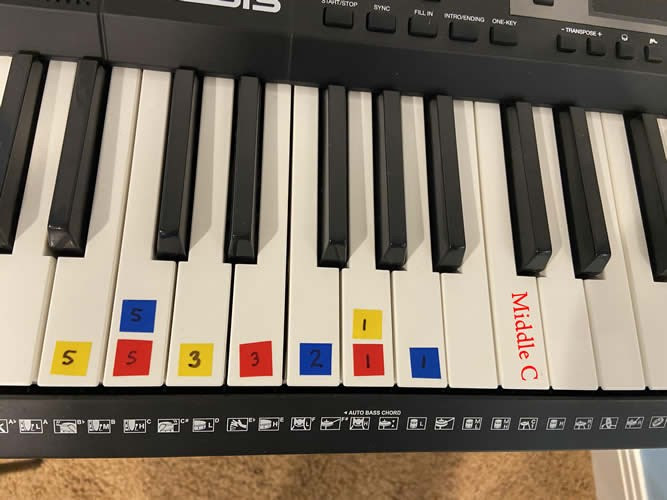
Please add your yellow stickers to your keyboard so they look like this. We have now learned the yellow chord, which is played with fingers 5, 3, and 1 on the left hand. We “glue” our thumb down and slide fingers 3 and 5 down by one baby step. Please be sure your child practices using the correct fingers! (In left hand we use the same fingers as the red chord!) Your child needs to beconfident with left hand chords alone before attempting to play both hands together. We would like success, rather than frustration!
Within the next month we will start enrolling for next year. If you have friends or family that you want on my waiting list to start 1st Year, please share the link ASAP so I can get their information before I begin open enrollment up to the general public.
Please respond to my survey so I know what days/times work for you for next fall! I want to be sure you have a class! Here’s the link:
https://forms.gle/hhaxJFGVgMG4BBog6
Celebrate Connection
A few ideas to bring playfulness to practice time!
- Have a contest between yourself and your child to see who can play the most transitions between the red and yellow chord with the left hand in 30 seconds! Have your child try to beat his/her own record!
- Practice chord transitions from red to yellow with your eyes shut! Use your ears to tell you if you are playing the right notes. Make sure you always use the correct fingers for each chord! (5, 3, and 1 for both chords.)
- Guess the chord. Have your child play a chord and you guess which color chord it is. Then switch roles and have your child guess what you are playing!
Online Fun:
Review finger numbers with these fun games I made! Choose between matching and memory.
Finger Number PracticeC Position & Middle C Position
We learned where the RH and LH rest on the keyboard for both of these positions. With C Position the RH Thumb (Finger 1) is on Middle C and LH Pinky (Finger 5) is on Bass C. With Middle C Position both Thumbs (Fingers 1) share Middle C. We liken this position to a butterfly. The two thumbs resting on middle c together are the butterfly body and their hands are the wings. Are their soft wings (fingers) resting gently on the keys? Don’t forget your “BUBBLEFLIES!” (That’s bubble hand butterflies…I made that up myself!)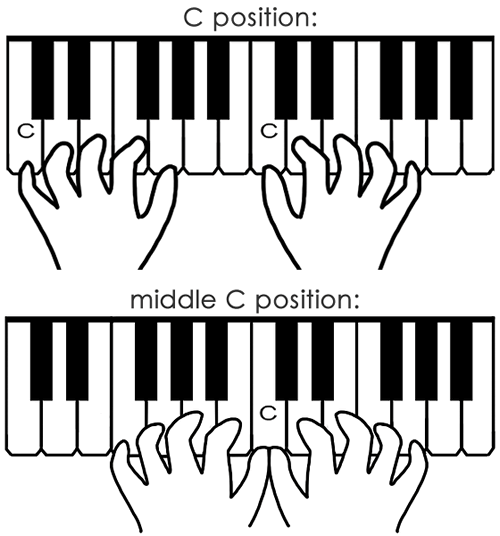
A fun review is to chant each position, simply moving the LEFT HAND back and forth. Practice in the air, at the kitchen table, in the car running errands, and of course on the piano!
Caterpillar Song
This week when we played Caterpillar Song in class, I was SO impressed with how well the kids “glued” their fingers to the keys! This song is only meant to be fast if fingers aren’t flying off the keyboard. Remember, CATERPILLARS DON’T FLY! Please be sure the kids practice this way EVERY TIME they play this song. Having good “BUBBLEFLIES” (for this song especially) will help them develop the correct habits that will manifest themselves in all our other songs!
C Major Scale
We learned how to play UP the C Major Scale (Do, Re, Mi, Fa, Sol, La, Ti, Do) with our LEFT HAND. We don’t have enough fingers to play this scale, so we learned how to POP our bubble hands and then reset them to complete the scale. Practice this SLOWLY to ensure that your child plays this correctly. 1) Play Do, Re, Mi, Fa, Sol with 5-4-3-2-1 fingers with a rounded bubble hand. 2) To play La, POP finger number 3 over the thumb. 3) Reset the BUBBLE and proceed to play La, Ti, Do with finger numbers 3-2-1. Sing the scale with finger numbers: 5-4-3-2-1-3-2-1. Don’t have them try to play down yet, just UP.
I am Robin Hood
Enjoy ‘drumming’ the slow slugs on the piano with the interval of a 5th using Left Hand Bass Clef fingers 5 and 1 when practicing this song. Sing the melody together while parents drum along on laps, the edge of the piano, clap along to keep a steady slug beat or drum with any can, canister, or container from around the home. Switch places so parents can play and kiddos can drum!
Do You Want to Build a YELLOW Snowman?
This bottom heavy snowman built with a 3rd on the bottom and a 4th on the top is melting from the YELLOW sun! We play this chord with fingers 5-3-1. Place Left Hand in C Position. SLIDE Finger 5 (pinky) and Finger 3 (middle finger) down one baby step while Finger 1 (thumb) stays put. Now time your musician for 30 seconds and count how many bass clef Yellow Chords they can play!C Major Scale Left Hand Middle C vs. C Position & Review Caterpillar Song
Homework theory answer key, all skills videos, and make-up videos for missed classes: (tap, click or scan) We call our new puppet show “The Pirate Ship” but the real title is Hungarian Dance No. 5 by Johannes Brahms. The Hungarian Dances are a set of 21 lively dance tunes based mostly on Hungarian themes. They are among Brahms’ most popular works, and were certainly the most profitable for him. Each dance has been arranged for a wide variety of instruments and ensembles. Brahms originally wrote the version for piano four-hands and later arranged the first 10 dances for solo piano. The most famous is Hungarian Dance No. 5.
Have a musical day!
-Ms. Bethany 🙂
-
Yellow Arrows #3
<!-- InstanceBeginEditable name="doctitle" -->Yellow Arrows Newsletter<!-- InstanceEndEditable --> Lesson #3 Use this week to get your left hand red-blue chord transition solidified before we add the yellow chord next week. We should be getting to the point where we can play this transition with our eyes closed and even hands together! (That’s tricky because the fingering is different for the RH than the LH. Only try it hands together when the muscle memory is solid in each hand separately).
Celebrate Connection
Here are some practice tips to change things up. The winter blues might be setting in! Try putting red and blue stickers or candies on the keys that should be played for each chord. After practicing them a few times, they get to keep the stickers or eat the candies. Have a parent play through the practice and kiddo watches to be sure mom or dad is getting it right!
A few ideas to bring playfulness to practice time!- Play “Freeze ad Thaw” – Parent or child will say “start”. Child will play until parent randomly says “freeze”. Child will freeze until parent says “thaw”. Then trade places.
- Play your chords with a small washcloth or towel over your hands. Can you do it without peeking? Use your ears to tell you if you are playing the right notes. Make sure you always use the right fingers for each chord!
- Name that tune! In how few of notes can you name a song?
Online Fun:
Since we just added our final melodic pattern, check out this fun Melodic Pattern Matching Memory Game (Level 3) on my website!Caterpillar Song
WOW! Our caterpillars are getting smoother and steadier with this 5 finger pattern! As your child progresses playing this song, watch for these 4 things:- Bubble Hand—at beginning and end of playing, but eventually throughout. Visualize fingers stuck in bubble hand position with honey, caramel, glue, Velcro, etc. to keep them from flying away!
- Strong Independent Fingers—strike the key and make sure that finger comes up when you strike another note. Sing finger numbers with hands together.
- Smooth Sound—indicates finger strength and coordination. Remember SLOW is the way to GO!
- Steady Rhythm—fingers 1, 2, 3 are stronger and they like to go a little faster. Singing and emphasizing finger numbers 5-4-3-2-1-2-3-4-5, Ca-Ter-Pill-Ar, and the lyrics out loud will help keep a steady caterpillar.
This week we focused playing the “Turtle Shell” intervals with the left hand. Everyone agrees that it’s harder than the right hand! Using fingers 4 & 5 is tougher than using 1 & 2. Before playing, warm up with “Where is 4? Where is 5?” then have your child play the interval (a 2nd) with fingers 4 & 5. Repeat for the 3rd, 4th, and 5th. We tried hands together in class, but if that is too much, just focus on left hand only. Once your child masters the intervals with the left hand,THEN play hands together. Enjoy a little twist on the classic game Twister to reinforce and strengthen those finger numbers.
Love Somebody
We LOVE when our parents play along with us! Share more love with your child by playing and singing the melody an octave higher or accompanying together with the chords using the album. Ask your child to teach your family the ‘LOVELY’ game that accompanies this song!
I am Robin Hood
“I am Robin Hood” is used to introduce quarter rests and the dotted quarter – eighth note pattern. The philosophy that feeling a “pulling” feeling will promote correct performance of that particular rhythm pattern, is brought to life in a playful way through the “pulling” of arrows. The open 5th in the left hand is a particularly satisfying sound to young children, resembles the sound of drums and is easy to play! Homework theory answer key, all skills videos, and make-up videos for missed classes: (tap, click or scan) Teaching our students to read music using steps and skips leads to more fluent playing and better sight-readers. Echo Edna helps our students in class be able to recognize steps and skips on the staff, sing them, AND play them. Simon Says to Step or Skip is a fun game to practice this concept at home. You can print and cut out the cards here, or make your own and shuffle them in two different piles (one with step/skip and the other with up/down). ‘Simon’ chooses any note to start on, then chooses one card from each pile and invites the other person to follow those directions. After a few rounds, switch roles. Did you do as Simon Said? A fun way to add tactile and visual reinforcement is to use small pencil top erasers or any small toy as a starting note and then step or skip with another one. It’s so fun!
Have a musical day!
-Ms. Bethany 🙂