
 | ||
| Lesson # 4 | ||
 | ||
The music included in Sound Beginnings curriculum was chosen to represent the best in folk music and nostalgic songs. Our Smart Moves dances allow us to also experience well-known classical pieces in age-appropriate ways. Dance along at home to continue the fun we have in class. Here’s a downloadable cue card of the way we experience the "Ice Skaters Dance" in class.
My favorite thing about teaching this class is knowing that this class makes a difference to you and your child. Please text to let me know one activity from class that you've enjoyed at home and how you and your child experienced it!I love hearing success stories, both big and small! | ||
 Transitions & subdivision: Our transition activity allows us to hear and feel how a segment of Parachute: Parachute play is a great way to strengthen the upper body and | ||
 | ||
| In order to to fully benefit from music, children need to do more than just listen. When a child sings, has rhythmic experiences, or dances along to a piece of music, a signal is sent to the brain to process and make meaning of the musical experience. Smart Moves dances are helping your child’s brain understand music in a more meaningful way and process musical elements such as theme, dynamics, and phrasing.
| ||
| Watch an orchestra play our "Ice Skaters Dance" song! You can watch just until the 3:00 mark for our shortened version, or you can even start the video at the beginning and enjoy the entire song! Here is a Facebook video (from the husband of another Sound Beginnings teacher) with pronunciation for “Frere Jacques” that we’ll start on next week. | ||
 Speech Development: A recent study suggests that infants exposed to musical activities have stronger brain responses Speech Development: A recent study suggests that infants exposed to musical activities have stronger brain responsesto both music and speech rhythm, and that exposure to music increases the ability to detect patterns in sounds. (University of Washington’s Institute for Learning & Brain Sciences) | ||
 | ||
| ||
| ||
Have a musical day! |

-
<!-- InstanceBeginEditable name="doctitle" -->Yellow Arrows Newsletter<!-- InstanceEndEditable -->  Lesson #4
Parents attend next week and tuition is due for those of you who did not pay the semester up front. You can use Zelle (using my phone number) or Venmo (@musikandme).
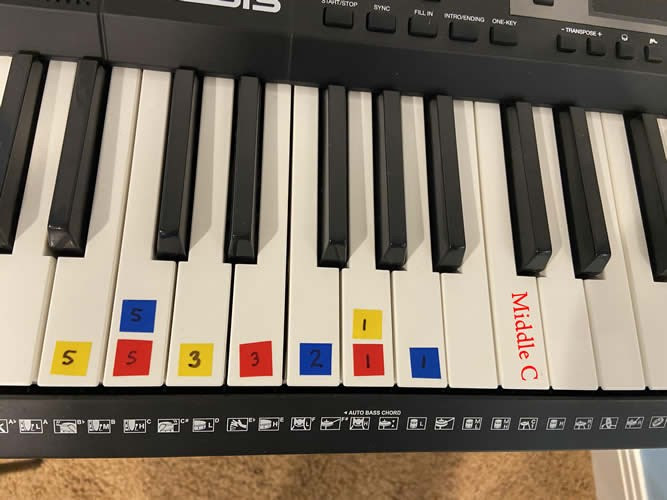
Please add your yellow stickers to your keyboard so they look like this. We have now learned the yellow chord, which is played with fingers 5, 3, and 1 on the left hand. We “glue” our thumb down and slide fingers 3 and 5 down by one baby step. Please be sure your child practices using the correct fingers! (In left hand we use the same fingers as the red chord!) Your child needs to beconfident with left hand chords alone before attempting to play both hands together. We would like success, rather than frustration!
Within the next month we will start enrolling for next year. If you have friends or family that you want on my waiting list to start 1st Year, please share the link ASAP so I can get their information before I begin open enrollment up to the general public.
Please respond to my survey so I know what days/times work for you for next fall! I want to be sure you have a class! Here’s the link:
https://forms.gle/hhaxJFGVgMG4BBog6
Celebrate Connection
A few ideas to bring playfulness to practice time!
- Have a contest between yourself and your child to see who can play the most transitions between the red and yellow chord with the left hand in 30 seconds! Have your child try to beat his/her own record!
- Practice chord transitions from red to yellow with your eyes shut! Use your ears to tell you if you are playing the right notes. Make sure you always use the correct fingers for each chord! (5, 3, and 1 for both chords.)
- Guess the chord. Have your child play a chord and you guess which color chord it is. Then switch roles and have your child guess what you are playing!

Online Fun:
Review finger numbers with these fun games I made! Choose between matching and memory.
Finger Number PracticeC Position & Middle C Position
We learned where the RH and LH rest on the keyboard for both of these positions. With C Position the RH Thumb (Finger 1) is on Middle C and LH Pinky (Finger 5) is on Bass C. With Middle C Position both Thumbs (Fingers 1) share Middle C. We liken this position to a butterfly. The two thumbs resting on middle c together are the butterfly body and their hands are the wings. Are their soft wings (fingers) resting gently on the keys? Don’t forget your “BUBBLEFLIES!” (That’s bubble hand butterflies…I made that up myself!)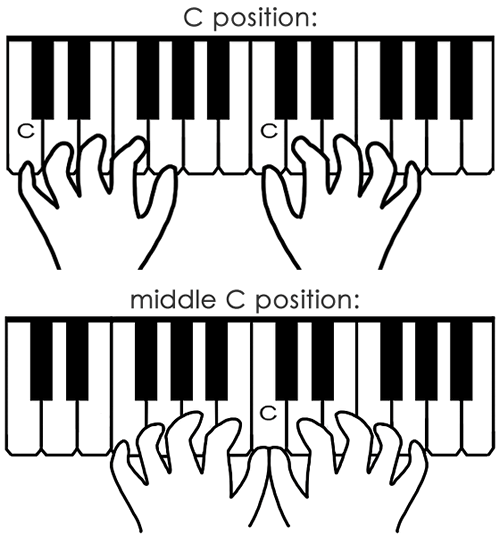
A fun review is to chant each position, simply moving the LEFT HAND back and forth. Practice in the air, at the kitchen table, in the car running errands, and of course on the piano!
Caterpillar Song
This week when we played Caterpillar Song in class, I was SO impressed with how well the kids “glued” their fingers to the keys! This song is only meant to be fast if fingers aren’t flying off the keyboard. Remember, CATERPILLARS DON’T FLY! Please be sure the kids practice this way EVERY TIME they play this song. Having good “BUBBLEFLIES” (for this song especially) will help them develop the correct habits that will manifest themselves in all our other songs!
C Major Scale
We learned how to play UP the C Major Scale (Do, Re, Mi, Fa, Sol, La, Ti, Do) with our LEFT HAND. We don’t have enough fingers to play this scale, so we learned how to POP our bubble hands and then reset them to complete the scale. Practice this SLOWLY to ensure that your child plays this correctly. 1) Play Do, Re, Mi, Fa, Sol with 5-4-3-2-1 fingers with a rounded bubble hand. 2) To play La, POP finger number 3 over the thumb. 3) Reset the BUBBLE and proceed to play La, Ti, Do with finger numbers 3-2-1. Sing the scale with finger numbers: 5-4-3-2-1-3-2-1. Don’t have them try to play down yet, just UP.
I am Robin Hood
Enjoy ‘drumming’ the slow slugs on the piano with the interval of a 5th using Left Hand Bass Clef fingers 5 and 1 when practicing this song. Sing the melody together while parents drum along on laps, the edge of the piano, clap along to keep a steady slug beat or drum with any can, canister, or container from around the home. Switch places so parents can play and kiddos can drum!
Do You Want to Build a YELLOW Snowman?
This bottom heavy snowman built with a 3rd on the bottom and a 4th on the top is melting from the YELLOW sun! We play this chord with fingers 5-3-1. Place Left Hand in C Position. SLIDE Finger 5 (pinky) and Finger 3 (middle finger) down one baby step while Finger 1 (thumb) stays put. Now time your musician for 30 seconds and count how many bass clef Yellow Chords they can play!
C Major Scale Left Hand Middle C vs. C Position & Review Caterpillar Song
 Homework theory answer key, all skills videos, and make-up videos for missed classes:
 (tap, click or scan)
 We call our new puppet show “The Pirate Ship” but the real title is Hungarian Dance No. 5 by Johannes Brahms. The Hungarian Dances are a set of 21 lively dance tunes based mostly on Hungarian themes. They are among Brahms’ most popular works, and were certainly the most profitable for him. Each dance has been arranged for a wide variety of instruments and ensembles. Brahms originally wrote the version for piano four-hands and later arranged the first 10 dances for solo piano. The most famous is Hungarian Dance No. 5.
Have a musical day!
-Ms. Bethany 🙂
-
Bridge Lesson 
Lesson #10B
Here is what we did in class this week:
Online Fun:
Note Value Matching (Memory Game)
Beat Value Matching
Flashcards
- We made a Counting Pyramid that helped us visualize the counts of each of our note and rest types and how they relate to each other.
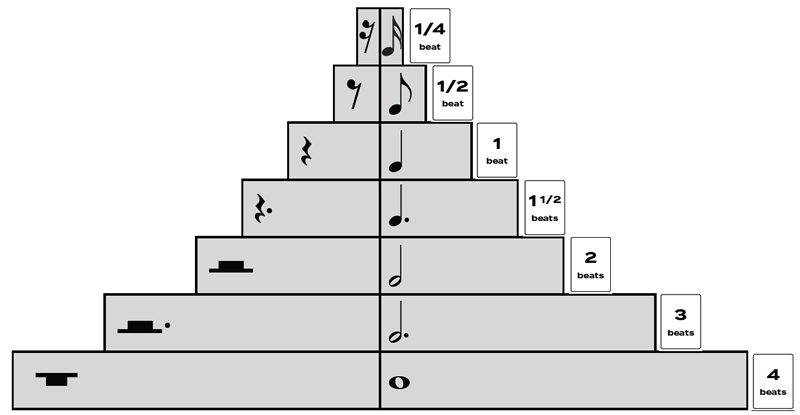
- Starting from the bottom, there are whole notes/rests (4 counts), dotted half notes/rests (3 counts), half notes/rests (2 counts), dotted quarter notes/rests (1 1/2 counts), quarter notes/rests (1 count), eighth notes/rests (1/2 count) – 1 flag/beam, and sixteenth notes/rests (1/4 count) – 2 flags/beams!
- These counts are accurate as long as the time signature has a “4” as the bottom number. (All the values change if there’s a different number at the bottom of a time signature, but we haven’t talked about this in class yet.)
- We played hopscotch again to review the WWHWWWH pattern of a major scale. The kids each got to take turns playing the song on the piano while the others jumped.
- We learned how to make wrist circles when we play up and down so we can look professional. Here is a link to see a video that demonstrates this as we play “Capture the Flag”. We want this motion to be smooth and very exaggerated for now. It will settle into a nice professional-looking motion as it gets practiced more over the next several weeks/months.
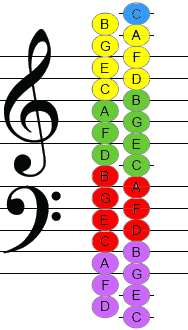 We built our alphabet on the grand staff using our 5 anchor C’s. We can sing our Music Alphabet song forwards (up) and backwards (down)!
Here’s this week’s homework assignment sheet and we’re doing the BLUE highlights! (You can click the image to open a PDF!)
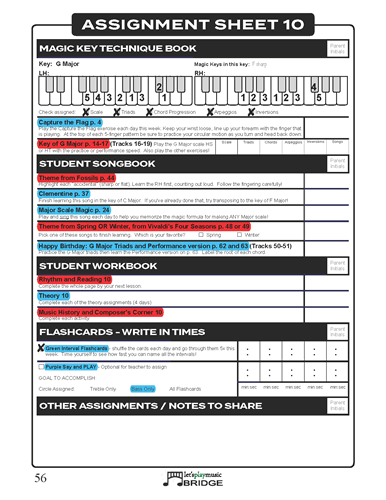
Remember to help get your child’s C-Major and F-Major exercises and songs passed off by sending me a video of each?(red book, pages 6 through 9 and 10-13)!?(I would like everyone in the class to pass these off!)?I would like them to play the?scales, triads, and progressions?HT?with the backtracks (9-11 for C and 13-15 for F). Arpeggios and inversions?can just be played as written in the book. I would also like them to play all 4 songs on pages 8 and 9?while singing. We will do this for every key we learn! It is best if they can pass off one key before getting too far into the next key. They don’t have to be perfect, but I do need to see that your child understands how to do them and they are trying their best. You can email, text, or Marco Polo those to me. There will be special prizes at the end of the year for passing off all the songs and scales!
Please be sure to do the flashcards! This will help with how fast your child can play the piano. We want to make seeing the note on the staff translate to playing the note on the keyboard happen AUTOMATICALLY! That will happen with practice!
Please let me know if you have any questions!
Have a musical day!
-Ms. Bethany 🙂
- We made a Counting Pyramid that helped us visualize the counts of each of our note and rest types and how they relate to each other.
-
<!-- InstanceBeginEditable name="doctitle" -->Orange Roots Newsletter<!-- InstanceEndEditable -->  Lesson #3
I can build a triad! From any note on the staff, I just add a 3rd and a 5th. Then guess what! I can move the notes around (as long as they stay on the same letter) and the root is still the same. If the chord isn’t in root position, then “the note above the gap’s the root” (just listen to the song… it explains it all!). We will continue to explore this concept in the coming weeks.
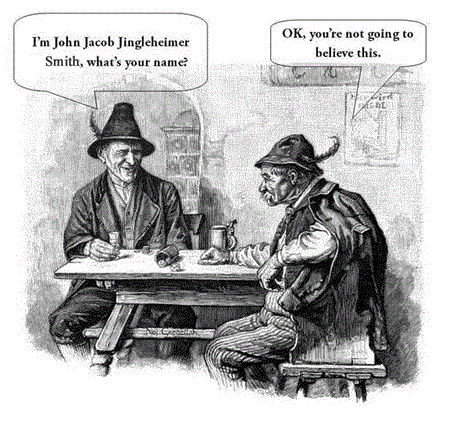 In “John Jacob Jingleheimer Smith” we found that it was missing a note in the first measure in the bass clef. We decided what note we should put there by finding out what the root of the chord was in the treble clef. We wrote some of the letter names in the space between the treble and bass clefs during class, but the kids were told to finish writing them at home.
While we are only practicing the first two lines of part I in “From the New World,” it would be easy to just simply ‘play’ it, but remember to not only sing the note names, (“e-g-g-e-d-c” etc.) but try singing the rhythm as well (“shoot-the half note” etc.) while playing it this week. Or you could even sing the counts! (1+ 2+ 3+ 4+…) This is a wonderful song to practice counting with.
For additional counting practice you can download the counting cards that were included in last week’s email. Make counting fun by using something unusual to keep a steady beat. For example: tap a cardboard box with a pencil, pat a balloon with a plastic spoon, or tap a metal pan with a wooden spoon! Let your child be creative and have fun with counting rhythms! This is a lifelong music skill that will be used in every musical endeavor your child chooses!

Online Fun:
Instead of using your purple flashcards, use these games onthe computer:
Say It & Play It (Grand Staff & Use Timer)
Flashcards (All Notes & Use Timer)John Jacob Jingleheimer Smith
This fun song from yourchildhood will get us learning a new style of bass root accompanying. Once we understand this we can improvise on a two handed marching style. It also is another opportunity to feel a half cadence. This song is also another opportunity to feel a half cadence (ends on a yellow chord instead of red).John Jacob Jingleheimer Smith I Can Build a Triad
Like the song says, “Pick any note to be the root… then add a third, and add a fifth!” Now that we are learning chord structure, our skipping snakes will help us to chant and spell each of our triads. Like any language, you speak (sing) it first, and then you can learn to write it. Want to practice making your own Skipping Snakes at home? Print out this PDF file and have fun with your own alphabet magnets at home! Homework theory answer key, all skills videos, and make-up videos for missed classes: (tap, click or scan)
 There are lots of different variations on our ‘John Jacob’ song. I remembered singing it as ‘Schmidt’ instead of ‘Smith’ as a kid, and instead of ‘look there he goes again’ we would just sing ‘la la la la la la la.’ It can be lots of fun to take a familiar tune and improvise in fun and crazy ways. Which way does your family like best? The Rock’n’Roll, the Sesame Street, or the Sing-a-Ma-Jig version??
Have a musical day!
-Ms. Bethany 🙂
-
<!-- InstanceBeginEditable name="doctitle" -->Blue Bugs Newsletter<!-- InstanceEndEditable --> 
 Homework theory answer key, all skills videos, and make-up videos for missed classes: (tap, click or scan)
 Grab a basketball and use the Let’s Play Music bugs to PLAY a game with the ball after you watch this video!
Have a musical day!
-Ms. Bethany 🙂
-
Document Lesson # 3 This semester has a few French songs to help expose the students to the sounds of the French language. We are not attempting to teach a broad vocabulary, fluency, or even proper pronounciation, but simply exposure. Please check out the link below (in the section entitled "Exposure to Languages") to see how this benefits your student far more than you may realize!  Next week’s songs:
 - Days of the Week
- The Shape Song
- Thread Follows Needle
- In My Class I Have Some Bells
- Mary, Mary Quite Contrary
- Miss Mary Mack
- The Button Factory
- If You Want to Speak in French
- The Blue Danube
- This Little River
Here is a Facebook video another teacher’s husband made for the song “If You Want to Speak in French” that goes over the pronunciation, if you want to be more precise than what we do in class. (I think you need to be logged in to Facebook to see it.)
Thank you for your enthusiastic participation in class! When you enjoy class activities you issuing a safe, non-threatening invitation for your child to also participate.
Even if your child is reserved and hesitant to fully engage in class, they are learning. Continue to encourage participation (but never force/bribe) and listen to the music often at home. Your example demonstrates how much fun making music can be!
Shapes: Recognizing the attributes of shapes is the same basic cognitive process children use in observing, comparing and discussing everything they encounter. Why Shapes, Shapes & Color Recognition
Exposure to Languages: Exposure to multiple languages varies their social experience and
helps children develop more effective social communication skills. Multilingual Exposure, Smarter Babies Understanding shape is foundational to cognitive development because shape is a primary source that infants and toddlers use to identify the objects around them. Eventually children will utilize this same cognitive process to observe, compare and discuss all they see and encounter.
Optional Home Fun Activity:
Color and cut out the shapes on page 29 of your workbook.Here is our Singable Storybook "Miss Mary Mack" for you to sing along with!
Music as a Social Bond: Synchronous movements such as clapping, bouncing, or dancing in time to music with infants have proven to help form social bonds between caregiver and child. (Department of Psychology, Neuroscience & Behavior at McMaster University) Sound Beginnings is education through musical play! It prepares children for success in Kindergarten and Let’s Play Music. Sound Beginnings provides research-based elements that stimulate growth in the areas particularly crucial to the development of the young child. These elements make up the foundation of the Sound Beginnings curriculum. Here is just one: 
In class we experience steady beat and imitate rhythmic patterns with our voices, bodies, and through hands-on use of instruments. We incorporate Eurythmics, which is movement-based rhythm training that is perfect for toddlers! Have a musical day!
-Ms. Bethany 🙂
-
<!-- InstanceBeginEditable name="doctitle" -->Yellow Arrows Newsletter<!-- InstanceEndEditable --> Lesson #3 Use this week to get your left hand red-blue chord transition solidified before we add the yellow chord next week. We should be getting to the point where we can play this transition with our eyes closed and even hands together! (That’s tricky because the fingering is different for the RH than the LH. Only try it hands together when the muscle memory is solid in each hand separately).
Celebrate Connection
Here are some practice tips to change things up. The winter blues might be setting in! Try putting red and blue stickers or candies on the keys that should be played for each chord. After practicing them a few times, they get to keep the stickers or eat the candies. Have a parent play through the practice and kiddo watches to be sure mom or dad is getting it right!
A few ideas to bring playfulness to practice time!- Play “Freeze ad Thaw” – Parent or child will say “start”. Child will play until parent randomly says “freeze”. Child will freeze until parent says “thaw”. Then trade places.
- Play your chords with a small washcloth or towel over your hands. Can you do it without peeking? Use your ears to tell you if you are playing the right notes. Make sure you always use the right fingers for each chord!
- Name that tune! In how few of notes can you name a song?
Online Fun:
Since we just added our final melodic pattern, check out this fun Melodic Pattern Matching Memory Game (Level 3) on my website!Caterpillar Song
WOW! Our caterpillars are getting smoother and steadier with this 5 finger pattern! As your child progresses playing this song, watch for these 4 things:- Bubble Hand—at beginning and end of playing, but eventually throughout. Visualize fingers stuck in bubble hand position with honey, caramel, glue, Velcro, etc. to keep them from flying away!
- Strong Independent Fingers—strike the key and make sure that finger comes up when you strike another note. Sing finger numbers with hands together.
- Smooth Sound—indicates finger strength and coordination. Remember SLOW is the way to GO!
- Steady Rhythm—fingers 1, 2, 3 are stronger and they like to go a little faster. Singing and emphasizing finger numbers 5-4-3-2-1-2-3-4-5, Ca-Ter-Pill-Ar, and the lyrics out loud will help keep a steady caterpillar.
This week we focused playing the “Turtle Shell” intervals with the left hand. Everyone agrees that it’s harder than the right hand! Using fingers 4 & 5 is tougher than using 1 & 2. Before playing, warm up with “Where is 4? Where is 5?” then have your child play the interval (a 2nd) with fingers 4 & 5. Repeat for the 3rd, 4th, and 5th. We tried hands together in class, but if that is too much, just focus on left hand only. Once your child masters the intervals with the left hand,THEN play hands together. Enjoy a little twist on the classic game Twister to reinforce and strengthen those finger numbers.
Love Somebody
We LOVE when our parents play along with us! Share more love with your child by playing and singing the melody an octave higher or accompanying together with the chords using the album. Ask your child to teach your family the ‘LOVELY’ game that accompanies this song!
I am Robin Hood
“I am Robin Hood” is used to introduce quarter rests and the dotted quarter – eighth note pattern. The philosophy that feeling a “pulling” feeling will promote correct performance of that particular rhythm pattern, is brought to life in a playful way through the “pulling” of arrows. The open 5th in the left hand is a particularly satisfying sound to young children, resembles the sound of drums and is easy to play! Homework theory answer key, all skills videos, and make-up videos for missed classes: (tap, click or scan) Teaching our students to read music using steps and skips leads to more fluent playing and better sight-readers. Echo Edna helps our students in class be able to recognize steps and skips on the staff, sing them, AND play them. Simon Says to Step or Skip is a fun game to practice this concept at home. You can print and cut out the cards here, or make your own and shuffle them in two different piles (one with step/skip and the other with up/down). ‘Simon’ chooses any note to start on, then chooses one card from each pile and invites the other person to follow those directions. After a few rounds, switch roles. Did you do as Simon Said? A fun way to add tactile and visual reinforcement is to use small pencil top erasers or any small toy as a starting note and then step or skip with another one. It’s so fun!
Have a musical day!
-Ms. Bethany 🙂
-
Bridge Lesson Lesson #10A
Here is what we did in class this week:
Online Fun:
Try this brand new interval game! (I just made it after class!) Interval Identification – Ear Training (Level 1)- We found some strategies to help us know when we’re hearing a 2nd interval.
- We can sing the major scale in our head: DO, RE.
- We can think about the beginning of “Hap-py Birth-day to You”… that’s a 2nd interval! DO, DO, RE, DO, FA, MI
- We found some strategies to help us know when we’re hearing a 3rd interval.
- We can sing the major scale in our head: DO, RE, MI.
- We can think of our Chords in Pieces song for the red chord: DO, MI, SOL.
- We can think about the beginning of “Oh When the Saints”… that’s a 3rd interval! DO, MI, FA, SOL
- We played a listening game to decide if what I was playing on the piano was a 2nd, 3rd, 4th, or 5th interval.
- We learned about Camille Saint-Saens and that he was an actual child prodigy. He was composing songs at the age of 3 and he was performing piano and organ concerts at age 7! He remembered everything he learned because he had a photographic memory. He was very good at math and learning languages. His most famous work is Carnival of the Animals, which he wrote as a fun joke to perform for his friends.
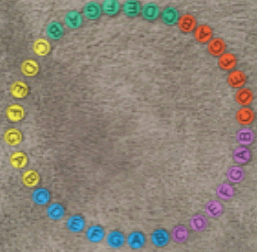 We practiced singing our musical alphabet by moving around the circle both forward AND backwards (C, B, A, G, F, E, D)!
Here’s this week’s homework assignment sheet and we’re doing the RED highlights! (You can click the image to open a PDF!)
Don’t forget to send videos of songs and scales! I want to see the tote bags covered in pins by the end of the semester!
Please let me know if you have any questions!
Have a musical day!
-Ms. Bethany 🙂
- We found some strategies to help us know when we’re hearing a 2nd interval.
-
<!-- InstanceBeginEditable name="doctitle" -->Orange Roots Newsletter<!-- InstanceEndEditable --> Lesson #2  We’re beginning a fun new way to celebrate how fast the kids know their note flashcards. It’s called the “In a Flash Club” and the kids get to compete against their own best time for how fast they can go over all their PURPLE NOTE FLASHCARDS. There’s a place in the homework each week where the kids are supposed to time themselves for how long it takes. This only needs to be done 3 times each week, not every practice. (And if they want to do their 3 times all in a row, that’s better than not doing it 3 times, so let them!) We will record their best time on a card in class so they can see how much better they get each week! The kids will also get “fish food” stickers to put in their fishbowl (in the back of their homework book) for each time they do “In a Flash” and “Say It, Then Play It” as part of their homework. If they do both of those the right amount of times, they will get one sticker for each of those. If their time is better than the previous week, they will get another sticker! So they can earn up to 3 "fish food" stickers each week! Let’s get those bowls so full of fish food that we can’t even see the fish! Both of these flashcard games are available on my website if your child would prefer using a computer than the purple flashcards. (Settings for both In a Flash and Say It, Then Play It should be Grand Staff and Use Timer.) Just write down the time it shows when the game ends.
We also began counting rhythms (very simple ones) today. If you would like to print out some practice counting pages for home, you can download them here: set 1, set 2, set 3. You can either cut each card apart, or you can randomly pick one for your child to clap and count. Just know this is completely optional and have fun with it!
Online Fun:
(content here)Echo Edison
The newest member of our Echo family has arrived. He is Echo Ed and Echo Edna’s grandfather! He doesn’t like when he gets echoed though. He likes to ask musical questions and have the kids give him musical answers. He will not only help us learn technique and play finger exercises in 5 keys, but is the vehicle for helping us create our compositions this semester!
Cadence Blues
Cadence Blues is actually ONLY printed in the key of C in your songbooks, but on your CD you have the ‘Blues’ in other keys. While playing in the key of F or G, you still have to read the song written in the key of C. That’s right! Your little musician will be transposing! Woot woot! Be sure to keep the music player near the keyboard to make practicing fun! (Trust me, it makes a world of difference!)
Monsters
The new puppet show is entitled Monsters. However, the real name of the puppet show is Montagues and Capulets, also known as Dance of the Knights and is from the ballet ‘Romeo and Juliet’ composed by Sergei Prokofiev. This puppet show is similar to many of our past puppet shows–it follows the ABA formula that composers love! But the themes are layered on top of each other, and we will further develop our ear training to distinguish the individual layers of sound.Musicians definitely have a sense of humor! Check out this fun video of a trick played on an orchestra conductor while playing our "Monsters" song!!
Homework theory answer key, all skills videos, and make-up videos for missed classes: (tap, click or scan) Wouldn’t it be funny if all the characters from our Monsters Puppet Show were actually just friends in their LPM (Lambda Pi Mu) fraternity at Monsters U??? Check it out in this fun post on our Let’s Play Music Blog! This is a GREAT resource to be able to isolate and hear all the different parts in the song.
Or watch this fun video of some Let’s Play Music students performing their own Monsters Ballet!
Have a musical day!
-Ms. Bethany 🙂
-
<!-- InstanceBeginEditable name="doctitle" -->Blue Bugs Newsletter<!-- InstanceEndEditable --> Homework theory answer key, all skills videos, and make-up videos for missed classes: (tap, click or scan) Meet the Blue Bugs! Enjoy reading about why we use rhythm syllables in Let’s Play Music.
If you like the “food language” chart in the middle of that page, just know that I’ve created a fun game using food words for rhythm! I’ll share it in a few weeks, after the kids are more familiar with the rhythms.
Have some fun building chords! Here’s a quick and easy game I made on my website! Can you put the solfege pieces in the correct triangles?
Have a musical day!
-Ms. Bethany 🙂