
 Lesson #12  No class next week because of Spring Break! Parents come the following week and final payment is due! If you are unsure if you are caught up on your payments or not, please just ask. All entries for the Spirit Month drawing are due this Saturday by 8:00pm. NO EXCEPTIONS. You MUST fill out this form if you wish to enter the drawing. You can text me a picture of your BINGO card if you didn’t bring it to class. I will be printing each child’s composition in a book that I will present each child at the recital. I will need to finalize their compositions this week so they are exactly the way the students want them, and so they have time to practice them. I want them to feel confident playing them in front of an audience. If any changes need to be made, please let me know ASAP! In class this week we got to experience harmonic dictation. We listened to more than one note played at a time and wrote it in our books. The students are getting really good at knowing the difference between how the red, blue and yellow chords sound! 
Our compositions are coming along great! Please be sure your student is introducing their piece (as it is written in their homework book) each time they practice it so they can be well prepared for our recital! The introduction should be memorized, but their composition doesn’t need to be… although it will help them feel more confident if they do! 
We are getting so good at playing our scales in F Major, G Major, and A minor. Check out this fun video to see what it would look like to play your scales with your feet!!! Have a musical day! -Ms. Bethany 🙂  |
-
Orange Roots #11
<!-- InstanceBeginEditable name="doctitle" -->Orange Roots Newsletter<!-- InstanceEndEditable --> Lesson #11 Notice that this week your child will be practicing most of the same things as Lesson #10. Here’s a video that covers some of the songs they will be practicing this week. PLEASE have your child watch it if they are struggling with the songs in the homework this week!
Be sure your child practices any new changes we have made to the composition. We have almost all finished our compositions and they sound great! I’m so proud of all my Orange Roots! Please make sure that your child practices their composition EVERY DAY. Use theory assignment #11 to help your student introduce their recital piece. They should practice saying it out loud EACH TIME they practice their composition. I want them to be prepared and confident at our recital.
Let’s Play Music BRIDGE is the next step for LPM graduates who want to keep growing as full musicians with a strong piano focus. Students build on everything they learned in Let’s Play Music while diving deeper into theory, technique, creativity, and performance. Bridge students gain confidence, fluency, and readiness for private lessons or any musical path. The two‑year format gives them time to grow steadily and feel successful without overwhelm. Register for Bridge today!
Online Fun:
Have you played this game yet?
Mystery Bug
The progress that we have made in developing our compositions has been exciting. Our homework is preparing us to perform our composition at our recital. Look how cute this spider is as he introduces his composition!
Homework theory answer key, all skills videos, and make-up videos for missed classes: (tap, click or scan)
 Your student will enjoy these clips of the winners from our National Composition Contest introducing and performing their compositions.
Have a musical day!
-Ms. Bethany 🙂
-
Orange Roots #10
<!-- InstanceBeginEditable name="doctitle" -->Orange Roots Newsletter<!-- InstanceEndEditable --> Lesson #10 Next week for private lessons have your child come 1-3 minutes early. If you haven’t already, start writing in possible elements to your child’s existing composition–a bridge, a coda, an introduction. Or at LEAST talk to your child about adding some elements and I can work my magic on my end. Either way, send their old composition (with any new notes) in addition to the homework booklet so I can still check practicing and homework (if I have time). I have added a supplemental video (below) that you can watch together this week to help generate some additional ideas for your child’s composition!
I will send a text with the times your child is expected to be here for their private lesson. If you need to make a change, please let me know ASAP!
Did you know that Echo Edison’s page in your orange songbook (pg. 9) is a GREAT warm up page for any song your child will be playing. See what key the song is in and play Edison’s questions and answers for that key. You can call it the “5 finger warmup!” Just for fun, your child can try improvising new QUESTIONS with the same answers!
I’m seeing fewer and fewer flashcard times as the semester progresses! Please don’t skip this part of the homework! If your child really doesn’t like flashcards (mine didn’t!), check out the online games I made.
Registration is now open for current students! Classes are just about full for next fall! Thanks to those that have already registered for Bridge. Remember, in Bridge parents don’t come to any classes!
I still have a few openings in my Sound Beginnings and 1st Year Let’s Play Music classes. I’ve also got an evening Sound Beginnings class for working parents! If you know of anyone who might be interested, I’m holding free preview classes for LPM and SB. PLEASE share this link to any friends you think might be interested in music classes: https://www.eventbrite.com/cc/free-preview-classes-at-musik-me-studio-1756869 Also, I LOVE having current students at my preview classes. Please sign up if you are able to come to either or both of the classes. I can’t do “make up” classes, but you can think of this as being a bonus class if you ever missed one… or even if you didn’t!
Did you see that I’m offering Ukulele classes and Recorder classes this spring and summer? Some of the kids in this class are old enough to enroll in those classes! Great for any siblings age 6-12 too!
Are you still working on your Spirit Month BINGO worksheets? I will have drawings for a MINI YOTO PLAYER, an mp3 player, egg shakers, cage bell set, tambourines, singable storybooks, CASH ($20, $10 & $5), and MORE! Here is the BINGO worksheet again, if you need another copy. They will be due on lesson #12, and you and your child can decide which prizes you want to put your tickets toward! I’ll do the drawing the following Friday.
Online Fun:
For flashcards that are easier than the acutal purple cards, check these games out!
Staff Flashcards
Say It & Play ItThe Circus
The official name of this puppet show is Symphony No. 1, 2nd movement by Gustav Mahler. Mahler named his entire first symphony ‘The Titan’. It was originally written as a symphonic poem, meaning that the music followed a “plot,” in five movements instead of the traditional four. The second movement, the finale of which we use as our circus puppet show, is labeled “Set With Full Sails.” Interestingly, this melody is in an Austrian folk dance form called a ländler (in 3/4 time). For those of you who like trivia, this is the dance from The Sound of Music during which Maria and Captain Von Trapp fall in love.
Composition Help (watch before next week’s private lesson) Homework theory answer key, all skills videos, and make-up videos for missed classes: (tap, click or scan) Check out this youth orchestra performing the music to our Circus puppet show live. These performers aren’t a whole lot older than your child! When you click on the link, listen carefully for some new music not on our soundtrack. Ask your child if it makes them think of a possible new character/theme for our show!
Have a musical day!
-Ms. Bethany 🙂
-
Orange Roots #9
<!-- InstanceBeginEditable name="doctitle" -->Orange Roots Newsletter<!-- InstanceEndEditable --> Lesson #9 Thank you, parents for attending this week!
SPIRIT WEEK IS UNDERWAY! Let me know if you need any substitutions for any of the squares. The BINGO card is in the Spirit Week email, if you lose yours and need to make a copy (or if you didn’t get one)! As a reminder, some of the drawing prizes are some instruments and an MP3 player that you can put your class music on!
One of the items on the BINGO card is to leave a Google review. I’m striving for a 5 star rating. If you don’t plan to give me 5 stars, please talk to me BEFORE you post a review so I can address any issues you may have. Unfortunately, negative feedback has much more impact than positive feedback does, so please give me the chance to earn 5 stars if I’m not already there. If you already left one previously, now is a good time to update it with additional comments! Thanks! Here is the link to post a review on Google: https://g.page/musikandmebethany/review
Bridge is a fun class for Let’s Play Music graduates that is a great “bridge” between Let’s Play Music classes and private lessons. I will be starting a new Bridge 1class next year, and will be teaching it as a 2-year program. Here is where you REGISTER for Bridge 1 and get more information. I’d love to see ALL the 3rd Year kids do Bridge! Even if you feel like they were a little behind in Let’s Play Music, there is lots of review and it is easier to personalize the songs to meet each student at their level. And if they were totally on top of Let’s Play Music, there’s still room for even more growth! And it is so much fun!
I just want to remind you of our new puppet show elements that can be incorporated into your student’s composition. We have the introduction, which is at the beginning of a piece, the coda, which is at the tail (end) of the piece, and the bridge that leads from one section to another, often when changing keys. If your child has changes they’d like to make before our private lesson in 2 weeks, feel free to take a picture and send it to me!
We’ve been working on our G Major scale this week. Don’t forget that the key of G has the F# as the magic key!
Online Fun:
Can you build a triad?
I Can Build a Triad!Bagatelle Bridges
This repertoire piece has all the elements that we’ve learned about in our puppet shows! It has an introduction, a CODA (special ending) and it has 2 BRIDGES. We will actually learn the theme in C Major and then we will get to show off our transposing skills to play it in F Major and G Major.
G Major Scale
This is the last of the major scales we will learn during our time in Let’s Play Music. All of our scales have taught us finger technique and strength, but also allowed us to understand key signatures and scale compositions. Just as our Magic Keys Song will tell us, "the F# is a ti which leads to DO on C" so don’t forget to play that F# on ti!!!G Major Scale a minor Cadence
Homework theory answer key, all skills videos, and make-up videos for missed classes: (tap, click or scan) 
Even Disney’s Aristocats know how important it is to practice their scales (and arpeggios)!Also, it’s in the book, but you can download additional coloring pages for our new Circus Puppet Show! Have your child color and cut them out, add sticks, and perform their very own circus puppet show for your family!
Have a musical day!
-Ms. Bethany 🙂
-
Orange Roots #8
<!-- InstanceBeginEditable name="doctitle" -->Orange Roots Newsletter<!-- InstanceEndEditable --> Lesson #8 Parents come next week, tuition is due, and SPIRIT MONTH is right around the corner! (You’ll receive a separate email with details.)
Registration will be happening soon. The fall schedule should be ready next week!
Thank you for sending the Marco Polo and text videos this week. It really helps us get through more fun things in class when we don’t need to take the time for each student to play their song during class. If you didn’t send a video yet, you still can!
We started working on the A minor scale and cadences this week! The best part about A minor is that the scale feels just like playing a C Major scale, with no sharps or flats! We did have to change our solfege words though. A minor scale is DO, RE, ME (pronounced “may”), FA, SOL, LE (pronounced “lay”), TE (pronounced “tay”), DO. Our cadences are almost the same, but when we play the yellow chord, we do have to remember to play the G#!
Our dictation exercise was different today. We had all the same notes, but we had to listen to the rhythm and write the rhythm we heard. We also practiced drawing a bass clef, which is also called the “F clef” because the big dot is on the F line and the two dots are on both sides of the F line.
Next week we will do Showtime as a class with New World Symphony. Have your child practice the part they want to play in class and we’ll all play our parts at the same time to make a beautiful ensemble!
Students should now have all orange rhythm flashcards unbanded so they can practice all 16 cards!
Optional: if you’d like to have your student practice more rhythms in a super fun way, you can print off these orange counting cards: set 1, set 2, set 3. There are 3 sets with 2 pages each. You can print them front-to-back and you’ll have the same rhythms with bugs to help on one side and no bugs on the other side!
Online Fun:
Looking for steps and skips makes reading music faster! Here’s a fun game to review steps and skips:
Name That Tune
(Remember, the tone bells are the same as the white keys on the keyboard!)Russian Sailor Dance
This song is ALWAYS a student favorite. Another great repertoire piece that reinforces ABA form, improvisations, and provides a study in legato and staccato themes. But it’s the the accelerando at the end that will have your student BEGGING to practice it all the time! This song may start out slowly (maybe even feel boring!), but just wait until you see the end!a-minor Scale Russian Sailor Dance Homework theory answer key, all skills videos, and make-up videos for missed classes: (tap, click or scan) Have you already found a private teacher for when your student graduates from Let’s Play Music? It is best if you can meet in person with the teacher before the summer break to help the new teacher get to know your child’s progress while its still fresh. Here is a great post on our Let’s Play Music Blog with tips on how to interview and what to look for in a private teacher.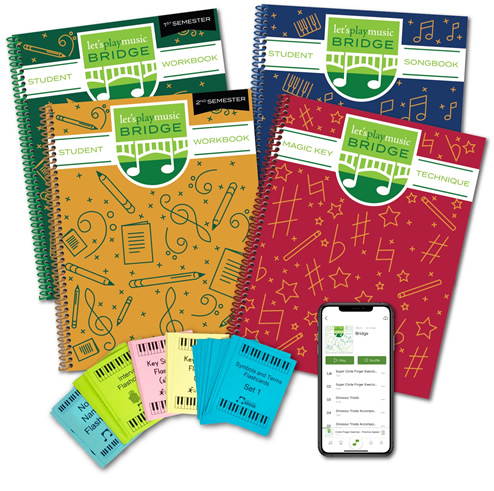 Bridge is a really fun class for Let’s Play Music graduates that is a great “bridge” between Let’s Play Music classes and private lessons. I will be starting a new Bridge class next year, teaching it as a 2-year program. The kids will learn lots of new songs, scales, musical concepts, and so much more! It is more self-paced than LPM, so it’s perfect for if you feel like your child has missed out on some musical concepts or skills in Orange Roots. There is enough review that your child won’t feel "behind" if they missed a concept from LPM, and there is enough new material that your child won’t be bored either! If you are interested, let me know and I’ll get you more information.Have a musical day!
-Ms. Bethany 🙂
-
Orange Roots #7
<!-- InstanceBeginEditable name="doctitle" -->Orange Roots Newsletter<!-- InstanceEndEditable --> Lesson #7 We learned the real names of our chords today! While it seems like most of the kids understood this concept, I’m posting this video to show you parents how we discovered the names during class. Feel free to watch this video on your own or with your child. This is another teacher (the creator of LPM!) demonstrating what we did in class.
We started playing the blue chord in its inversions today. We used counters on the keyboards – putting them on middle C, F and A, (which is actually 2nd inversion) and then jumped the first blue counter up to the next octave C – for the root position version of this triad. Remember, the letter names stay the same, the order is just mixed up! Here’s a quick demo video to help visualize how this works. Go ahead and try it with your child. Build a blue chord with 3 little erasers or small toys. Then jump the bottom note up to the next same note and keep going!
Showtime is back! While we haven’t been playing this in class, your child has been practicing “Cockles and Mussels” at home. Please send me a Marco Polo video or a video text message of your child playing it so I can be sure they understand the concepts we’re working on for this song.
Registration for next fall begins IN JUST A COUPLE WEEKS! I need to know how many BRIDGE classes I will be putting on my schedule. Please fll out this survey so I can get an idea of what my schedule should look like. I want to make sure you have the class time that works best for my students that have been with me for so long!
Have your children continue to practice their recital pieces. Don’t forget, it is THEIR composition and if they want to add to it or change anything, they are allowed to do that until lesson #11, when we have our next and final private lesson. You can send me revisions by text or email or send it with your child to class next week. They can use the lined pages in their composition section of their songbook to add extra music, such as a B part, if they so desire.
Online Fun:
Review music symbols with this fun memory game:
Music Symbol MatchingDO is Home
While finding a pitch (out of thin air) through audiation isn’t a new thing for our Let’s Play Music student, we are now switching it up. We started to find ‘fa’ and make F home instead of C and now we will make G home, instead of C and F. We are always doing this relative to Middle C to continually reinforce the sound of Middle C and to teach relative pitch.
Scale Degrees
Actually numbering the steps of the scale as ‘scale degrees‘ is the first step in transitioning out of calling our primary chords by colors. The Red, Blue, and Yellow chords are respectively the I, IV and V chord (we call ’em 1, 4, and 5) and they get their chord names because their root is that numbered scale degree within the scale. Here’s a fun ASL visual to help remember them: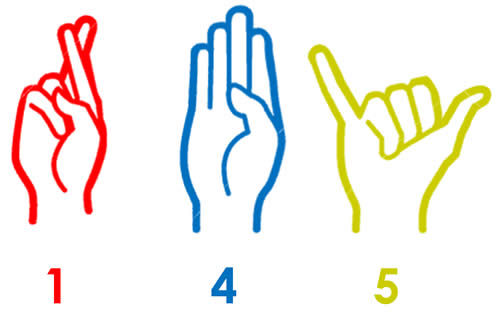 (R)ED: When your fingers are stuck together, they look like a number 1
(B)LUE: You are holding up 4 fingers
(Y)ELLOW: You are holding up finger 1 and finger 5.C Major and F Major Scales Homework theory answer key, all skills videos, and make-up videos for missed classes: (tap, click or scan) Did you know that your little musician has super powers? They really do!!!
Have a musical day!
-Ms. Bethany 🙂
-
Orange Roots #6
<!-- InstanceBeginEditable name="doctitle" -->Orange Roots Newsletter<!-- InstanceEndEditable --> Online Fun:
Check out these two fun staff note games:
What’s the Word
Play the WordComposition
The composition is the culminating event for your Let’s Play Music student! We have been experiencing, internalizing, and now labeling many things over our three year development as a young musician. We will rely on our knowledge of: major and minor, time signatures, chord uses and sounds, ABA song form, staccato and legato, theme and variations, block, broken, and marching chords, and MANY other skills that will help your child as they compose and create their own original composition. We’ve got a starting point, now I’ll encourage implementing more of these musical attributes to really make their composition musical!Homework Help Compsition Help Start with Melody Start with Rhythm Start with Chords Homework theory answer key, all skills videos, and make-up videos for missed classes: (tap, click or scan) Watch this video of a young prodigy composer who pulls four musical notes out of hat, improvising and composing a piano sonata in under a minute.
Have a musical day!
-Ms. Bethany 🙂
-
Orange Roots #5
<!-- InstanceBeginEditable name="doctitle" -->Orange Roots Newsletter<!-- InstanceEndEditable --> Lesson #5 Thank you parents for coming this week! Your participation plays such a big role in your child’s success! Don’t forget tuition is due for those of you that didn’t pay for the semester up front. You can pay through Zelle (using my phone number) or Venmo me (@musikandme).
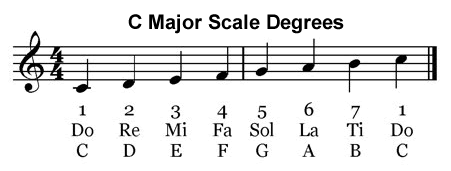
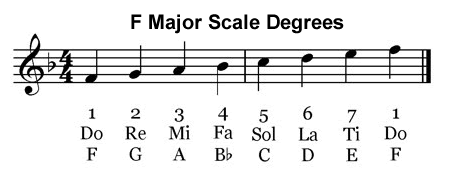
Here’s a little help with this week’s theory assignment. In a major scale, we start numbering each note at 1 and because it begins to repeat after number 7, we go back to 1. This is the same way we go back to DO or C.
 Even though the students cannot play all three parts of New World at the same time, you (the parent) should be able to play a part or two with them at home. Have fun playing as a family ensemble!
This next week I will be meeting with your child in their 1st private lesson to begin creating their composition. We have been working during class to brainstorm ideas we might like to use, and have been encouraging ‘tinkering’ at the keyboard at home. Please encourage your child to be thinking about a musical question (and maybe an answer) that we could work on together next week. This could be a simple melody or some chords that they have written down, can play, or even just hum. Or if they have specific characters they want in their song, they can write a short melody for each character. This is only the beginning of this process, so I’m not looking for you to send a ‘finished’ product. Feel free to watch the supplemental videos with your child (links down below). Please send your child with their Orange Roots Songbook so we can look over their Composer’s Corner activities together. Thanks!
I’ll text the schedule for next week’s 20 minute private lesson. Please have your child watch the “Composition Help” video right away to spark ideas for how to write their composition. They don’t need to write anything beforehand if they don’t want to, but watching the video will help them feel more confident when they come to the private lesson. If you watch it with your child, you will see just how simple it can be to compose a song!
PLEASE be on time for drop off and pick up! This private lesson is only for the students, but if you need to come stay warm inside, you are welcome to!
Online Fun:
Use the timer option to substitute for doing purple flashcards! (just write your time!)
Flashcards – Staff to Letter
Say It & Play It – Staff to Letter to KeyboardComposition
The composition is the culminating event for your Let’s Play Music student! We have been experiencing, internalizing, and now labeling many things over our three year development as a young musician. We will rely on our knowledge of: major and minor, time signatures, chord uses and sounds, ABA song form, staccato and legato, theme and variations, block, broken, and marching chords, and MANY other skills that will help your child as they compose and create their own original composition.Magic Keys
This is our 2nd song to graduate up with us from our purple semester. As we continue to sing (and play this song) we will further expand our understanding of key signatures and note relationships–This is the KEY in transposing music. Our new verse allows us to understand and play in the key of G Major, with our new magic key, F#.G Major Cadence 
Composition Help Here are 3 helpful videos that break down 3 different ways to start a song. Your child might like to try one of these ways: Start with Melody, Start with Rhythm, Start with Chords.
Homework theory answer key, all skills videos, and make-up videos for missed classes: (tap, click or scan) Inspiration for composition can come in many ways. A man saw birds sitting on telephone wires and it inspired him to create his own composition. Can’t wait to see where all of our students get their inspiration from! Excited to meet them all individually next week.
Have a musical day!
-Ms. Bethany 🙂
-
Orange Roots #4
<!-- InstanceBeginEditable name="doctitle" -->Orange Roots Newsletter<!-- InstanceEndEditable --> Lesson #4 Parents come next week and tuition is due for those of you that didn’t pay for the semester up front. You can pay through Zelle (using my phone number) or Venmo me (@musikandme).
We started working on chord inversions this week. Use the red stickers on the cover of your child’s homework booklet to help them easily jump from inversion to inversion. Starting on Middle C, put 6 red stickers on your keyboard at home as shown on Lesson 4. of your student manual. The stickers should be placed on middle C, middle E, middle G and treble C (the C above middle C), treble E and treble G. The 3 heart erasers are meant to be placed on the first 3 keys with red stickers, then moved up one at a time to the next matching note as they change hand shape to match the notes being played. Once they understand the concept, they can just look at the stickers to see where their fingers should go. (Remember, these are ALL red chords, and we’re just playing the same pieces in a different order.)
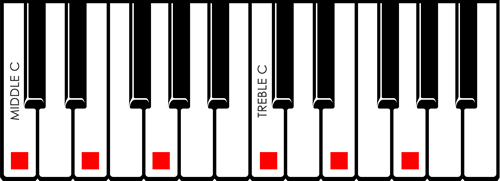
Please, please make sure your child is using the correct fingers listed in the book. I made a chart for quick reference:
Chords
Correct Fingering Shape Left Hand Right Hand Snowman 5-3-1 1-3-5
Top Heavy 5-2-1
1-3-5 Bottom Heavy 5-3-1
1-2-5
We learned how to play the F Major scale! We play the left hand the same as in a C Major scale (don’t forget the B-flat)! The right hand is DIFFERENT! We learned a fun chant to help us remember what fingers to use:
For going up: 1-2-3-4, 1-2-3-4. Different than I played before!
And for going down: 4-3-2-1, 4-3-2-1. Wow, my F scale’s lots of fun!Do NOT have your child play hands together until they can do both LH and RH independently! We want them to feel successful, not frustrated!
 We reviewed that eighth notes have one beam (the horizontal line) holding them together. They get half a count when bugs (quarter notes) get one. They are counted out loud: "one and two and three and four and".
 Sixteenth notes have two beams and they get 1/4 of a count. They are counted out loud: "one ee and a two ee and a three ee and a four ee and a". We write this a little more simply (as shown in the homework).
Be sure to look at reference pages 50 and 51 in your homework book if you need a little clarification. If you still can’t make heads or tails of it, please ask me! I know this is just as new to some of the parents as it is to the students.
Online Fun:
Beat Value Matching Memory GameCockles and Mussels
Here’s a video of how the LH chords step up and stay in root position. It also shows how to play broken chords if your student would like something additional to work on!Inversions / Mixed Paint
New World Symphony
We actually HAVE played our yellow and blue chords in inversions–we just didn’t realize it. We are now ready to take a root position chord and ‘invert’ it. This just means re-arranging the pieces. The chord is still CEG, but C moves to the top, then the E moves to the top, then the G and you are in root position again. We will play Old Paint in a new ‘Mixed’ up way to help us hear that it’s still a red chord no matter matter if it is in root position, 1st inversion or 2nd inversion. No matter what the shape or order is, it just has to retain the same ‘pieces’ (in this case C-E-G) for it to be a red (C) chord. Be sure to add your stickers to your keyboard! (See diagram above!)
Our Let’s Play Music students have created harmony in many different ways in 1st and 2nd year. Now in 3rd year we have the unique opportunity to play as an ensemble in class to produce harmony and a much fuller sound than they can accomplish playing by themselves. By listening to the CD, the children are provided the opportunity to model and to audiate the music in their heads as they practice.
Our Bugs are So Fun! (new verse)
A few of our songs from our purple CD have upgraded to our orange CD–with some new lyrics! The new verse in ‘Our Bugs are So Fun!’ will help us to learn to count those tricky ‘beamed’ rhythms that include eighth notes and sixteenth notes! If counting in this new way seems tricky, here is a parent help page that dissects the lyrics to Our Bugs are So Fun! with visual examples and simple explanations to help.How to Play C Chord Inversions How to Play F Major Scale Cockles & Mussels Broken Chords
Homework theory answer key, all skills videos, and make-up videos for missed classes: (tap, click or scan) Check out this young group of musicians experiencing the value of playing as an ensemble. Your student will recognize this piece as our very own Largo from New World Symphony by Antonin Dvorak.
Have a musical day!
-Ms. Bethany 🙂
-
Orange Roots #3
<!-- InstanceBeginEditable name="doctitle" -->Orange Roots Newsletter<!-- InstanceEndEditable --> Lesson #3 I can build a triad! From any note on the staff, I just add a 3rd and a 5th. Then guess what! I can move the notes around (as long as they stay on the same letter) and the root is still the same. If the chord isn’t in root position, then “the note above the gap’s the root” (just listen to the song… it explains it all!). We will continue to explore this concept in the coming weeks.
 In “John Jacob Jingleheimer Smith” we found that it was missing a note in the first measure in the bass clef. We decided what note we should put there by finding out what the root of the chord was in the treble clef. We wrote some of the letter names in the space between the treble and bass clefs during class, but the kids were told to finish writing them at home.
While we are only practicing the first two lines of part I in “From the New World,” it would be easy to just simply ‘play’ it, but remember to not only sing the note names, (“e-g-g-e-d-c” etc.) but try singing the rhythm as well (“shoot-the half note” etc.) while playing it this week. Or you could even sing the counts! (1+ 2+ 3+ 4+…) This is a wonderful song to practice counting with.
For additional counting practice you can download the counting cards that were included in last week’s email. Make counting fun by using something unusual to keep a steady beat. For example: tap a cardboard box with a pencil, pat a balloon with a plastic spoon, or tap a metal pan with a wooden spoon! Let your child be creative and have fun with counting rhythms! This is a lifelong music skill that will be used in every musical endeavor your child chooses!
Online Fun:
Instead of using your purple flashcards, use these games onthe computer:
Say It & Play It (Grand Staff & Use Timer)
Flashcards (All Notes & Use Timer)John Jacob Jingleheimer Smith
This fun song from yourchildhood will get us learning a new style of bass root accompanying. Once we understand this we can improvise on a two handed marching style. It also is another opportunity to feel a half cadence. This song is also another opportunity to feel a half cadence (ends on a yellow chord instead of red).John Jacob Jingleheimer Smith I Can Build a Triad
Like the song says, “Pick any note to be the root… then add a third, and add a fifth!” Now that we are learning chord structure, our skipping snakes will help us to chant and spell each of our triads. Like any language, you speak (sing) it first, and then you can learn to write it. Want to practice making your own Skipping Snakes at home? Print out this PDF file and have fun with your own alphabet magnets at home! Homework theory answer key, all skills videos, and make-up videos for missed classes: (tap, click or scan) There are lots of different variations on our ‘John Jacob’ song. I remembered singing it as ‘Schmidt’ instead of ‘Smith’ as a kid, and instead of ‘look there he goes again’ we would just sing ‘la la la la la la la.’ It can be lots of fun to take a familiar tune and improvise in fun and crazy ways. Which way does your family like best? The Rock’n’Roll, the Sesame Street, or the Sing-a-Ma-Jig version??
Have a musical day!
-Ms. Bethany 🙂