
 Lesson #10  Next week for private lessons have your child come 1-3 minutes early. If you haven’t already, start writing in possible elements to your child’s existing composition–a bridge, a coda, an introduction. Or at LEAST talk to your child about adding some elements and I can work my magic on my end. Either way, send their old composition (with any new notes) in addition to the homework booklet so I can still check practicing and homework (if I have time). I have added a supplemental video (below) that you can watch together this week to help generate some additional ideas for your child’s composition! I will send a text with the times your child is expected to be here for their private lesson. If you need to make a change, please let me know ASAP! Did you know that Echo Edison’s page in your orange songbook (pg. 9) is a GREAT warm up page for any song your child will be playing. See what key the song is in and play Edison’s questions and answers for that key. You can call it the “5 finger warmup!” Just for fun, your child can try improvising new QUESTIONS with the same answers! I’m seeing fewer and fewer flashcard times as the semester progresses! Please don’t skip this part of the homework! If your child really doesn’t like flashcards (mine didn’t!), check out the online games I made. Registration is now open for current students! Classes are just about full for next fall! Thanks to those that have already registered for Bridge. Remember, in Bridge parents don’t come to any classes! I still have a few openings in my Sound Beginnings and 1st Year Let’s Play Music classes. I’ve also got an evening Sound Beginnings class for working parents! If you know of anyone who might be interested, I’m holding free preview classes for LPM and SB. PLEASE share this link to any friends you think might be interested in music classes: https://www.eventbrite.com/cc/free-preview-classes-at-musik-me-studio-1756869 Also, I LOVE having current students at my preview classes. Please sign up if you are able to come to either or both of the classes. I can’t do “make up” classes, but you can think of this as being a bonus class if you ever missed one… or even if you didn’t! Did you see that I’m offering Ukulele classes and Recorder classes this spring and summer? Some of the kids in this class are old enough to enroll in those classes! Great for any siblings age 6-12 too! Are you still working on your Spirit Month BINGO worksheets? I will have drawings for a MINI YOTO PLAYER, an mp3 player, egg shakers, cage bell set, tambourines, singable storybooks, CASH ($20, $10 & $5), and MORE! Here is the BINGO worksheet again, if you need another copy. They will be due on lesson #12, and you and your child can decide which prizes you want to put your tickets toward! I’ll do the drawing the following Friday. 
The Circus

Check out this youth orchestra performing the music to our Circus puppet show live. These performers aren’t a whole lot older than your child! When you click on the link, listen carefully for some new music not on our soundtrack. Ask your child if it makes them think of a possible new character/theme for our show! Have a musical day! -Ms. Bethany 🙂  |

-
<!-- InstanceBeginEditable name="doctitle" -->Blue Bugs Newsletter<!-- InstanceEndEditable --> 
 Homework theory answer key, all skills videos, and make-up videos for missed classes:
 (tap, click or scan)
 The homework for lesson 10 is the beginning skill of dictation. Dictation is the ability to write music, knowing where to put the notes is the first step. We are preparing them to write their own composition in the 3rd Year of Let’s Play Music! Your kids are getting so smart!
Music can change lives! It can be anywhere and it can be beautiful! What a gift you are giving your children! Check out how in this video.
Have a musical day!
-Ms. Bethany 🙂
-
<!-- InstanceBeginEditable name="doctitle" -->Yellow Arrows Newsletter<!-- InstanceEndEditable -->  Lesson #10
This week we played broken chords with the LH. It is imperative we play all chords with correct fingerings as this transfers over to every chord structure with all 12 major and 36 minor keys!!!
Continue to solidify the Right Hand, RH, and LH Red, Blue, and Yellow Chords! Watch that fingering, it makes a big difference when done correctly. (I can tell that some of the students aren’t practicing it correctly at home because they aren’t doing it correctly in class!)
Celebrate Connection
A few ideas to make practice more playful!
- One day this week, have Mom or Dad be the student. Show them where to place their hands, what chord/note to play, how to look up at the notes, and YOU point to each note as they play. Watch for nice bubble hands! Sometimes being a teacher is the best way to prove that you’ve learned something!
- Play your piece backwards. Start on the last measure and work your way to the front.
- Play through your piece replacing Mr. Rests with a “shh”
Registration is now open for current students! Classes are just about full for next fall! Thanks to those that have already registered for 3rd Year. Remember, in 3rd year the parents only come five times a semester!
I still have a few openings in my Sound Beginnings and 1st Year Let’s Play Music classes. I’ve also got an evening Sound Beginnings class for working parents! If you know of anyone who might be interested, I’m holding free preview classes for LPM and SB. PLEASE share this link to any friends you think might be interested in music classes: https://www.eventbrite.com/cc/free-preview-classes-at-musik-me-studio-1756869 Also, I LOVE having current students at my preview classes. Please sign up if you are able to come to either or both of the classes. I can’t do “make up” classes, but you can think of this as being a bonus class if you ever missed one… or even if you didn’t!
Did you see that I’m offering Ukulele classes and Recorder classes this spring and summer? Some of the kids in this class are old enough to enroll in those classes! Great for any siblings age 6-12 too!
Are you still working on your Spirit Month BINGO worksheets? I will have drawings for a MINI YOTO PLAYER, an mp3 player, egg shakers, cage bell set, tambourines, singable storybooks, CASH ($20, $10 & $5), and MORE! Here is the BINGO worksheet again, if you need another copy. They will be due on lesson #12, and you and your child can decide which prizes you want to put your tickets toward! I’ll do the drawing the following Friday.

Online Fun:
Do you remember the pieces of our chords?
Primary Chord TrianglesThe Wheels on the Bus sing Melodic Patterns
Melodic patterns are found in every song. How many Sol-Mi-Do’s and Sol-Sol-Do’s can you hear in this version of a favorite childhood song?I Gotta Shake
Get ready to play the rests in this silly song! Our fingers must rest from playing or holding down the note when we see a quarter rest sign. 1st say ‘sh’ or ‘rest’ while playing. Then play again hearing the rest inside while playing the silence in the song.How to Skip
Keep skipping with fingers 1-3-5 in the RH saying the middle anchor notes. Play the LH separate while singing 1st the chord color and 2nd the melody with this favorite song. We will put hands together soon!Tinga Layo
Duet time with shakers! Invite your child to play the chords on the piano while you or a sibling play “shoot-the-bug-bug” rhythm with a shaker. Switch! Make your own shaker with rice, beans, pennies, small beads, etc. in a plastic egg, empty spice container, or baby food jar. Shake away! Homework theory answer key, all skills videos, and make-up videos for missed classes: (tap, click or scan)
 Charles Gounod was born in 1818 in Paris, France. His mom was a piano teacher and his father was an artist, so he started receiving music instruction very early in his life. He attended excellent musical schools. By the time he was 21, he was receiving awards and prizes for his compositions. He also taught other musicians, most notably, Georges Bizet. Today people still recognize his songs, O Divine Redeemer, Ave Maria, and Funeral March for a Marionette (our current puppet show known as March of the Gnomes!) Can you hear the kings heavy down beat in this recording?
Have a musical day!
-Ms. Bethany 🙂
-
Document 
Lesson # 10 
 Next week’s songs:
 - Days of the Week
- Acka Backa
- The Shape Song
- Name the Instruments (French horn, clarinet, triangle, trumpet, bass)
- Jack and Jill
- Lady with the Alligator Purse
- Six Little Ducks
- Celebration Dance (Horn Concerto #4)
- Il Court Il Court Le Furet
- Un Elephant
- The Water is Wide
Believe it or not, our semester of musical fun is quickly coming to a close! I would love to have you join us for more musical adventures. The next semester of Sound Beginnings will be Black Spiders. I hope to see you all there…well, most of you!
For those of you with a child that will be age 4 by September 1st, I invite you to come to a Let’s Play Music free preview class. You can sign up here: https://www.musikandme.com/Preview-Class. I encourage you to invite a friend to join you too!
You can learn more about Let’s Play Music on my website: www.musikandme.com It’s similar to Sound Beginnings, but not really! It’s a 3-year total musicianship program where kids will learn piano skills, music theory, classical music appreciation, in-tune singing, and SO MUCH MORE, all through play!

Cultural Importance of Dance
Dance has long been used throughout the world to celebrate festivals, births, weddings, crop harvests, or other important occasions. Simple Overview, Basic Timeline/HistoryNext Semester
Our next semester of Sound Beginnings classes is Black Spiders! In addition to creepy crawlies we will learn about trains, manners, and the months of the year. You’ve already received a separate email with registration information. Be sure to check it out if you haven’t already! The Early Bird Special ends soon!
We love our sing-along books in Sound Beginnings! Besides being fun, reading aloud to young children has many benefits. To name a few: - It varies the vocabulary to which children are exposed.
- It affects brain activity associated with visual imagery.
- It enhances concentration.
- It develops creativity and encourages imagination.
- It strengthens social, emotional and character development.
Optional Home Fun Activity:
Make the alligator purse on page 25 in the workbook — it’s a great place to store your shape buttons! 🙂Here is a video with our Celebration Dance! It’s really called Horn Concerto #4 by Mozart. It’s a little longer here than what we do in class, but it shows the instruments playing it…especially the French horn! (You can see just how big the bass actually is – there are two of them in the back at time 0:36!)  Language Development
Babies learn words more easily when they are accompanied by simple melodies. Singing folk
songs, rhymes, and other child-friendly repertoire exposes them to new vocabulary.
Sound Beginnings is education through musical play! It prepares children for success in Kindergarten and Let’s Play Music. Sound Beginnings provides research-based elements that stimulate growth in the areas particularly crucial to the development of the young child. These elements make up the foundation of the Sound Beginnings curriculum. Here is just one: 
In class we experience steady beat and imitate rhythmic patterns with our voices, bodies, and through hands-on use of instruments. We incorporate Eurythmics, which is movement-based rhythm training that is perfect for toddlers! Have a musical day!
-Ms. Bethany 🙂
-
Bridge Lesson 
Lesson #12B
Here is what we did in class this week:
Online Fun:
Just a reminder, you can do your flashcards ONLINE!
Flashcards – Grand Staff
Interval Identification (Level 3)We learned about the legend of William Tell and started playing the William Tell Overture, which is the song we used for "Fox Hunt" in our Blue Bugs semester. We’re going to try to play that song HT from the start, but take it slowly at first.
We learned about accents and how they mean to make that note louder.
Here’s what a note looks like if it is accented: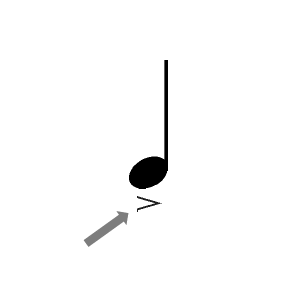
We played "One Potato" as we passed beanbags around a circle to the beat. We could feel the accent each time we said a number and passed it. Our song Willliam Tell Overture has lots of accents in it! Those notes all should be louder.
I’d like to see anything the kids have done on their compositions. I want them to play something at the recital/showcase at the end of the semester. Please send an email attachment or text a picuture to me of anything they have done so I can update it on my end and we can finalize their pieces soon!
I’m planning to teach classes for Recorder and Ukulele this spring/summer! Either of these would be a fun addition to the piano knowledge the kids are gaining! Click the links to find out more about each!
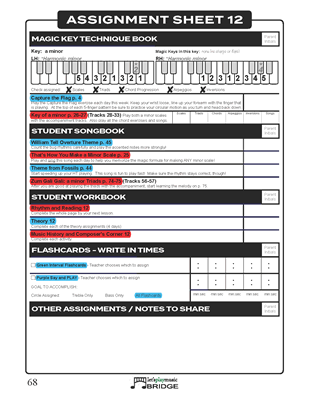
Here’s this week’s homework assignment sheet and we’re doing the BLUE highlights! (You can click the image to open a PDF!)
For this class, consider yourself already registered. Materials have already been purchased. We’ll just call it a continuation from this semester. The cost will be the same as it was this year.
Please let me know if you have any questions!
Have a musical day!
-Ms. Bethany 🙂
-
<!-- InstanceBeginEditable name="doctitle" -->Orange Roots Newsletter<!-- InstanceEndEditable --> Lesson #9 Thank you, parents for attending this week!
SPIRIT WEEK IS UNDERWAY! Let me know if you need any substitutions for any of the squares. The BINGO card is in the Spirit Week email, if you lose yours and need to make a copy (or if you didn’t get one)! As a reminder, some of the drawing prizes are some instruments and an MP3 player that you can put your class music on!
One of the items on the BINGO card is to leave a Google review. I’m striving for a 5 star rating. If you don’t plan to give me 5 stars, please talk to me BEFORE you post a review so I can address any issues you may have. Unfortunately, negative feedback has much more impact than positive feedback does, so please give me the chance to earn 5 stars if I’m not already there. If you already left one previously, now is a good time to update it with additional comments! Thanks! Here is the link to post a review on Google: https://g.page/musikandmebethany/review
Bridge is a fun class for Let’s Play Music graduates that is a great “bridge” between Let’s Play Music classes and private lessons. I will be starting a new Bridge 1class next year, and will be teaching it as a 2-year program. Here is where you REGISTER for Bridge 1 and get more information. I’d love to see ALL the 3rd Year kids do Bridge! Even if you feel like they were a little behind in Let’s Play Music, there is lots of review and it is easier to personalize the songs to meet each student at their level. And if they were totally on top of Let’s Play Music, there’s still room for even more growth! And it is so much fun!
I just want to remind you of our new puppet show elements that can be incorporated into your student’s composition. We have the introduction, which is at the beginning of a piece, the coda, which is at the tail (end) of the piece, and the bridge that leads from one section to another, often when changing keys. If your child has changes they’d like to make before our private lesson in 2 weeks, feel free to take a picture and send it to me!
We’ve been working on our G Major scale this week. Don’t forget that the key of G has the F# as the magic key!
Online Fun:
Can you build a triad?
I Can Build a Triad!Bagatelle Bridges
This repertoire piece has all the elements that we’ve learned about in our puppet shows! It has an introduction, a CODA (special ending) and it has 2 BRIDGES. We will actually learn the theme in C Major and then we will get to show off our transposing skills to play it in F Major and G Major.
G Major Scale
This is the last of the major scales we will learn during our time in Let’s Play Music. All of our scales have taught us finger technique and strength, but also allowed us to understand key signatures and scale compositions. Just as our Magic Keys Song will tell us, "the F# is a ti which leads to DO on C" so don’t forget to play that F# on ti!!!
G Major Scale a minor Cadence
Homework theory answer key, all skills videos, and make-up videos for missed classes: (tap, click or scan) 
Even Disney’s Aristocats know how important it is to practice their scales (and arpeggios)!Also, it’s in the book, but you can download additional coloring pages for our new Circus Puppet Show! Have your child color and cut them out, add sticks, and perform their very own circus puppet show for your family!
Have a musical day!
-Ms. Bethany 🙂
-
<!-- InstanceBeginEditable name="doctitle" -->Blue Bugs Newsletter<!-- InstanceEndEditable --> Homework theory answer key, all skills videos, and make-up videos for missed classes: (tap, click or scan)  Our new puppet show was written by Gioachino Antonio Rossini, who was born on February 29 (leap year!), 1792 in Italy to a family of musicians. His father played the horn and his mother was a singer. He was just six years old when he joined his father’s band – he played the triangle. When he was only 10 years old, he was asked often to play the piano and sing at their church. At that age, he began composing and soon became the most celebrated composer of Italian Opera. Our puppet show, “The Fox Hunt” is from the William Tell Overture. This famous piece has been imitated and heard in various “rock-n-roll” forms all over the world! Here are the puppets if you want to print your own! Have a musical day!
-Ms. Bethany 🙂
-
<!-- InstanceBeginEditable name="doctitle" -->Yellow Arrows Newsletter<!-- InstanceEndEditable --> Lesson #9 Thank you, parents, for coming to class! We enjoy having you here and bonding with your child. What a gift you are giving them!
Tuition is due for those who didn’t pay for the entire semester up front.
Registration starts this FRIDAY at NOON for the next semester of Let’s Play Music and we’ll start Purple Magic! If you register by March 20th, you don’t have to pay the $20 registration fee! I’ll have two class times available for 3rd Year.
If you know anyone with a child the right age for LPM, I will be doing some preview classes the next couple weeks. Please sign up for any preview classes you would like. (Think of them as “make up” classes for any you may have missed!) Please let your friends know about the preview classes as well. Full preview classes are WAY more fun than small classes. I have to cancel any preview class that doesn’t have at least 3 families in it!
You should have received a separate email about Spirit Month, so have fun earning as many tickets as you can!
Celebrate Connection
A few ideas to make the alphabet pieces game more playful!
- Super Skippers:
Your child draws out an alphabet letter and places it on the keyboard as a ‘starter’. Next, she chooses another piece and checks to see if it can make a skip up or a skip down from the starter. If not, discard it and player 2 gets a turn to play (player 2 should start her skipping chain on a different octave from player 1). Keep taking turns until someone makes a chain, by adding skips at the top or bottom, that is 7 letters long and wins!
- Parking Lot Cars:
Draw a letter from the lot and park your car on the white key “parking space” that matches. Keep going until you run out of cars (or whatever counters you have).
- Cowboys and Indians:
Start one tiny plastic character (ANY tiny plastic figures you have will do: Pokemon, animals, cowboys, princesses, etc.) at one end of the keyboard on a white key, and another at the other end. Draw a tile out and move the low guy up to that key. Draw another tile and move the high guy down to that key. Keep going until they meet (and battle, or shake hands, or whatever you pretend!)
Online Fun:
Do you need a review of your finger numbers? Try to match them as fast as you can! Finger Number MatchingBug Scale
We can now play UP the C Major Scale with our RH! Place the RH in C position and play with fingers 1-2-3 (CDE) then POP UNDER with the thumb to make a new bubble and continue playing with fingers 1-2-3-4-5 (FGABC). Choose your favorite BUG to practice this new skill. One way to remind where to pop is to insert POP with the bug like this: Butterfly, Butterfly, Butterfly, POPPERfly, Butterfly, etc. As always, we try to make our technique drills so fun that the kids don’t even notice they are getting practice!
A Warm Welcome to Middle B and Middle D
The 5 anchor notes used in 2nd year include the members of the “C” family: Treble C, Middle C, and Bass C and the Middle Friends including Middle B who is B-elow Middle C and Middle D who is Down under the first line on the staff. ?"Middle C, Middle C, has 2 Bud-Dies: B and D!"?
How to Skip
We will master all of our middle anchor notes with this song: Middle B, Middle C, Middle D. Use the same 3 fingers for the entire song: 1-3-5. Simply move your thumb to the appropriate starting note. Sing “C-skip-skip-skip, D-skip-skip” etc. emphasizing each anchor note. This is where the practice of seeing and playing those middle anchor notes connect!
I am Robin Hood
If your child can play each hand of “I am Robin Hood” comfortably, they are ready to put both hands together! Isolate 1 or 2 measures at a time to have a successful experience, then continue to add 1-2 measures until they can play the entire song with confidence! While practicing with your child, you can guide their eyes by pointing note by note with V fingers. Hooray for Hands Together!March of the Gnomes
What did you think of our new puppet show? Look in the back of the piano book and you’ll find the “March of the Gnomes” coloring pages.C Major Scale Right Hand Ascending
Homework theory answer key, all skills videos, and make-up videos for missed classes: (tap, click or scan) How instinctive is your child getting with their keyboard geography and naming all of the white keys? Time your child for 1 minute and see how many alphabet pieces they can put on the piano. Your student will treasure these game ideas as they continue to solidify all of the notes on the keyboard.

Also, I’ve added the March of the Gnomes puppets for you to download, print and let your child color the characters as you discuss their favorite part about the puppet show! (Don’t forget to listen to the music while coloring!) Perform the puppet show together for the rest of your family!Have a musical day!
-Ms. Bethany 🙂
- Super Skippers:
-
Document Lesson # 9 Children sing spontaneously because it is joyous, playful, personal, expressive, and creative. Their natural desire to imitate helps develop their singing voice, learn to match pitch and sing simple melodies correctly. Next week’s songs: - Days of the Week
- DO Pentatonic Scale
- In My Class I Have Some Bells
- Cherry Pe
- Lady with the Alligator Purse
- Celebration Dance (Horn Concerto #4)
- Un Elephant
- Six Little Ducks
- Il Court Il Court Le Furet
- The Water is Wide
Registration starts this FRIDAY at NOON for the next semester of Sound Beginnings which is called Black Spiders! For those of you “graduating” into Let’s Play Music, you can register for that as well. If you register by March 20th, you don’t have to pay the $20 registration fee! I have several class times available for both SB and LPM.
I will be doing more preview classes the next couple weeks. Please sign up for as many preview classes as you would like. (Think of them as “make up” classes for any you may have missed!) Please let your friends know about the preview classes as well. Full preview classes are WAY more fun than small classes. I have to cancel any preview class that doesn’t have at least 3 families in it!
You should have received a separate email about Spirit Month, so have fun earning as many tickets as you can!
Unvoiced Sounds
The "unvoiced" sounds do not have a vowel sound attached. Pronouncing these sounds correctly will help your children as they start to sound out words they are reading. Voiced vs. Unvoiced, Text/Video ExplanationSOL-MI singing
Children naturally use the Sol-Mi interval when singing or calling, making it a great place to start when teaching children to sing in tune! LPM Blog “Il Court, Il Court Le Furet” is a traditional French children’s folk song and singing game. French folk music varies by the region in which it originated and reflects the traditions and culture of that region.
Because all folk music around the world originated with commoners, untrained in the musical arts, it’s melodies are easy to learn and sing. This makes folk music, in any language, a wonderful tool for early music instruction.
Optional Home Fun Activity:
Color and cut out the ferret puppet on page 35 in your workbook.Here is a video of a jazzy version of “Baby Elephant Walk” that features the clarinet! Also, be sure to check out the bass around the 2 minute mark (and there are trumpets shown briefly around the 1 minute mark as well)! Spacial Awareness and Gross Motor
The gross movement used in class helps to develop the infant’s vestibular system. The vestibular system provides our brain with information about motion, head position, and spatial orientation; it
also helps us to keep our balance, stabilize our head and body during movement, and maintain posture. Sound Beginnings is education through musical play! It prepares children for success in Kindergarten and Let’s Play Music. Sound Beginnings provides research-based elements that stimulate growth in the areas particularly crucial to the development of the young child. These elements make up the foundation of the Sound Beginnings curriculum. Here is just one: 
Sound Beginnings channels the young voice into beautiful, in-tune singing by providing proper vocal modeling in the correct range. Solfege hand signs teach pitch relationships; the minor 3rd (SOL-MI) pattern is used to develop in-tune singing and pitch matching. Have a musical day!
-Ms. Bethany 🙂
-
Bridge Lesson Lesson #12A
Here is what we did in class this week:
Online Fun:
We can now build a major scale, a minor natural scale, and a minor harmonic scale! As long as we follow the formula, it will always work! Here’s a fun way to practice: Build a Scale!We reviewed the formula for making a minor scale:
- WHWWHWW
- DO RE me FA SOL le te DO
- This is for a NATURAL minor scale
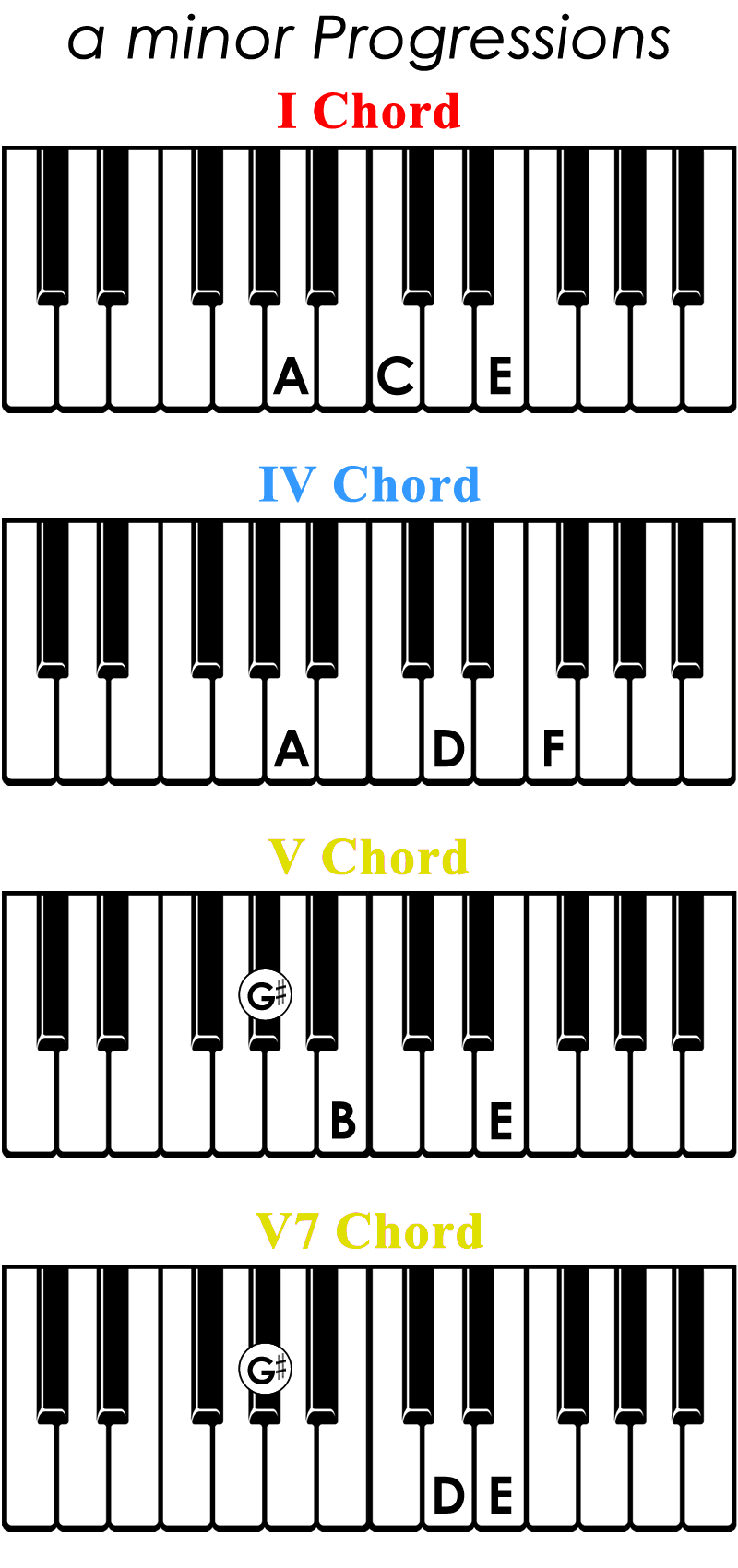
We learned how to make a HARMONIC minor scale:
- We make the 7th degree 1/2 step higher, so it leads to DO better
- DO RE me FA SOL le TI DO
- These are the same notes we use when we do our chord progressions
Here’s this week’s homework assignment sheet and we’re doing the RED highlights! (You can click the image to open a PDF!)
We are wanting to get more buttons on the tote bags, so PLEASE send me videos of your child passing off their songs, scales, and chords! The videos don’t need to be exactly perfect, but I do need to see that the kids know the concepts.
REGISTRATION FOR NEXT FALL BEGINS THIS FRIDAY. I’ll send out a separate email for how to register for that.
Please let me know if you have any questions!
Have a musical day!
-Ms. Bethany 🙂