
 
Have a musical day! -Ms. Bethany 🙂  |
-
Yellow Arrows #9
<!-- InstanceBeginEditable name="doctitle" -->Yellow Arrows Newsletter<!-- InstanceEndEditable -->  Lesson #9
Thank you, parents, for coming to class! We enjoy having you here and bonding with your child. What a gift you are giving them!
Tuition is due for those who didn’t pay for the entire semester up front.
Registration starts this FRIDAY at NOON for the next semester of Let’s Play Music and we’ll start Purple Magic! If you register by March 20th, you don’t have to pay the $20 registration fee! I’ll have two class times available for 3rd Year.
If you know anyone with a child the right age for LPM, I will be doing some preview classes the next couple weeks. Please sign up for any preview classes you would like. (Think of them as “make up” classes for any you may have missed!) Please let your friends know about the preview classes as well. Full preview classes are WAY more fun than small classes. I have to cancel any preview class that doesn’t have at least 3 families in it!
You should have received a separate email about Spirit Month, so have fun earning as many tickets as you can!
Celebrate Connection
A few ideas to make the alphabet pieces game more playful!
- Super Skippers:
Your child draws out an alphabet letter and places it on the keyboard as a ‘starter’. Next, she chooses another piece and checks to see if it can make a skip up or a skip down from the starter. If not, discard it and player 2 gets a turn to play (player 2 should start her skipping chain on a different octave from player 1). Keep taking turns until someone makes a chain, by adding skips at the top or bottom, that is 7 letters long and wins!
- Parking Lot Cars:
Draw a letter from the lot and park your car on the white key “parking space” that matches. Keep going until you run out of cars (or whatever counters you have).
- Cowboys and Indians:
Start one tiny plastic character (ANY tiny plastic figures you have will do: Pokemon, animals, cowboys, princesses, etc.) at one end of the keyboard on a white key, and another at the other end. Draw a tile out and move the low guy up to that key. Draw another tile and move the high guy down to that key. Keep going until they meet (and battle, or shake hands, or whatever you pretend!)

Online Fun:
Do you need a review of your finger numbers? Try to match them as fast as you can! Finger Number MatchingBug Scale
We can now play UP the C Major Scale with our RH! Place the RH in C position and play with fingers 1-2-3 (CDE) then POP UNDER with the thumb to make a new bubble and continue playing with fingers 1-2-3-4-5 (FGABC). Choose your favorite BUG to practice this new skill. One way to remind where to pop is to insert POP with the bug like this: Butterfly, Butterfly, Butterfly, POPPERfly, Butterfly, etc. As always, we try to make our technique drills so fun that the kids don’t even notice they are getting practice!
A Warm Welcome to Middle B and Middle D
The 5 anchor notes used in 2nd year include the members of the “C” family: Treble C, Middle C, and Bass C and the Middle Friends including Middle B who is B-elow Middle C and Middle D who is Down under the first line on the staff. ?"Middle C, Middle C, has 2 Bud-Dies: B and D!"?
How to Skip
We will master all of our middle anchor notes with this song: Middle B, Middle C, Middle D. Use the same 3 fingers for the entire song: 1-3-5. Simply move your thumb to the appropriate starting note. Sing “C-skip-skip-skip, D-skip-skip” etc. emphasizing each anchor note. This is where the practice of seeing and playing those middle anchor notes connect!
I am Robin Hood
If your child can play each hand of “I am Robin Hood” comfortably, they are ready to put both hands together! Isolate 1 or 2 measures at a time to have a successful experience, then continue to add 1-2 measures until they can play the entire song with confidence! While practicing with your child, you can guide their eyes by pointing note by note with V fingers. Hooray for Hands Together!March of the Gnomes
What did you think of our new puppet show? Look in the back of the piano book and you’ll find the “March of the Gnomes” coloring pages.
C Major Scale Right Hand Ascending
 Homework theory answer key, all skills videos, and make-up videos for missed classes:
 (tap, click or scan)
 How instinctive is your child getting with their keyboard geography and naming all of the white keys? Time your child for 1 minute and see how many alphabet pieces they can put on the piano. Your student will treasure these game ideas as they continue to solidify all of the notes on the keyboard.

Also, I’ve added the March of the Gnomes puppets for you to download, print and let your child color the characters as you discuss their favorite part about the puppet show! (Don’t forget to listen to the music while coloring!) Perform the puppet show together for the rest of your family!Have a musical day!
-Ms. Bethany 🙂
- Super Skippers:
-
Orange Roots #8
<!-- InstanceBeginEditable name="doctitle" -->Orange Roots Newsletter<!-- InstanceEndEditable -->  Lesson #8
Parents come next week, tuition is due, and SPIRIT MONTH is right around the corner! (You’ll receive a separate email with details.)
Registration will be happening soon. The fall schedule should be ready next week!
Thank you for sending the Marco Polo and text videos this week. It really helps us get through more fun things in class when we don’t need to take the time for each student to play their song during class. If you didn’t send a video yet, you still can!
We started working on the A minor scale and cadences this week! The best part about A minor is that the scale feels just like playing a C Major scale, with no sharps or flats! We did have to change our solfege words though. A minor scale is DO, RE, ME (pronounced “may”), FA, SOL, LE (pronounced “lay”), TE (pronounced “tay”), DO. Our cadences are almost the same, but when we play the yellow chord, we do have to remember to play the G#!
Our dictation exercise was different today. We had all the same notes, but we had to listen to the rhythm and write the rhythm we heard. We also practiced drawing a bass clef, which is also called the “F clef” because the big dot is on the F line and the two dots are on both sides of the F line.
Next week we will do Showtime as a class with New World Symphony. Have your child practice the part they want to play in class and we’ll all play our parts at the same time to make a beautiful ensemble!
Students should now have all orange rhythm flashcards unbanded so they can practice all 16 cards!
Optional: if you’d like to have your student practice more rhythms in a super fun way, you can print off these orange counting cards: set 1, set 2, set 3. There are 3 sets with 2 pages each. You can print them front-to-back and you’ll have the same rhythms with bugs to help on one side and no bugs on the other side!

Online Fun:
Looking for steps and skips makes reading music faster! Here’s a fun game to review steps and skips:
Name That Tune
(Remember, the tone bells are the same as the white keys on the keyboard!)Russian Sailor Dance
This song is ALWAYS a student favorite. Another great repertoire piece that reinforces ABA form, improvisations, and provides a study in legato and staccato themes. But it’s the the accelerando at the end that will have your student BEGGING to practice it all the time! This song may start out slowly (maybe even feel boring!), but just wait until you see the end!a-minor Scale Russian Sailor Dance  Homework theory answer key, all skills videos, and make-up videos for missed classes: (tap, click or scan) Have you already found a private teacher for when your student graduates from Let’s Play Music? It is best if you can meet in person with the teacher before the summer break to help the new teacher get to know your child’s progress while its still fresh. Here is a great post on our Let’s Play Music Blog with tips on how to interview and what to look for in a private teacher.
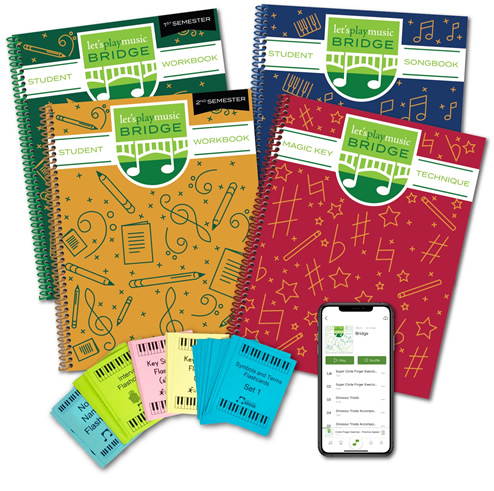 Bridge is a really fun class for Let’s Play Music graduates that is a great “bridge” between Let’s Play Music classes and private lessons. I will be starting a new Bridge class next year, teaching it as a 2-year program. The kids will learn lots of new songs, scales, musical concepts, and so much more! It is more self-paced than LPM, so it’s perfect for if you feel like your child has missed out on some musical concepts or skills in Orange Roots. There is enough review that your child won’t feel "behind" if they missed a concept from LPM, and there is enough new material that your child won’t be bored either! If you are interested, let me know and I’ll get you more information.Have a musical day!
-Ms. Bethany 🙂
-
Blue Bugs #8
<!-- InstanceBeginEditable name="doctitle" -->Blue Bugs Newsletter<!-- InstanceEndEditable --> Have a musical day!
-Ms. Bethany 🙂
Yellow Arrows #8
<!-- InstanceBeginEditable name="doctitle" -->Yellow Arrows Newsletter<!-- InstanceEndEditable --> Lesson #8 Parents come next week, tuition is due, and SPIRIT MONTH is right around the corner! (You’ll receive a separate email with details.)
Registration will be happening soon. The fall schedule should be ready next week!
Celebrate Connection
A few ideas to bring playfulness to practice time!
- Alpha-frogger:
Pretend each alphabet foam piece is a tiny frog. Have your child choose an alphabet frog, then hop it across the keyboard helping froggie find all keys of that letter. These frogs don’t croak- each time the “frog” lands on one of her special lily pads, sing the letter (on pitch!).
- Hiss:
Place one letter on the keyboard as a starter snake. Each player takes turns drawing a letter and checking to see if they can add it to the head or the tail with baby steps to make the snake longer. If not, start a new snake somewhere else on the keyboard. Anytime someone makes a snake with 8 or more segments, they get to remove it from the keyboard and keep the points (1 per segment)! Play until the pieces run out. It’s pretty cool if you are able to join 2 snakes by drawing the missing link between them, and win a really long snake! You might enjoy non-piano Hiss, too.
- Silly Songs:
Have your child draw out 5-10 alphabet notes and line them up along the music stand. With her right hand in C position, play each note with the finger touching that key. If the note is a B, slide the thumb down to yellow position to reach it; if the note is an A, slide the hand into blue position to reach it. This might be a wacky song, or it might be something cool. If you like the tune, play it again!
Online Fun:
Test your memory skills with this fun Melodic Pattern Memory Matching game (level 3)!!Oh, When the Saints & Lullaby and Goodnight
D-O-W-N and that’s the DOWN-BEAT! The downbeat is the strong beat that tells us when to begin playing a song. Sometimes the downbeat is on the first word of a song, sometimes it is not. Ask your child what word the DOWNBEAT is on in both of these songs!Tinga Layo
Our toe-tapping donkey, dances a shaky, stylized rhythm called CALYPSO. See if you can hear this fun rhythm while singing along!I am Robin Hood
It’s duet time! While your child plays the melody, you or a sibling can clap or pat drumbeats on lap in a repeated slug pattern. Then switch! Once your child is confidant playing the melody by themselves, invite them to pat their own leg while playing. Impressive harmony! Homework theory answer key, all skills videos, and make-up videos for missed classes: (tap, click or scan) When listening to Don’t Put Your Trash encourage your child to do the actions to the part he hears during the harmony. It is also creative to change up the lyrics especially when encouraging chores: Don’t put your SOCKS (insert any noun) in my BEDROOM (insert any place) my bedroom’s full!
Have a musical day!
-Ms. Bethany 🙂
Orange Roots #7
<!-- InstanceBeginEditable name="doctitle" -->Orange Roots Newsletter<!-- InstanceEndEditable --> Lesson #7 We learned the real names of our chords today! While it seems like most of the kids understood this concept, I’m posting this video to show you parents how we discovered the names during class. Feel free to watch this video on your own or with your child. This is another teacher (the creator of LPM!) demonstrating what we did in class.
We started playing the blue chord in its inversions today. We used counters on the keyboards – putting them on middle C, F and A, (which is actually 2nd inversion) and then jumped the first blue counter up to the next octave C – for the root position version of this triad. Remember, the letter names stay the same, the order is just mixed up! Here’s a quick demo video to help visualize how this works. Go ahead and try it with your child. Build a blue chord with 3 little erasers or small toys. Then jump the bottom note up to the next same note and keep going!
Showtime is back! While we haven’t been playing this in class, your child has been practicing “Cockles and Mussels” at home. Please send me a Marco Polo video or a video text message of your child playing it so I can be sure they understand the concepts we’re working on for this song.
Registration for next fall begins IN JUST A COUPLE WEEKS! I need to know how many BRIDGE classes I will be putting on my schedule. Please fll out this survey so I can get an idea of what my schedule should look like. I want to make sure you have the class time that works best for my students that have been with me for so long!
Have your children continue to practice their recital pieces. Don’t forget, it is THEIR composition and if they want to add to it or change anything, they are allowed to do that until lesson #11, when we have our next and final private lesson. You can send me revisions by text or email or send it with your child to class next week. They can use the lined pages in their composition section of their songbook to add extra music, such as a B part, if they so desire.
Online Fun:
Review music symbols with this fun memory game:
Music Symbol MatchingDO is Home
While finding a pitch (out of thin air) through audiation isn’t a new thing for our Let’s Play Music student, we are now switching it up. We started to find ‘fa’ and make F home instead of C and now we will make G home, instead of C and F. We are always doing this relative to Middle C to continually reinforce the sound of Middle C and to teach relative pitch.
Scale Degrees
Actually numbering the steps of the scale as ‘scale degrees‘ is the first step in transitioning out of calling our primary chords by colors. The Red, Blue, and Yellow chords are respectively the I, IV and V chord (we call ’em 1, 4, and 5) and they get their chord names because their root is that numbered scale degree within the scale. Here’s a fun ASL visual to help remember them: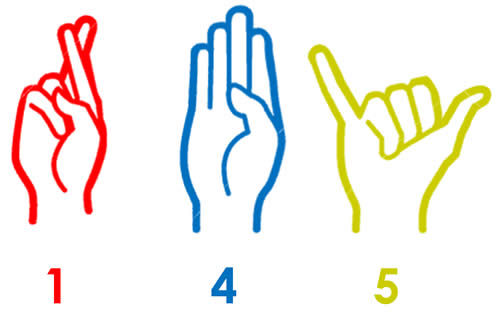 (R)ED: When your fingers are stuck together, they look like a number 1
(B)LUE: You are holding up 4 fingers
(Y)ELLOW: You are holding up finger 1 and finger 5.C Major and F Major Scales Homework theory answer key, all skills videos, and make-up videos for missed classes: (tap, click or scan) Did you know that your little musician has super powers? They really do!!!
Have a musical day!
-Ms. Bethany 🙂
Blue Bugs #7
<!-- InstanceBeginEditable name="doctitle" -->Blue Bugs Newsletter<!-- InstanceEndEditable --> Homework theory answer key, all skills videos, and make-up videos for missed classes: (tap, click or scan) For a fun twist as you listen to our new “Sleep My Treasure” song, you can invite your kiddo to rock a stuffed animal while they listen. This helps them with keeping a steady beat, internalizing the beat and expanding their musical expressive awareness. So many great things from one little activity!
Have a musical day!
-Ms. Bethany 🙂
Yellow Arrows #7
<!-- InstanceBeginEditable name="doctitle" -->Yellow Arrows Newsletter<!-- InstanceEndEditable --> Lesson #7 I am so happy with the progress of class! One thing I would love them to focus on this week is doing the Alphabet Pieces Game consistently. I know it doesn’t seem like a very important activity BUT, the 3rd year students who do not do it consistently, struggle to know their keys. Here is a link to some fun ideas to make it more enjoyable! We will be doing races in class to help them get faster at naming the notes and I want everyone to feel successful. (More fun ideas at the end of this email…keep reading!)
Is your child starting to fight you on practice time? Here is a post about motivation and a focus on your child’s learning style to make practice time more cooperative and enjoyable. Don’t forget, we’re trying to get ONE tally mark for each activity EACH DAY for FIVE DAYS. This will help your child to really understand and master the concepts taught that week.
Registration for next semester is right around the corner! I’ll be holding free preview classes in just a couple weeks for new families to see what Let’s Play Music is all about. Please help me spread the word… I do give referral bonuses! Please feel free to sign up for a free preview class if you ever had to miss a class. (It’s the closest thing to having a make-up class that I’m allowed to do!) Classes are always more fun with experienced families, even if the kids are a little older!
Do you have another child that is going to be 4 years old by September 1st? Sign up for a Let’s Play Music free preview class for them!
Do you have another child that is 0-4 years old that would benefit from Sound Beginnings? You’re welcome to sign up for a free preview class for that as well!
Celebrate Connection
A few ideas to bring playfulness to practice time!
- Alphabet Race:
Have your child take one alphabet piece from the bag and quickly set it on the correct white key. Continue until the bag is empty! Time yourself and see if you can beat yesterday’s time. For students who struggle, have the student look at the picture (key-group diagram) in the back of the Yellow Songbook and form his own visual conclusion.
- Take a Second:
Have your child choose two alphabet pieces and place them on the keyboard. Identify what interval they make, and play the interval. If it’s anything other than a 2nd, play again! The game ends when you take a second to make a 2nd.
- Go Fish:
Each player starts with 3 alphabet tiles hidden in his hand. Try to make matches by asking the other player: “Do you have a…” then PLAY the note on the piano to make your request. If you end up with an empty hand, draw 3 more tiles. Keep playing until the tiles are all gone, and see who got more matches.
Online Fun:
What’s that piano key name? Play Keyboard Letter NamesMelodic Patterns
When learning to play melodic patterns:- Play all 5 in Middle C Position.
- Play at separate times. The clef tells which hand will play. Treble Clef is RH and these patterns go DOWN. Bass Clef is LH and these patterns go UP.
- What are the notes telling you to play? Steps, skips, or leaps? They ALL end on Middle C.
I am Robin Hood
This theme song is significant because it is the first song we play hands together with each hand playing independently. In class we learned to play the melody with the right hand. Place your RH thumb (1) on Middle C, 2nd finger on Middle D, and the 3rd finger on the black note above Middle D. And then play in the rhythm of BUG-BUG-BEETLE-BUG, BEETLE-BEETLE-SLUG. Practice hands separately this week. We will put it all together soon!
Lullaby and Goodnight
Did you know that we can make a song sound different by changing a block chord to a broken chord? It’s time to break all of the chords in Lullaby and Goodnight. Stylizing the block chords to broken will change the mood of this song into a calm, peaceful lullaby. Played piano (find the p under the music) with broken chords this lullaby will be sure to put you to sleep! Homework theory answer key, all skills videos, and make-up videos for missed classes: (tap, click or scan) Are you ready for spring to come? Let It (Winter) Go is a cool piece to play now that our students are warmed up with all of the chords in right and left hand.
 If your child is really into learning things digitally, I found a very simple app (FREE with NO ADS!) that quizzes them on the piano keys. I believe it’s only available for Apple devices though. (I haven’t tried finding it on Android yet.) It’s called Bees Keys. Time your child to see how fast they can get all 7 letters, then see if they can beat that time! Have them look at the letter diagram in the back of their book if they don’t know it. Remember, we’re NOT teaching them to count up from C, but teaching them to know the letters by just looking at the keyboard. It will be way faster in the long run!Have a musical day!
-Ms. Bethany 🙂
Orange Roots #6
<!-- InstanceBeginEditable name="doctitle" -->Orange Roots Newsletter<!-- InstanceEndEditable --> Online Fun:
Check out these two fun staff note games:
What’s the Word
Play the WordComposition
The composition is the culminating event for your Let’s Play Music student! We have been experiencing, internalizing, and now labeling many things over our three year development as a young musician. We will rely on our knowledge of: major and minor, time signatures, chord uses and sounds, ABA song form, staccato and legato, theme and variations, block, broken, and marching chords, and MANY other skills that will help your child as they compose and create their own original composition. We’ve got a starting point, now I’ll encourage implementing more of these musical attributes to really make their composition musical!Homework Help Compsition Help Start with Melody Start with Rhythm Start with Chords Homework theory answer key, all skills videos, and make-up videos for missed classes: (tap, click or scan) Watch this video of a young prodigy composer who pulls four musical notes out of hat, improvising and composing a piano sonata in under a minute.
Have a musical day!
-Ms. Bethany 🙂
Blue Bugs #6
<!-- InstanceBeginEditable name="doctitle" -->Blue Bugs Newsletter<!-- InstanceEndEditable --> Homework theory answer key, all skills videos, and make-up videos for missed classes: (tap, click or scan) Your student has been taking baby steps and skipping around in class for sometime. Now, we get to take the concepts that we’ve been experiencing and start applying them to reading music on the staff. This approach to reading music is somewhat unique to Let’s Play Music. Young children will be reading from the staff without knowing any note names; read more details on how this effective method works. Try playing these baby steps on the Let’s Play Music App! Click on the two notes at the bottom left and find the tone bells. Touch a bell to hear it play, be sure your phone is off Silent Mode and volume is up.
BONUS GAME!!!
Since your children are now more familiar with the bug rhythms, I think they’re ready for this fun matching game I made called “Rhythm Foods“!
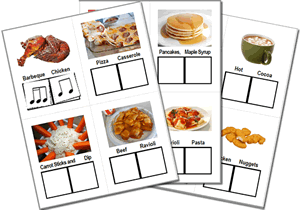 Instructions:
- Print the PDF in color or black/white.
- Cut out the notes on the first page (there are 3 extra notes). If you’d like to make them more durable, laminate them, or cut them into strips and put shipping tape on both sides before cutting them out individually.
- You may keep the other 4 pages as they are, or cut them into 4 sections so each of the 16 foods is a separate card.
- Begin with ONLY the first food page (the one with Pop Tarts) to be sure they understand the concepts, then add the other 3 pages once they understand how to play.
- Have your child clap and say each food with you.
- The answers are on the last page (printing that page is optional).
Please let me know if you use this game and let me know what you think. Your honest feedback is greatly appreciated! I made this game for YOU! ♥
Have a musical day!
-Ms. Bethany 🙂
 Our new puppet show was written by Gioachino Antonio Rossini, who was born on February 29 (leap year!), 1792 in Italy to a family of musicians. His father played the horn and his mother was a singer. He was just six years old when he joined his father’s band – he played the triangle. When he was only 10 years old, he was asked often to play the piano and sing at their church. At that age, he began composing and soon became the most celebrated composer of Italian Opera. Our puppet show, “