
 Lesson #13B Here is what we did in class this week:
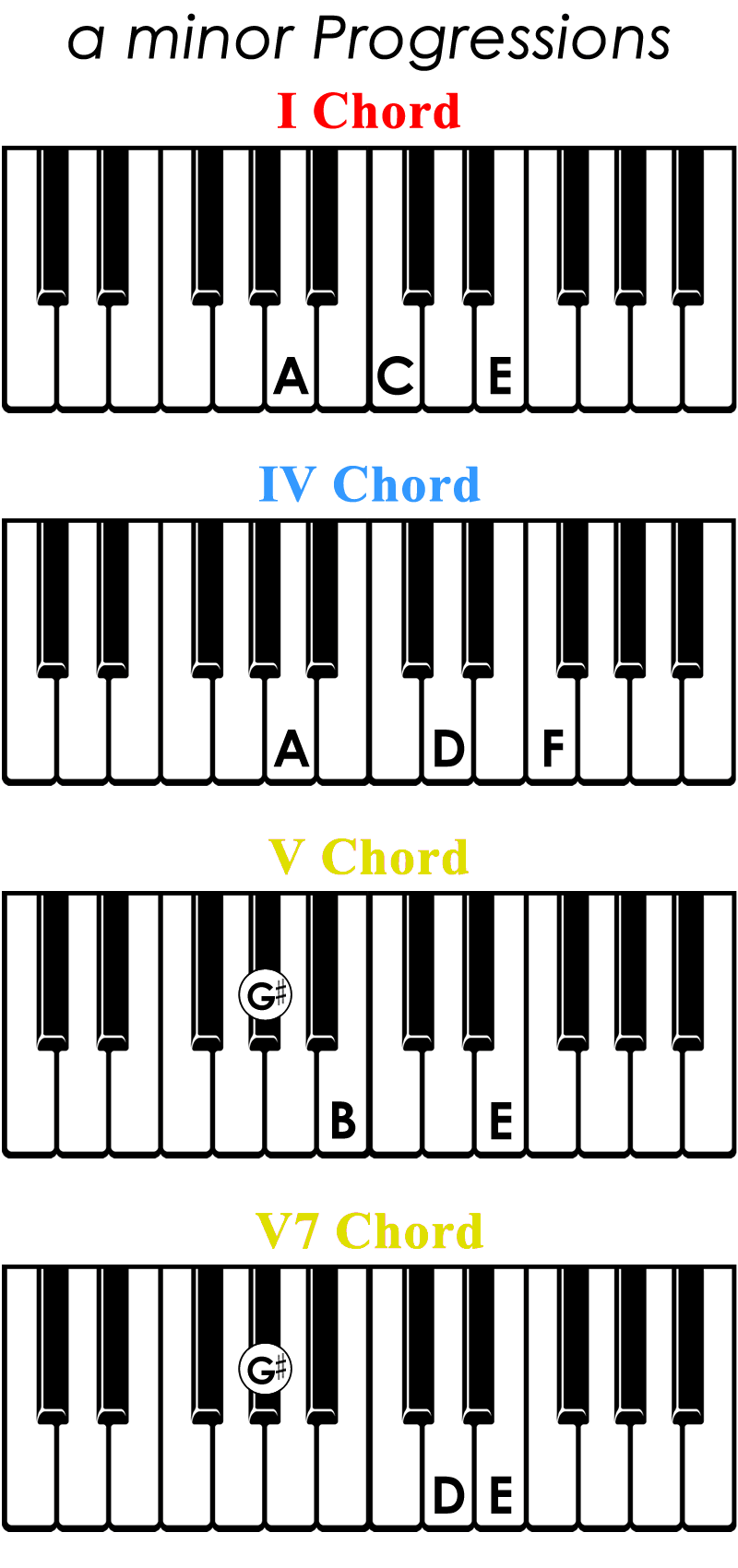
We learned about Franz Joseph Haydn and his Surprise Symphony. You can listen to it here with your child and see if you can hear the surprise! Be sure to turn up your sound! We have new flashcards to practice now. We reviewed them in class, but the students need to go through them at home as well. I even made an online game with the same flashcards to change it up a bit! We’re going to transpose a Christmas song, even thought it’s March! We will be able to play Joy to the World in C Major, F Major, and G Major. And if your child wants to play "Woe to the World" in the key of a minor, then let them go for it! (They just need to be sure to use the chord progressions with that tricky G-sharp in the yellow chord.) The class decided they want to play their compositions at the end-of-year recital. So please send me anything they have worked on in its raw form (Musescore file, if you can) and I can help the girls get them finished up. I will be around during Spring Break, so please schedule a time for a private lesson so we can complete their compositions. Here’s this week’s homework assignment sheet and we’re doing the BLUE highlights! (You can click the image to open a PDF!) 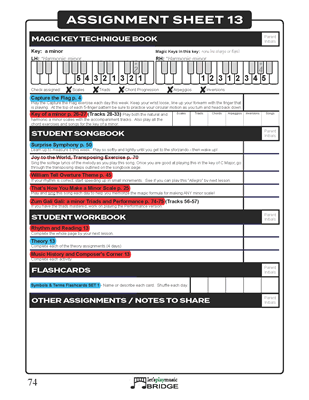 Please let me know if you have any questions! Have a musical day! |
-
Bridge #13a
Bridge Lesson Lesson #13A
Here is what we did in class this week:
Online Fun:
Fun games to add to your homework!
Interval Identification – Ear Training (Level 2)Build a Scale (Natural & Harmonic minor)
We reviewed how to know which interval we are listening to with a few easy tricks! And we have some fun visuals to go along with them! Don’t forget, we also have a fun way to practice listening to those at home (because I have this fun game on my website)!
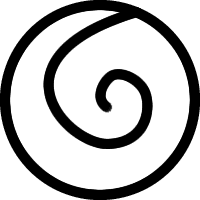 6th: "You’re Welcome" from Moana
 - the heart of te Fiti (but the swirl in the middle looks like a "6")
- the same notes are used as in the blue chord, but in a different order!
- 7th: We don’t have a song that goes with this, but just remember it sounds AWFUL!
- NO! We don’t want to hear this sound, so we think of a "no" symbol that sort of looks like a "7"
- NO! We don’t want to hear this sound, so we think of a "no" symbol that sort of looks like a "7"
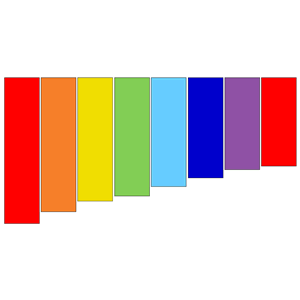
- Ocatave (8th): "Some-where over the rainbow"
- a rainbow
- our tone bells have 8 notes ant they are rainbow colored
- Prime (1st): same note
- the bottle looks like a "1"


We practiced drawing red, blue and yellow chords.
We reviewed the difference between natural minor and harmonic minor.
- Natural minor: DO, RE ME, FA, SOL, LE, TE, DO
- Harmonic minor: DO, RE ME, FA, SOL, LE, TI, DO
We reviewed our notes, rests, and the counting that goes along with them.
Here’s this week’s homework assignment sheet and we’re doing the RED highlights! (You can click the image to open a PDF!)
Please send me any composition music your child has made. So far I haven’t seen any modifications from any of the students. If they don’t want to do their own compositions, we can have them just play one of their favorite Bridge songs at the recital. We will be making compositions next year as well, so there’s no pressure to do it this year if they don’t want to.
Please let me know if you have any questions!
Have a musical day!
-Ms. Bethany 🙂
-
Bridge #12b
Bridge Lesson Lesson #12B
Here is what we did in class this week:
Online Fun:
Just a reminder, you can do your flashcards ONLINE!
Flashcards – Grand Staff
Interval Identification (Level 3)We learned about the legend of William Tell and started playing the William Tell Overture, which is the song we used for "Fox Hunt" in our Blue Bugs semester. We’re going to try to play that song HT from the start, but take it slowly at first.
We learned about accents and how they mean to make that note louder.
Here’s what a note looks like if it is accented: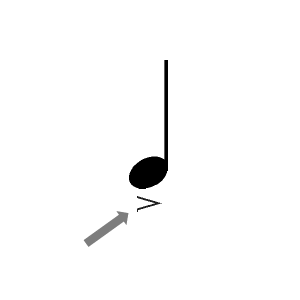
We played "One Potato" as we passed beanbags around a circle to the beat. We could feel the accent each time we said a number and passed it. Our song Willliam Tell Overture has lots of accents in it! Those notes all should be louder.
I’d like to see anything the kids have done on their compositions. I want them to play something at the recital/showcase at the end of the semester. Please send an email attachment or text a picuture to me of anything they have done so I can update it on my end and we can finalize their pieces soon!
I’m planning to teach classes for Recorder and Ukulele this spring/summer! Either of these would be a fun addition to the piano knowledge the kids are gaining! Click the links to find out more about each!
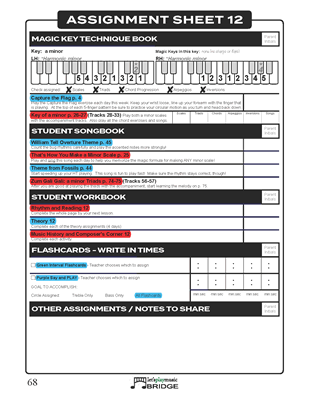
Here’s this week’s homework assignment sheet and we’re doing the BLUE highlights! (You can click the image to open a PDF!)
For this class, consider yourself already registered. Materials have already been purchased. We’ll just call it a continuation from this semester. The cost will be the same as it was this year.
Please let me know if you have any questions!
Have a musical day!
-Ms. Bethany 🙂
-
Bridge #12a
Bridge Lesson Lesson #12A
Here is what we did in class this week:
Online Fun:
We can now build a major scale, a minor natural scale, and a minor harmonic scale! As long as we follow the formula, it will always work! Here’s a fun way to practice: Build a Scale!We reviewed the formula for making a minor scale:
- WHWWHWW
- DO RE me FA SOL le te DO
- This is for a NATURAL minor scale
We learned how to make a HARMONIC minor scale:
- We make the 7th degree 1/2 step higher, so it leads to DO better
- DO RE me FA SOL le TI DO
- These are the same notes we use when we do our chord progressions
Here’s this week’s homework assignment sheet and we’re doing the RED highlights! (You can click the image to open a PDF!)
We are wanting to get more buttons on the tote bags, so PLEASE send me videos of your child passing off their songs, scales, and chords! The videos don’t need to be exactly perfect, but I do need to see that the kids know the concepts.
REGISTRATION FOR NEXT FALL BEGINS THIS FRIDAY. I’ll send out a separate email for how to register for that.
Please let me know if you have any questions!
Have a musical day!
-Ms. Bethany 🙂
-
Bridge #11b
Bridge Lesson Lesson #11B
NO CLASS NEXT WEEK!
NEXT CLASS WILL BE FEBRUARY 23RD
AND IT WILL BE A
GAME DAY!Here is what we did in class this week:
Online Fun:
Build a minor scale! (be sure you select "natural" because we haven’t learned "harmonic" yet)
Check out any of my other online games and let me know what you think!We learned the pattern to make a MINOR SCALE!
- WHWWHWW (whole, half, whole, whole, half, whole, whole)
- In the key of a minor, we use only white keys.
- Practice building any minor scale on my website!
We are getting really good at playing "Fossils" but for a fun challenge, the kids can learn to play it at full speed! Here’s the actual song and the part we have in the book takes only 9 seconds to get through when it is up to tempo! Just have your child increase the speed a little at a time and you’ll be surprised at how fast they can get it!
We performed our favorite Vivaldi season song for the class today. We practiced being a good audience for the one performing and had positive things to say to the performer afterward.
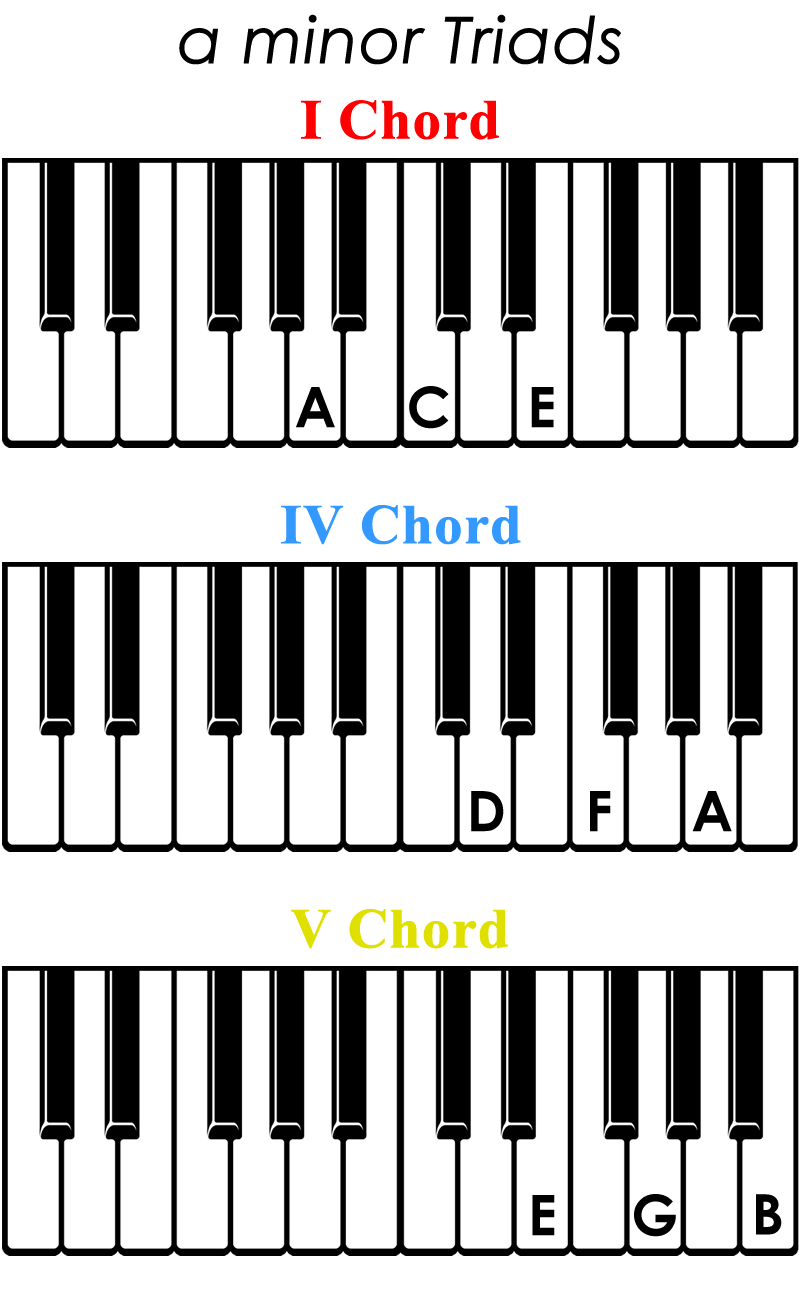
We are starting to learn more about the key of a minor, and the triads are just as easy to play as they are in the key of C Major!
Here’s this week’s homework assignment sheet and we’re doing the BLUE highlights! (You can click the image to open a PDF!)
Don’t forget to send me videos of all the scales and songs your child knows to get more pins! These next 2 weeks are meant to be used for playing "catch-up" so please take advantage of it! Have your child go back and finish any part of the homework that wasn’t completed, and even review old songs so they aren’t forgotten. Have your child make a list of all the songs they can play MEMORIZED! Transpose something. So many options for your child to really get some fun piano playing in!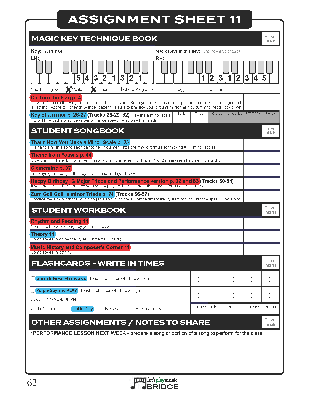
Please let me know if you have any questions!
Have a musical day!
-Ms. Bethany 🙂
-
Bridge #11a
Bridge Lesson Lesson #11A
Here is what we did in class this week:
Online Fun:
Can you figure out what interval you are hearing? Test your listening skills! Interval Identification – Ear TrainingWe reviewed how to know which interval we are listening to with a few easy tricks! And we now have a fun way to practice listening to those at home (because I added another game on my website)!
- 5th: "Twinkle Twinkle Little Star"
- a star has 5 points
- 4th: "Boom Boom Ain’t it Great to Be Crazy?"
- we celebrate with booming fireworks on the 4th of July
- 3rd: "Oh When the Saints Go Marching In"
- _ _ _ Saints (3 words before ‘saints’)
- 2nd: "Happy Birthday to (2) You"
- 2 candles on a cake
- WWHWWWH
We figured out the classical form for the song "Fossils".
- A A B A A Bv A
- This can help us when we write our own songs!
We are getting good at our Fossils song, and if we get good enough at it by next week, we’ll get to play it as a round in class!
Wrist circles help us to make the music smooth when we switch directions. Please see the video to be sure your child is doing them correctly!
We can play "Happy Birthday" using triads or progression chords in the left hand. Please send a video of your child playing hands together to earn a pin for their tote bags!
We will perform either Vivaldi’s "Winter" or "Spring" next week in class, so the favorite of those should be practiced well enough to not have mistakes!
Here’s this week’s homework assignment sheet and we’re doing the RED highlights! (You can click the image to open a PDF!)
We didn’t get a chance to highlight the homework page today to know which lines are for this week and which ones are for next week. Please be sure you copy the red and blue highlighting from here to the book so your child does the correct assignment items this week!
Please let me know if you have any questions!
Have a musical day!
-Ms. Bethany 🙂
- 5th: "Twinkle Twinkle Little Star"
-
Bridge #10b
Bridge Lesson Lesson #10B
Here is what we did in class this week:
Online Fun:
Note Value Matching (Memory Game)
Beat Value Matching
Flashcards
- We made a Counting Pyramid that helped us visualize the counts of each of our note and rest types and how they relate to each other.
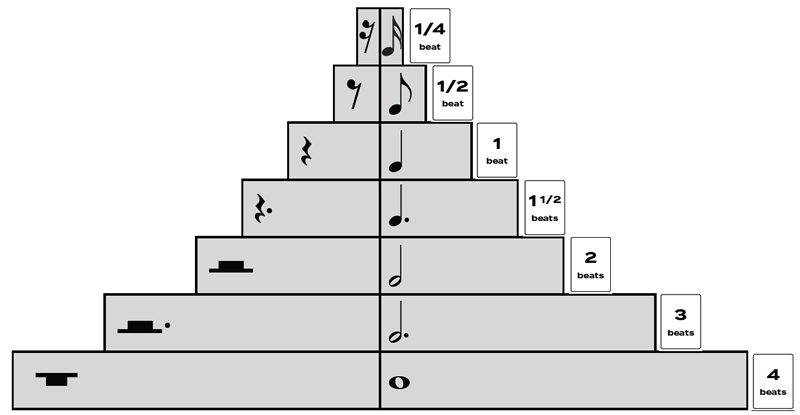
- Starting from the bottom, there are whole notes/rests (4 counts), dotted half notes/rests (3 counts), half notes/rests (2 counts), dotted quarter notes/rests (1 1/2 counts), quarter notes/rests (1 count), eighth notes/rests (1/2 count) – 1 flag/beam, and sixteenth notes/rests (1/4 count) – 2 flags/beams!
- These counts are accurate as long as the time signature has a “4” as the bottom number. (All the values change if there’s a different number at the bottom of a time signature, but we haven’t talked about this in class yet.)
- We played hopscotch again to review the WWHWWWH pattern of a major scale. The kids each got to take turns playing the song on the piano while the others jumped.
- We learned how to make wrist circles when we play up and down so we can look professional. Here is a link to see a video that demonstrates this as we play “Capture the Flag”. We want this motion to be smooth and very exaggerated for now. It will settle into a nice professional-looking motion as it gets practiced more over the next several weeks/months.
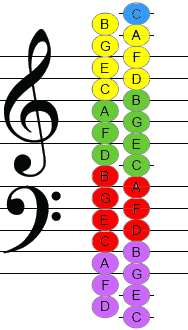 We built our alphabet on the grand staff using our 5 anchor C’s. We can sing our Music Alphabet song forwards (up) and backwards (down)!
Here’s this week’s homework assignment sheet and we’re doing the BLUE highlights! (You can click the image to open a PDF!)
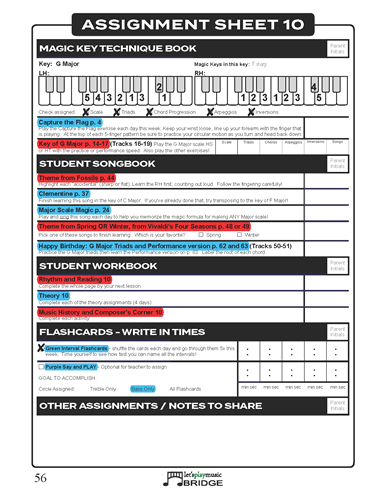
Remember to help get your child’s C-Major and F-Major exercises and songs passed off by sending me a video of each?(red book, pages 6 through 9 and 10-13)!?(I would like everyone in the class to pass these off!)?I would like them to play the?scales, triads, and progressions?HT?with the backtracks (9-11 for C and 13-15 for F). Arpeggios and inversions?can just be played as written in the book. I would also like them to play all 4 songs on pages 8 and 9?while singing. We will do this for every key we learn! It is best if they can pass off one key before getting too far into the next key. They don’t have to be perfect, but I do need to see that your child understands how to do them and they are trying their best. You can email, text, or Marco Polo those to me. There will be special prizes at the end of the year for passing off all the songs and scales!
Please be sure to do the flashcards! This will help with how fast your child can play the piano. We want to make seeing the note on the staff translate to playing the note on the keyboard happen AUTOMATICALLY! That will happen with practice!
Please let me know if you have any questions!
Have a musical day!
-Ms. Bethany 🙂
- We made a Counting Pyramid that helped us visualize the counts of each of our note and rest types and how they relate to each other.
-
Bridge #10a
Bridge Lesson Lesson #10A
Here is what we did in class this week:
Online Fun:
Try this brand new interval game! (I just made it after class!) Interval Identification – Ear Training (Level 1)- We found some strategies to help us know when we’re hearing a 2nd interval.
- We can sing the major scale in our head: DO, RE.
- We can think about the beginning of “Hap-py Birth-day to You”… that’s a 2nd interval! DO, DO, RE, DO, FA, MI
- We found some strategies to help us know when we’re hearing a 3rd interval.
- We can sing the major scale in our head: DO, RE, MI.
- We can think of our Chords in Pieces song for the red chord: DO, MI, SOL.
- We can think about the beginning of “Oh When the Saints”… that’s a 3rd interval! DO, MI, FA, SOL
- We played a listening game to decide if what I was playing on the piano was a 2nd, 3rd, 4th, or 5th interval.
- We learned about Camille Saint-Saens and that he was an actual child prodigy. He was composing songs at the age of 3 and he was performing piano and organ concerts at age 7! He remembered everything he learned because he had a photographic memory. He was very good at math and learning languages. His most famous work is Carnival of the Animals, which he wrote as a fun joke to perform for his friends.
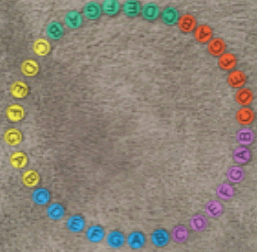 We practiced singing our musical alphabet by moving around the circle both forward AND backwards (C, B, A, G, F, E, D)!
Here’s this week’s homework assignment sheet and we’re doing the RED highlights! (You can click the image to open a PDF!)
Don’t forget to send videos of songs and scales! I want to see the tote bags covered in pins by the end of the semester!
Please let me know if you have any questions!
Have a musical day!
-Ms. Bethany 🙂
- We found some strategies to help us know when we’re hearing a 2nd interval.
-
Bridge #9b
Bridge Lesson Lesson #9B
Here is what we did in class this week:
Online Fun:
Purple Flashcards
(All Notes, Use Timer)Green Interval Flashcards
(Level 3)Build a Major Scale
(Major ONLY)- We played hopscotch using the pattern of WWHWWWH so we could remember how to create a major scale.
- We use 2 feet for the whole steps because a whole step is the same as two 1/2 steps.
- One foot for half steps because 1/2 step is the very next note
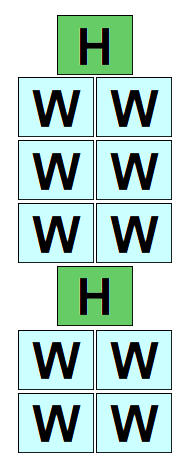
Start Here - All Major Scales have the same pattern, no matter what note you start on… even black notes!
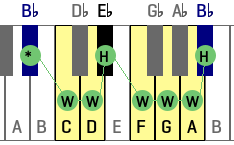
B-flat Major Scale - We practiced our Secret Circle Finger exercise again in class. We are getting much stronger knuckles, but we can still work on it!
- We reviewed our anchor Cs (low C, bass C, middle C, treble C, high C)
- "This is My C Song" will help us remember all these… Now we can play this song!
- We added to our G Major exercises:
- Triads are all snowman shaped and move around the keyboard. (See last week’s email if you’re confused!)
- Progressions are simply the way we learned chords to begin with… I=snowman, IV=top heavy, V=bottom heavy.
- When we play the yellow chord, we have to remember to play F#!
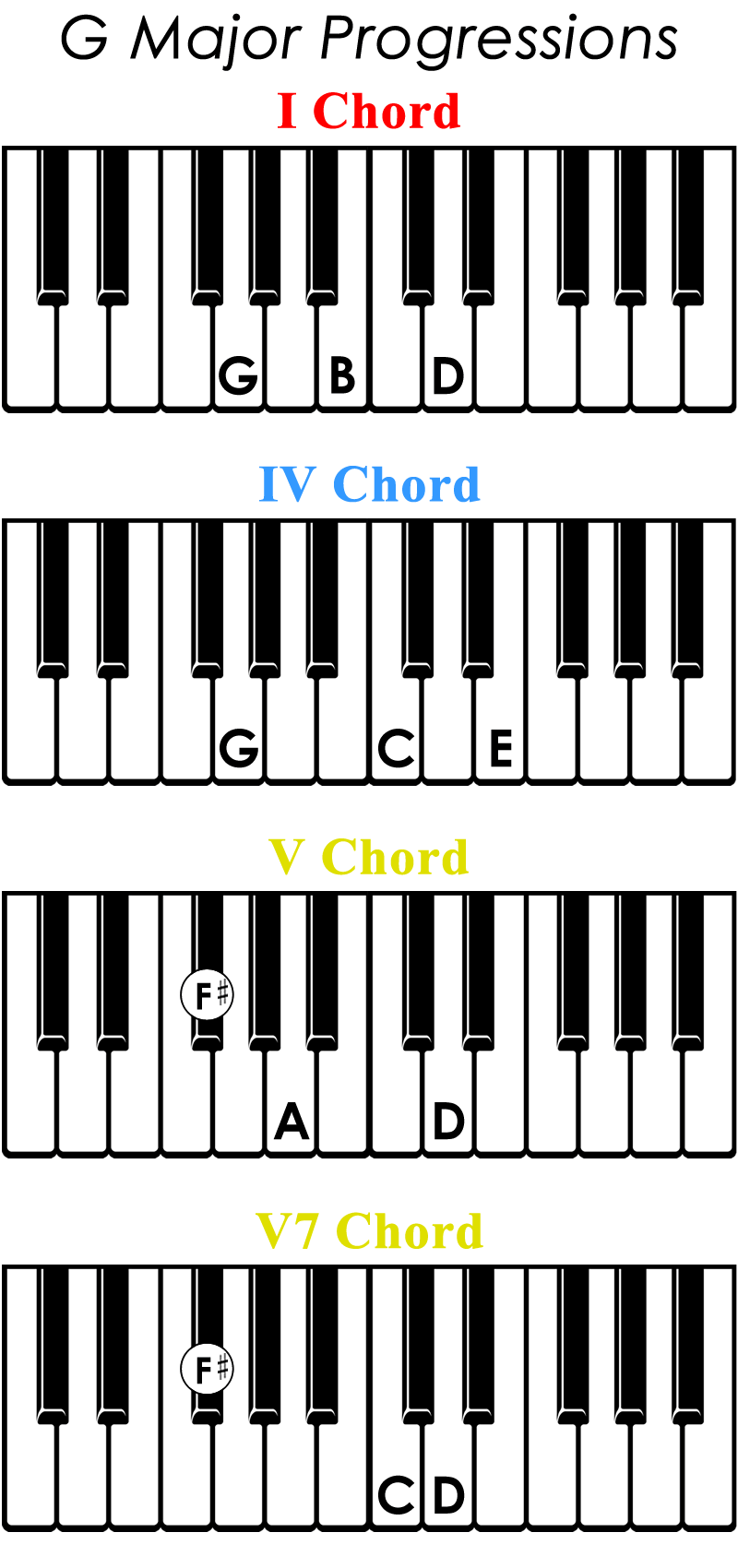
- Arpeggios feel the same as they did in the key of C Major because we don’t need any black keys for our G Major triad.
- Try to play it smoothly so you can’t tell when one hand stops playing and the next hand starts.
- Inversions also feel the same as they did in the key of C Major because we don’t have any black keys in the G Major triad.
- Remember: root (snowman), bottom heavy, top heavy, root (snowman)
- Remember to help get your child’s C-Major and F-Major exercises and songs passed off by sending me a video of each (red book, pages 6 through 9 and 10-13)! (So far I’ve only had one person pass all of these off!) I would like them to play the scales, triads, and progressions HT with the backtracks (9-11 for C and 13-15 for F). Arpeggios and inversions can just be played as written in the book. I would also like them to play all 4 songs on pages 8 and 9 while singing. We will do this for every key we learn! It is best if they can pass off one key before getting too far into the next key. They don’t have to be perfect, but I do need to see that your child understands how to do them and they are trying their best. You can email, text, or Marco Polo those to me. There will be special prizes at the end of the year for passing off all the songs and scales!
- I’ve noticed that more in our class are doing the flashcards! Yay! They are a wonderful tool for helping to read music quickly. Please take advantage of this by having your child do the flashcards every time they practice! It can be with the purple flashcards or my online flashcard game.
Here’s this week’s homework assignment sheet and we’re doing the BLUE highlights! (You can click the image to open a PDF!)
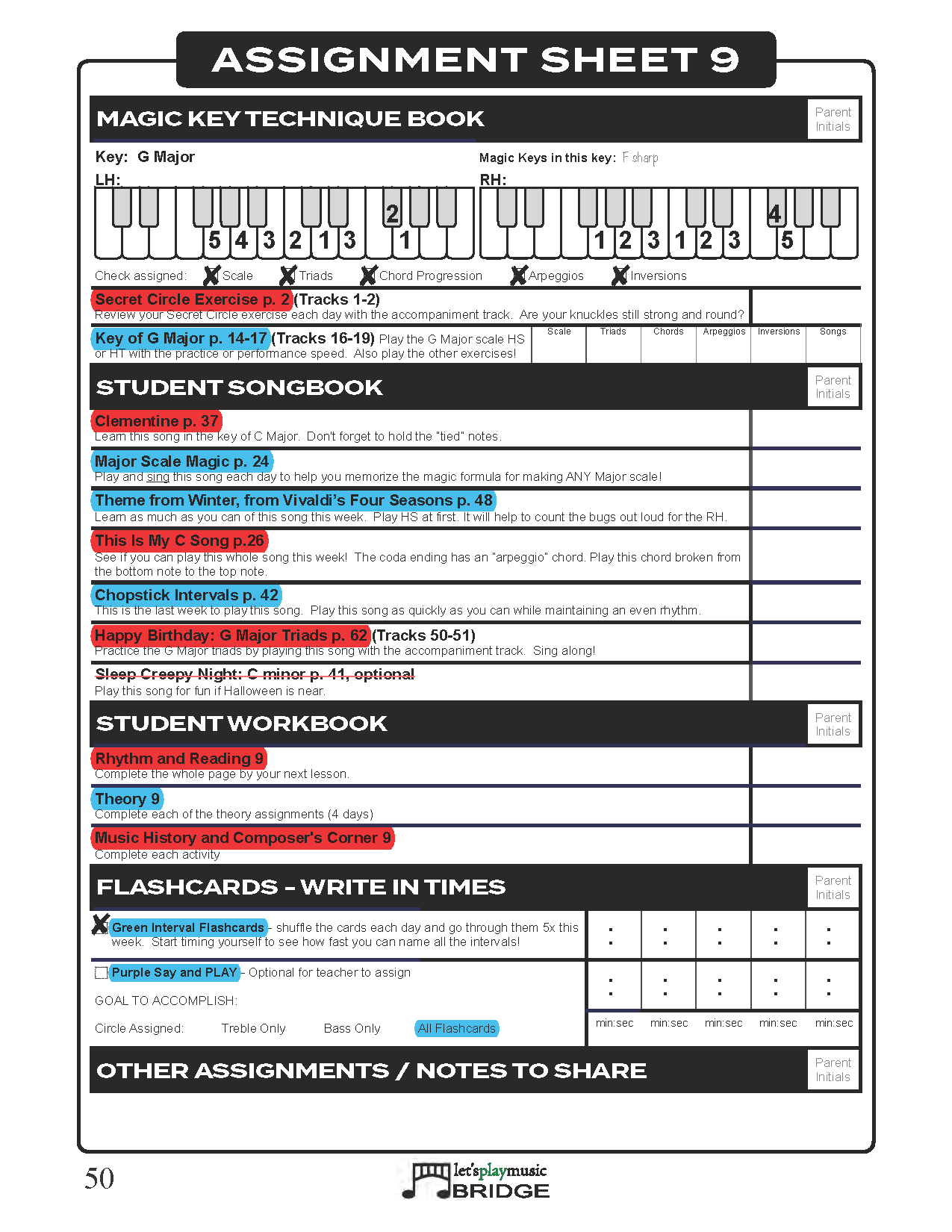
There was some confusion about which part of the assignment was supposed to be done last week. Last week was supposed to be only RED highlights and this week is the BLUE highlights (or finish the lesson).
Please let me know if you have any questions!
Have a musical day!
-Ms. Bethany 🙂
- We played hopscotch using the pattern of WWHWWWH so we could remember how to create a major scale.
-
Bridge #9a
Bridge Lesson Lesson #9A
Here is what we did in class this week:
Online Fun:
Purple Flashcards
(All Notes, Use Timer)Green Interval Flashcards
(Level 3)- We found some strategies to help us know when we’re hearing a 5th interval.
- We can sing the major scale in our head: DO, RE, MI, FA, SOL.
- We can think of our Chords in Pieces song for the red chord: DO, MI, SOL.
- We can think about the beginning of “Twinkle, Twinkle, Little Star”… that’s a 5th interval! DO, DO, SOL, SOL, LA, LA, SOL
- We found some strategies to help us know when we’re hearing a 4th interval.
- We can sing the major scale in our head: DO, RE, MI, FA.
- We can think of our Chords in Pieces song for the red chord: DO, FA LA.
- We can think about the beginning of “Boom, Boom, Ain’t it Great to Be Crazy”… that’s a 4th interval! DO, FA, Ain’t it Great!
- Depending on what key you’re in, the solfege can be different. When we learned that song, we said “SOL, DO, Ain’t it Great,” but it’s still a 4th!
- We noticed in “Clementine” p. 37 that we have a lot of tied notes and we hold some of the notes for 5 counts and some for 6 counts!
- We learned about the different kinds of “dots” in music. In the song “I Spot a Dot” we learned that the dot after a note extends the value of the note by half the value of the note!
- A dotted quarter is 1 1/2 counts because a quarter note is 1 count. Half of 1 is 1/2, so we add those together to make 1 1/2 counts.
- A dotted half note is 3 counts because a half note is 2 counts. Half of 2 is 1, so we add those together to make 3 counts.
- We already knew that one from our “Bugs Are So Fun” song, but now we know WHY a slug plus a dot equals 3!
- We looked at the notes with a dot under them and remembered that those notes were played STACCATO, or choppy.
- One more dot we looked at had a curve over it that looked like a snail shell. That helps us remember to take our time because snails are slow. We play those notes longer than usual. There’s not a set amount of time to play a fermata.

- We started working on our G Major triads.
- The roots of the G Major chords are G, C, and D.
- When we play the D triad, we have to remember to play F#!

- The song “Happy Birthday” is in G Major so we can practice our G Major triads on p. 62!
- Remember to help get your child’s C-Major and F-Major exercises and songs passed off by sending me a video of each (red book, pages 6 through 9 and 10-13)! I would like them to play the scales, triads, and progressions HT with the backtracks (9-11 for C and 13-15 for F). Arpeggios and inversions can just be played as written in the book. I would also like them to play all 4 songs on pages 8 and 9 while singing. We will do this for every key we learn!
- Don’t forget to do flashcards! They are a wonderful tool for helping to read music quickly. Please take advantage of this by having your child do the flashcards every time they practice! Remember, you can do the flashcards on my website instead (or in addition), if that works better for your student.
Here’s this week’s homework assignment sheet and we’re doing the RED highlights! (You can click the image to open a PDF!)
optional text here
Please let me know if you have any questions!
Have a musical day!
-Ms. Bethany 🙂
- We found some strategies to help us know when we’re hearing a 5th interval.