 | ||
| Lesson # 6 | ||
 | ||
Opportunities for meaningful interaction and purposeful connection with your child are included in all Sound Beginnings classes. Playing, singing, and dancing with your children promote a bond with music and strengthen their relationship with you!
| ||
 Echo Songs Rhythm Instruments | ||
 | ||
No matter their age, Sound Beginnings encourages caregivers to move and experience music together in class. Recent studies suggest that moving to music with a child triggers the release of oxytocin — the “bonding” hormone. Babies whose experience with music also involves movement smile more, are easier to soothe, and are more willing to explore their environment.
| ||
| Here is a video clip of the Baby Elephant walk song in the movie it was written for! Next week we’ll begin “Un Elephant” so if you’d like to have some pronunciation guidance, here’s a Facebook video with someone who knows how to do it correctly! | ||
 Timbre TimbreAs early as seven months, infants can discriminate between sounds of different timbres with the same pitch! Early exposure to various instruments builds neural connections that become the foundation for future study and knowledge. | ||
 | ||
| ||
| ||
Have a musical day! |
-
Yellow Arrows #6
<!-- InstanceBeginEditable name="doctitle" -->Yellow Arrows Newsletter<!-- InstanceEndEditable -->  Lesson #6
Please watch this week how your students’ mastery of Melodic Patterns and Chord Fingerings are going. I am seeing some fingering confusion and habits that will be hard to break the longer they practice them incorrectly. Focus and encourage lots of Red, Blue, and Yellow chord transitions this week, with both right and left hands separately.
Celebrate Connection
A few ideas to bring playfulness to practice time!
- When the notes go up the keyboard, lean to the right; when the notes go down, lean to the left.
- Sing along in pig-latin
- Play (and sing) a song as *Forte* as you can!
Registration for next semester is right around the corner! I’ll be holding free preview classes in just a couple weeks for new families to see what Let’s Play Music is all about. Please help me spread the word… I do give referral bonuses! Please feel free to sign up for a free preview class if you ever had to miss a class. (It’s the closest thing to having a make-up class that I’m allowed to do!) Classes are always more fun with experienced families, even if the kids are a little older!
Do you have another child that is going to be 4 years old by September 1st? Sign up for a Let’s Play Music free preview class for them!
Do you have another child that is 0-4 years old that would benefit from Sound Beginnings? You’re welcome to sign up for a free preview class for that as well!

Online Fun:
For practice with melodic patterns, try this fun memory game. Memory: Melodic Pattern Matching (You can play at level 3 now!)Melodic Patterns
We get to PLAY all of the melodic patterns this week! The value of this daily practice technique is to SEE, SING and PLAY each pattern all at once. Though their well-trained ears might tempt them to play each pattern by ear, insist they look at the book with their goggles, binoculars, laser beam eyes, telescopic vision, x-ray vision, heat vision, freeze vision, or night vision eyes while they play and sing!
Here are the verbal cues we sing in class with our hand signs. Invite them to sing these cues, finger numbers, or be creative and make up different words on the pitches of each melodic pattern.- MRD – Baby Steps Down
- SFMRD – Baby Steps Go-Ing Down
- SMD – Skip-Ping Down
- SSD – Same Same Leap-up
- SLTD – Baby Steps Going Up
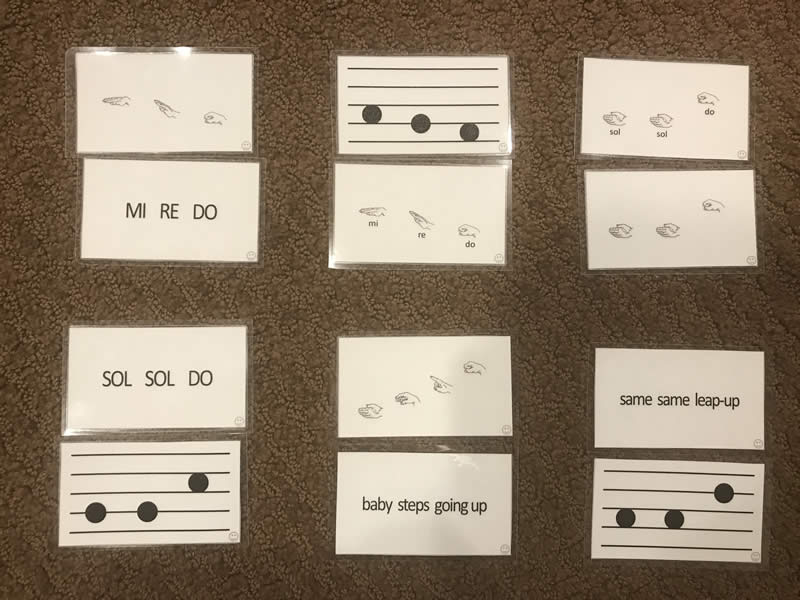
In case you missed it, I have created this printable Melodic Patterns Matching Game. This has all 5 melodic patterns in it. You may use whichever cards you wish (as long as there is a match). Any card that has the same pattern is a match (see picture example). The simplest way to make this game is to print on thick paper (or even regular paper) and cut them out. You can laminate them if you wish. Better yet, they fit perfectly on business card paper so you can just print, fold, and tear apart! Be sure you and your child sing ♫ each pattern as you turn the cards over!
Can’t Bug Me
Drumroll please…..Introducing BEAT BUG! “The BEAT is the BUG and the others play a long!” The Beat Bug sets the tempo on the metronome! He might go fast or slow but the beat is a ‘bug’ (quarter note) and the other rhythms (beetles, caterpillars, grasshoppers, butterflies, slugs) follow and fit within that given tempo.Hickory Dickory Dock
This song introduces parallel motion by following a steady beat through a metronome (a tick-tock is what we’ll call this motion in class).
Lullaby and Goodnight & Go to Sleep
After we solidify the chord transitions in our lullabies, we will make them sound more serene and calming by stylizing them with broken chords. Feel free to invite your child to color the chords in their piano book to make this an easier transition.
Primary Chord Song/Primary Cadence
Time to put on a show for the family! Your child can play ALL chords with BOTH HANDS! Invite them to perform the chords while singing the chords out loud! Play them hands separate, then try hands together with the correct fingerings! Homework theory answer key, all skills videos, and make-up videos for missed classes:
 (tap, click or scan)
 Why the importance of chords in piano playing? Kristi Ison, a Let’s Play Music teacher in Mesa, Arizona, shares the Top 10 Reasons for Learning Primary Chords!
Have a musical day!
-Ms. Bethany 🙂
-
Bridge #11b
Bridge Lesson 
Lesson #11B
NO CLASS NEXT WEEK!
NEXT CLASS WILL BE FEBRUARY 23RD
AND IT WILL BE A
GAME DAY!Here is what we did in class this week:
Online Fun:
Build a minor scale! (be sure you select "natural" because we haven’t learned "harmonic" yet)
Check out any of my other online games and let me know what you think!We learned the pattern to make a MINOR SCALE!
- WHWWHWW (whole, half, whole, whole, half, whole, whole)
- In the key of a minor, we use only white keys.
- Practice building any minor scale on my website!
We are getting really good at playing "Fossils" but for a fun challenge, the kids can learn to play it at full speed! Here’s the actual song and the part we have in the book takes only 9 seconds to get through when it is up to tempo! Just have your child increase the speed a little at a time and you’ll be surprised at how fast they can get it!
We performed our favorite Vivaldi season song for the class today. We practiced being a good audience for the one performing and had positive things to say to the performer afterward.
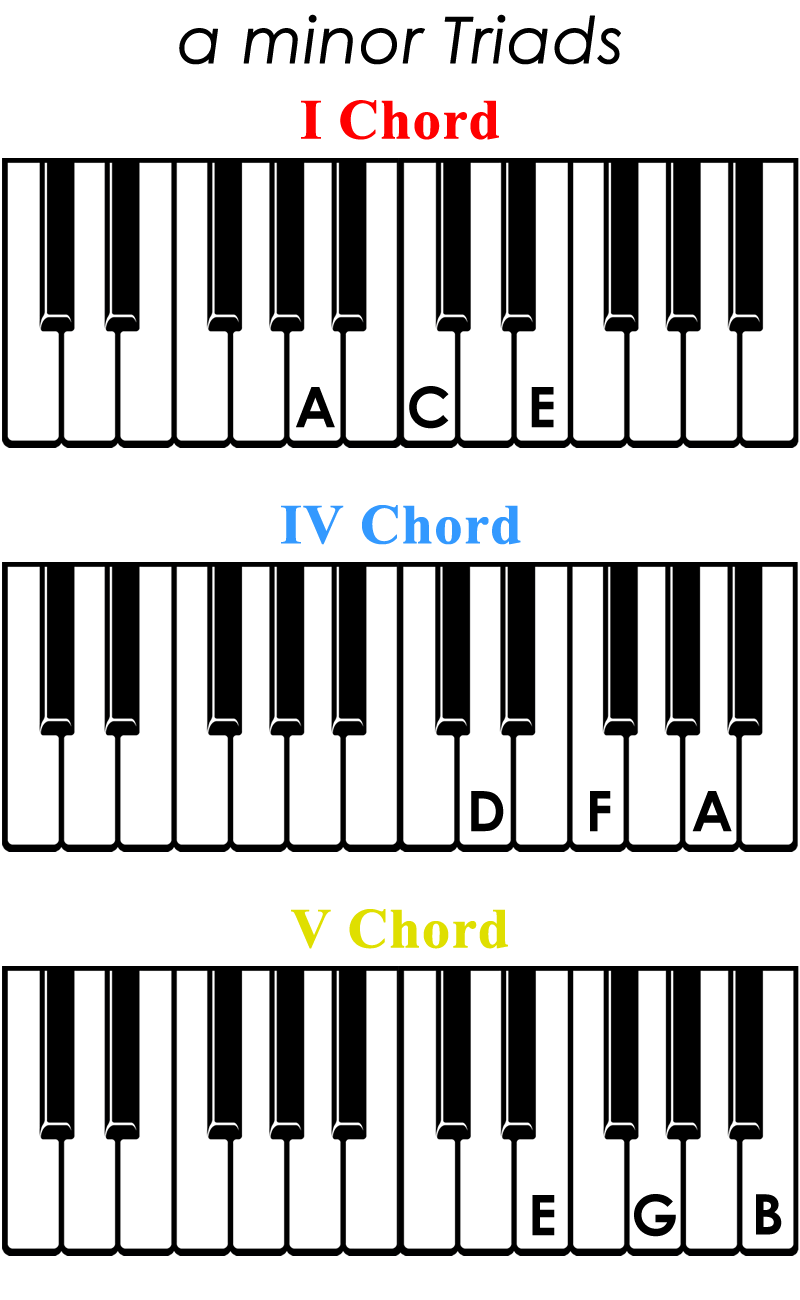
We are starting to learn more about the key of a minor, and the triads are just as easy to play as they are in the key of C Major!
Here’s this week’s homework assignment sheet and we’re doing the BLUE highlights! (You can click the image to open a PDF!)
Don’t forget to send me videos of all the scales and songs your child knows to get more pins! These next 2 weeks are meant to be used for playing "catch-up" so please take advantage of it! Have your child go back and finish any part of the homework that wasn’t completed, and even review old songs so they aren’t forgotten. Have your child make a list of all the songs they can play MEMORIZED! Transpose something. So many options for your child to really get some fun piano playing in!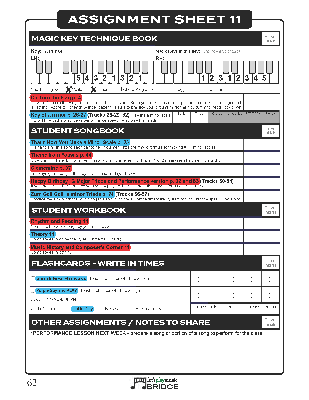
Please let me know if you have any questions!
Have a musical day!
-Ms. Bethany 🙂
-
Orange Roots #5
<!-- InstanceBeginEditable name="doctitle" -->Orange Roots Newsletter<!-- InstanceEndEditable -->  Lesson #5
Thank you parents for coming this week! Your participation plays such a big role in your child’s success! Don’t forget tuition is due for those of you that didn’t pay for the semester up front. You can pay through Zelle (using my phone number) or Venmo me (@musikandme).
Here’s a little help with this week’s theory assignment. In a major scale, we start numbering each note at 1 and because it begins to repeat after number 7, we go back to 1. This is the same way we go back to DO or C.
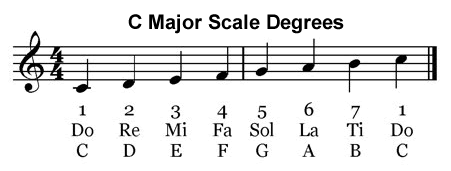
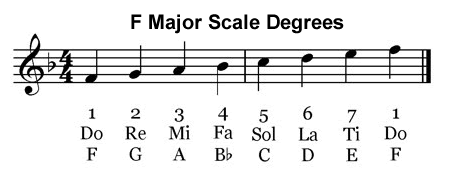 Even though the students cannot play all three parts of New World at the same time, you (the parent) should be able to play a part or two with them at home. Have fun playing as a family ensemble!
This next week I will be meeting with your child in their 1st private lesson to begin creating their composition. We have been working during class to brainstorm ideas we might like to use, and have been encouraging ‘tinkering’ at the keyboard at home. Please encourage your child to be thinking about a musical question (and maybe an answer) that we could work on together next week. This could be a simple melody or some chords that they have written down, can play, or even just hum. Or if they have specific characters they want in their song, they can write a short melody for each character. This is only the beginning of this process, so I’m not looking for you to send a ‘finished’ product. Feel free to watch the supplemental videos with your child (links down below). Please send your child with their Orange Roots Songbook so we can look over their Composer’s Corner activities together. Thanks!
I’ll text the schedule for next week’s 20 minute private lesson. Please have your child watch the “Composition Help” video right away to spark ideas for how to write their composition. They don’t need to write anything beforehand if they don’t want to, but watching the video will help them feel more confident when they come to the private lesson. If you watch it with your child, you will see just how simple it can be to compose a song!
PLEASE be on time for drop off and pick up! This private lesson is only for the students, but if you need to come stay warm inside, you are welcome to!

Online Fun:
Use the timer option to substitute for doing purple flashcards! (just write your time!)
Flashcards – Staff to Letter
Say It & Play It – Staff to Letter to KeyboardComposition
The composition is the culminating event for your Let’s Play Music student! We have been experiencing, internalizing, and now labeling many things over our three year development as a young musician. We will rely on our knowledge of: major and minor, time signatures, chord uses and sounds, ABA song form, staccato and legato, theme and variations, block, broken, and marching chords, and MANY other skills that will help your child as they compose and create their own original composition.Magic Keys
This is our 2nd song to graduate up with us from our purple semester. As we continue to sing (and play this song) we will further expand our understanding of key signatures and note relationships–This is the KEY in transposing music. Our new verse allows us to understand and play in the key of G Major, with our new magic key, F#.
G Major Cadence 
Composition Help Here are 3 helpful videos that break down 3 different ways to start a song. Your child might like to try one of these ways: Start with Melody, Start with Rhythm, Start with Chords.
 Homework theory answer key, all skills videos, and make-up videos for missed classes: (tap, click or scan)
 Inspiration for composition can come in many ways. A man saw birds sitting on telephone wires and it inspired him to create his own composition. Can’t wait to see where all of our students get their inspiration from! Excited to meet them all individually next week.
Have a musical day!
-Ms. Bethany 🙂
-
Blue Bugs #5
<!-- InstanceBeginEditable name="doctitle" -->Blue Bugs Newsletter<!-- InstanceEndEditable --> 
 Homework theory answer key, all skills videos, and make-up videos for missed classes: (tap, click or scan)
 We have a great article on subdividing. Check it out here!
Let’s take a walk in the jungle! “Walking In The Jungle” uses full body involvement (walking, stomping, jumping, skipping) with some creative play to teach steady beat. Gather your children and teach this song to the whole family.
Listening to music can spontaneously include doing some of the actions too! For instance, if you hear the song Umburra, sit down and pick an object to pass around on the beat. If you are practicing Bill Grogan’s Goat, have your student clap 4 times or nod their heads 4 times, between each line, etc. The more senses you use while “playing” the more your student will internalize. Let your student pretend “teach” a Let’s Play Music class to you, their siblings, or stuffed animals. This is great music practice and it’s FUN for them!
Have a musical day!
-Ms. Bethany 🙂
-
Silver Buttons #5
Document Lesson # 5  Next week’s songs:
 - The Shape Song
- Cherry Pie
- Frere Jacques
- DO Pentatonic Scale
- Risseldy, Rosseldy
- The Button Factory
- If You Want to Speak in French
- Baby Elephant Walk
- Make New Friends
- A Bushel and a Peck
Bonding with your child: Playing with your child and giving them focused attention is a great way to foster a bond that impacts their future mental, physical, social, and emotional health. Today’s Parent Article, USU Article
Pentatonic Scale: Music based on the pentatonic scale is found in all cultures world wide. It produces pleasing melodies that are easy to sing in tune. Power of Pentatonic
Four of our songs this semester will help us explore the French language. A recent study found that simply exposing children to more than one language improved social communication skills in their own language! Exposure to other languages means exposure to different social perspectives, giving children "intensive training in perspective taking, which could make them better communicators in any language."
Optional Home Fun Activity:
Color and cut out the pieces on page 21 for the French scene on page 27 in your workbook.Here is a video of our newest singable storybook, Risseldy Rosseldy! Instrument Use
When babies are given access to simple rhythm instruments, their natural curiosity leads to exploration and repetition that encourages important developmental skills such as independence and perseverance. Sound Beginnings is education through musical play! It prepares children for success in Kindergarten and Let’s Play Music. Sound Beginnings provides research-based elements that stimulate growth in the areas particularly crucial to the development of the young child. These elements make up the foundation of the Sound Beginnings curriculum. Here is just one: 
Our classes teach intelligent listening and understanding of classical form in a fun and interactive way. Each semester we study the timbre (tam’-ber) of various instruments and our ‘smart moves’ dances involve the whole body in an enjoyable, classical music experience. Have a musical day!
-Ms. Bethany 🙂
-
Yellow Arrows #5
<!-- InstanceBeginEditable name="doctitle" -->Yellow Arrows Newsletter<!-- InstanceEndEditable --> Lesson #5 Thank you parents for coming this week! We can’t have parent days without you!
Looking ahead to next year, as of right now, I’m planning to teach 3rd Year at almost the same times I’m currently teaching this class. So in August when we start Purple Magic, it will be Tuesdays at 4:00 or 5:30. (I need the extra time between classes because class is 55-60 minutes long.) Please let me know if that will or will not work for you.
Please cut out the letters as they are needed and play the alphabet keyboard game with your child. (If they’re already cut apart, just pull out all of one letter at a time.) Play this game on the largest keyboard you have. (If you have a piano with 88 keys, this is preferable to playing it on a 66-key keyboard.) You can do this separately from regular practicing. Just keep each letter session very short to begin with. You can even have several sessions in a day. We want the kids to enjoy playing this game. Maybe time them and have them beat their best time! The instructions I wrote in the Ziploc bag are different than those in the book. I have learned from experience that learning one new letter at a time makes it easier for the kids to remember. You should be able to play the game as described in the book very soon, but isolating the letters to begin with helps alleviate confusion. The repetition will help them remember faster. They will visualize the white keys for what they are, rather than what they are in relation to each other. If you have any questions or concerns about any of this, please let me know. I have many suggestions, but don’t want to overwhelm you with all of them at once!
Celebrate Connection
A few ideas to bring playfulness to practice time!- Blink with each note/chord you play in the bass clef (LH).
- Close your eyes, and run your finger over your music then stop and open your eyes. Start from wherever your finger landed and play through to the end.
- Knock on the wood/plastic of your keyboard when you come to Mr. Rests.
Online Fun:
Here’s a simple keyboard note naming game I built on my website – Name the NoteBass C and Treble C
The 3 C’s are in a family; they have different first names and the same last name! We’ve known Middle C since last semester. This week we introduced Bass C: 2nd Space in Bass Clef is Bass C! (♫ “Second space is C in the bass”) AND Treble C: 3rd Space in Treble Clef is Treble C (♫ “Space 1-2-3 is treble C”). These anchor notes on the staff will help orient us as we expand our keyboard skills. Treble C is just one octave up from Middle C and Bass C is just one octave below Middle C. You can look at pg. 56 in the homework book for reference, if needed.C Major Scale
Now that we know where Treble C is on the keyboard we can play the C Major Scale going DOWN. The technique is exactly like the Left Hand, though playing it with the Right! Practice this SLOWLY to ensure correct fingerings and bubble hand position. 1) Begin with RH finger number 5 on Treble C. (This is the C right above middle C.) 2) Play Do, Ti, La, Sol, Fa using fingers 5-4-3-2-1 with a rounded bubble hand. 3) To play Mi, POP finger number 3 over thumb. 4) Reset the BUBBLE and proceed to play Mi-Re-Do with finger numbers 3-2-1.I am Robin Hood
Shoo-oot the Ar-row, Waa-atch it fly—, teaches us how to feel and play the dotted quarter eighth note pattern (our bulls-eye and arrow feather) right on target. To feel this rhythm more accurately dance with the CD, stomp out the rhythm with hands and feet, or even sit them on your lap and bounce your knees up and down to the rhythm while chanting the song together. Mix up practice with this song by playing the bass clef 5th an octave lower to really sound like a deep drum!Mr. Rest
Could you believe all the musical symbols Old MacDonald had on his musical farm? A rest, though played with silence, is a very important aspect of music. Mozart said "The music is not in the notes but in the silence between." Rests are powerful!C Major Scale Right Hand Descending
Homework theory answer key, all skills videos, and make-up videos for missed classes: (tap, click or scan) Playing the Alphabet Pieces game every day will help us solidify keyboard geography by learning the names of ALL of the white keys. Once your child knows all the letters individually, you can enjoy playing this game with its theme and variations!
Have a musical day!
-Ms. Bethany 🙂
-
Bridge #11a
Bridge Lesson Lesson #11A
Here is what we did in class this week:
Online Fun:
Can you figure out what interval you are hearing? Test your listening skills! Interval Identification – Ear TrainingWe reviewed how to know which interval we are listening to with a few easy tricks! And we now have a fun way to practice listening to those at home (because I added another game on my website)!
- 5th: "Twinkle Twinkle Little Star"
- a star has 5 points
- 4th: "Boom Boom Ain’t it Great to Be Crazy?"
- we celebrate with booming fireworks on the 4th of July
- 3rd: "Oh When the Saints Go Marching In"
- _ _ _ Saints (3 words before ‘saints’)
- 2nd: "Happy Birthday to (2) You"
- 2 candles on a cake
- WWHWWWH
We figured out the classical form for the song "Fossils".
- A A B A A Bv A
- This can help us when we write our own songs!
We are getting good at our Fossils song, and if we get good enough at it by next week, we’ll get to play it as a round in class!
Wrist circles help us to make the music smooth when we switch directions. Please see the video to be sure your child is doing them correctly!
We can play "Happy Birthday" using triads or progression chords in the left hand. Please send a video of your child playing hands together to earn a pin for their tote bags!
We will perform either Vivaldi’s "Winter" or "Spring" next week in class, so the favorite of those should be practiced well enough to not have mistakes!
Here’s this week’s homework assignment sheet and we’re doing the RED highlights! (You can click the image to open a PDF!)
We didn’t get a chance to highlight the homework page today to know which lines are for this week and which ones are for next week. Please be sure you copy the red and blue highlighting from here to the book so your child does the correct assignment items this week!
Please let me know if you have any questions!
Have a musical day!
-Ms. Bethany 🙂
- 5th: "Twinkle Twinkle Little Star"
