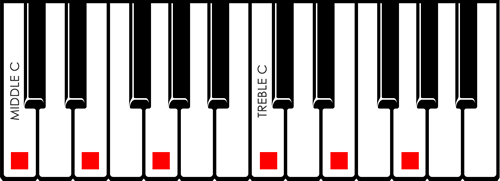
Lesson #4  Parents come next week and tuition is due for those of you that didn’t pay for the semester up front. You can pay through Zelle (using my phone number) or Venmo me (@musikandme). We started working on chord inversions this week. Use the red stickers on the cover of your child’s homework booklet to help them easily jump from inversion to inversion. Starting on Middle C, put 6 red stickers on your keyboard at home as shown on Lesson 4. of your student manual. The stickers should be placed on middle C, middle E, middle G and treble C (the C above middle C), treble E and treble G. The 3 heart erasers are meant to be placed on the first 3 keys with red stickers, then moved up one at a time to the next matching note as they change hand shape to match the notes being played. Once they understand the concept, they can just look at the stickers to see where their fingers should go. (Remember, these are ALL red chords, and we’re just playing the same pieces in a different order.)
Please, please make sure your child is using the correct fingers listed in the book. I made a chart for quick reference:
We learned how to play the F Major scale! We play the left hand the same as in a C Major scale (don’t forget the B-flat)! The right hand is DIFFERENT! We learned a fun chant to help us remember what fingers to use: For going up: 1-2-3-4, 1-2-3-4. Different than I played before! Do NOT have your child play hands together until they can do both LH and RH independently! We want them to feel successful, not frustrated!
Sixteenth notes have two beams and they get 1/4 of a count. They are counted out loud: "one ee and a two ee and a three ee and a four ee and a". We write this a little more simply (as shown in the homework). Be sure to look at reference pages 50 and 51 in your homework book if you need a little clarification. If you still can’t make heads or tails of it, please ask me! I know this is just as new to some of the parents as it is to the students. 
Cockles and Mussels Here’s a video of how the LH chords step up and stay in root position. It also shows how to play broken chords if your student would like something additional to work on! Inversions / Mixed Paint Our Let’s Play Music students have created harmony in many different ways in 1st and 2nd year. Now in 3rd year we have the unique opportunity to play as an ensemble in class to produce harmony and a much fuller sound than they can accomplish playing by themselves. By listening to the CD, the children are provided the opportunity to model and to audiate the music in their heads as they practice. Our Bugs are So Fun! (new verse) A few of our songs from our purple CD have upgraded to our orange CD–with some new lyrics! The new verse in ‘Our Bugs are So Fun!’ will help us to learn to count those tricky ‘beamed’ rhythms that include eighth notes and sixteenth notes! If counting in this new way seems tricky, here is a parent help page that dissects the lyrics to Our Bugs are So Fun! with visual examples and simple explanations to help.

Check out this young group of musicians experiencing the value of playing as an ensemble. Your student will recognize this piece as our very own Largo from New World Symphony by Antonin Dvorak. Have a musical day! -Ms. Bethany 🙂  | ||||||||||||||||||||||||||
 We reviewed that eighth notes have one beam (the horizontal line) holding them together. They get half a count when bugs (quarter notes) get one. They are counted out loud: "one and two and three and four and".